


Anterograde transport of surfactant protein C proprotein to distal processing compartments requires PPDY-mediated association with Nedd4 ubiquitin ligases
- PMID: 19366705
- PMCID: PMC2713532
- DOI: 10.1074/jbc.M109.002816
Anterograde transport of surfactant protein C proprotein to distal processing compartments requires PPDY-mediated association with Nedd4 ubiquitin ligases
Abstract
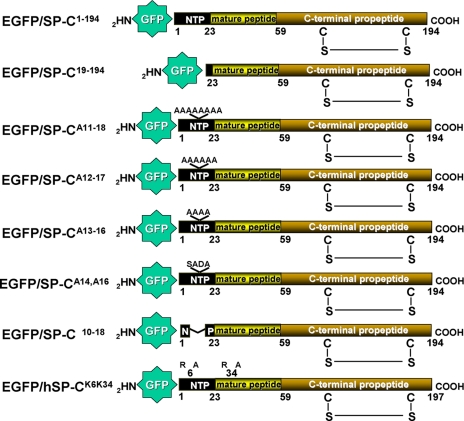
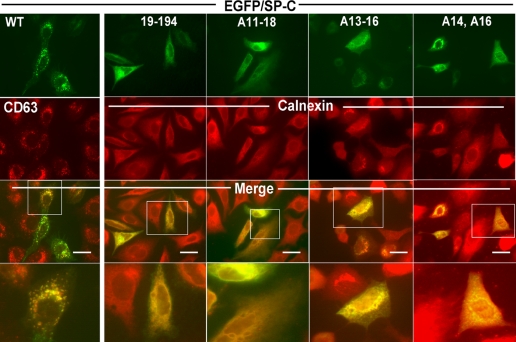
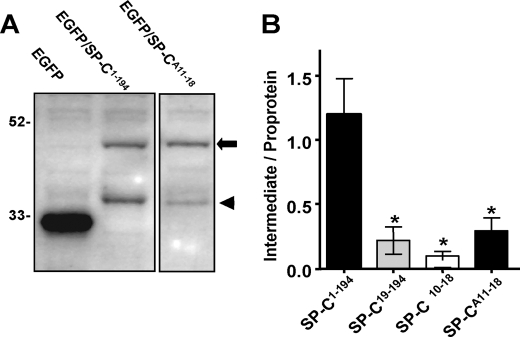
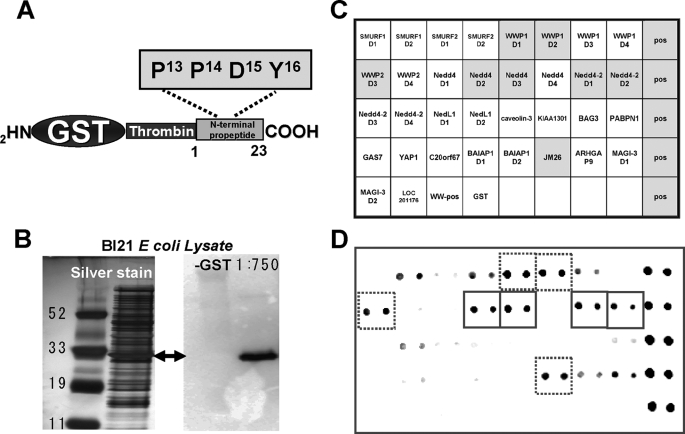
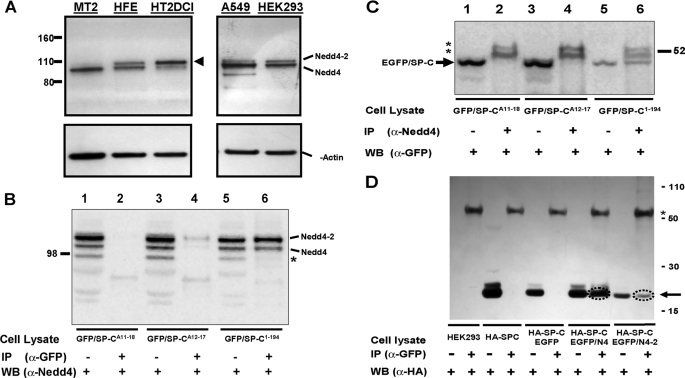
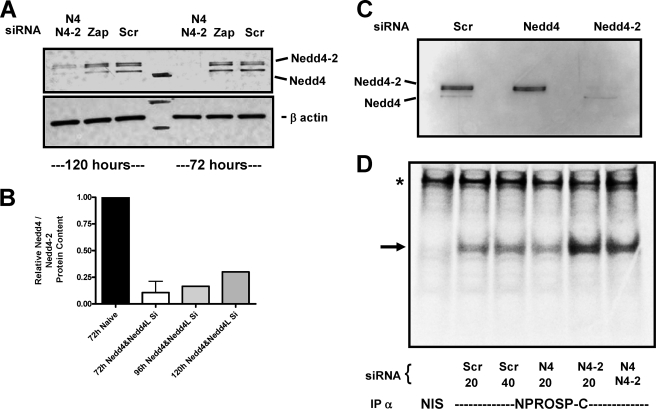
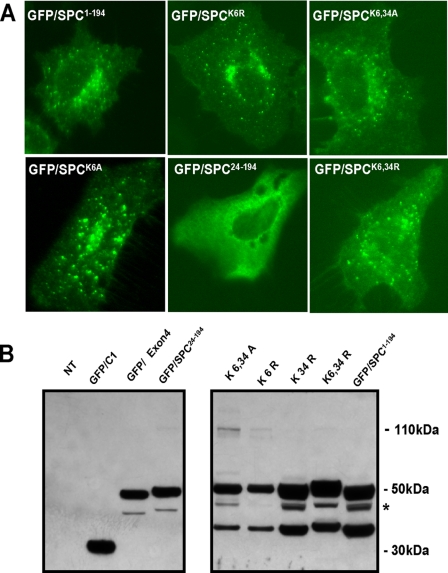
Biosynthesis of surfactant protein C (SP-C) by alveolar type 2 cells requires proteolytic processing of a 21-kDa propeptide (proSP-C21) in post-Golgi compartments to yield a 3.7-kDa mature form. Scanning alanine mutagenesis, binding assays, and co-immunoprecipitation were used to characterize the proSP-C targeting domain. Delivery of proSP-C21 to distal processing organelles is dependent upon the NH2-terminal cytoplasmic SP-C propeptide, which contains a conserved PPDY motif. In A549 cells, transfection of EGFP/proSP-C21 constructs containing polyalanine substitution for Glu11-Thr18, 13PPDY16, or 14P,16Y produced endoplasmic reticulum retention of the fusion proteins. Protein-protein interactions of proSP-C with known WW domains were screened using a solid-phase array that revealed binding of the proSP-C NH2 terminus to several WW domains found in the Nedd4 family of E3 ligases. Specificity of the interaction was confirmed by co-immunoprecipitation of proSP-C and Nedd4 or Nedd4-2 in epithelial cell lines. By Western blotting and reverse transcription-PCR, both forms were detected in primary human type 2 cells. Knockdown of Nedd4-2 by small interference RNA transfection of cultured human type 2 cells blocked processing of 35S-labeled proSP-C21. Mutagenesis of potential acceptor sites for ubiquitination in the cytosolic domain of proSP-C (Lys6, Lys34, or both) failed to inhibit trafficking of EGFP/proSP-C21. These results indicate that PPDY-mediated interaction with Nedd4 E3-ligases is required for trafficking of proSP-C. We speculate that the Nedd4/proSP-C tandem is part of a larger protein complex containing a ubiquitinated component that further directs its transport.
Figures
References
-
- Beers M. F., Mulugeta S. ( 2005) Annu. Rev. Physiol. 67, 663– 696 - PubMed
-
- Beers M. F., Lomax C. ( 1995) Am. J. Physiol. Lung Cell. Mol. Physiol. 269, L744– 753 - PubMed
-
- Brasch F., ten Brinke A., Johnen G., Ochs M., Kapp N., Müller K. M., Beers M. F., Fehrenbach H., Richter J., Batenburg J. J., Bühling F. ( 2002) Am. J. Respir. Cell Mol. Biol. 26, 659– 670 - PubMed
-
- Beers M. F. ( 1996) J. Biol. Chem. 271, 14361– 14370 - PubMed
-
- Vorbroker D. K., Voorhout W. F., Weaver T. E., Whitsett J. A. ( 1995) Am. J. Physiol. Lung Cell Mol. Physiol. 269, L727– 733 - PubMed
Publication types
MeSH terms
Substances
Grants and funding
LinkOut - more resources
Full Text Sources
