


Growth hormone deficiency is associated with decreased quality of life in patients with prior acromegaly
- PMID: 19366847
- PMCID: PMC2708960
- DOI: 10.1210/jc.2008-2671
Growth hormone deficiency is associated with decreased quality of life in patients with prior acromegaly
Abstract
Context: Both GH deficiency (GHD) and GH excess are associated with a decreased quality of life. However, it is unknown whether patients with GHD after treatment for acromegaly have a poorer quality of life than those with normal GH levels after cure of acromegaly.
Objective: The aim of the study was to determine whether patients with GHD and prior acromegaly have a poorer quality of life than those with GH sufficiency after cure of acromegaly.
Design and setting: We conducted a cross-sectional study in a General Clinical Research Center.
Study participants: Forty-five patients with prior acromegaly participated: 26 with GHD and 19 with GH sufficiency.
Intervention: There were no interventions.
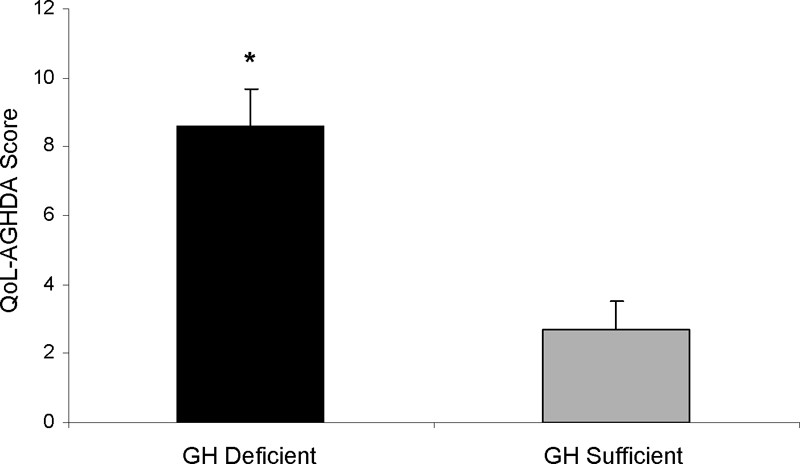
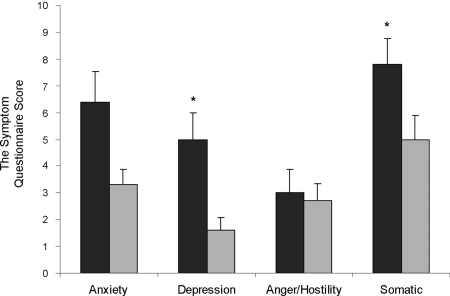
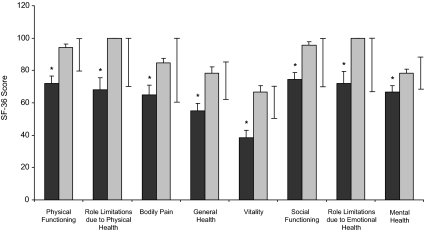
Main outcome measures: We evaluated quality of life, as measured by 1) the Quality of Life Adult Growth Hormone Deficiency Assessment (QoL-AGHDA); 2) the Short-Form Health Survey (SF-36); and 3) the Symptom Questionnaire.
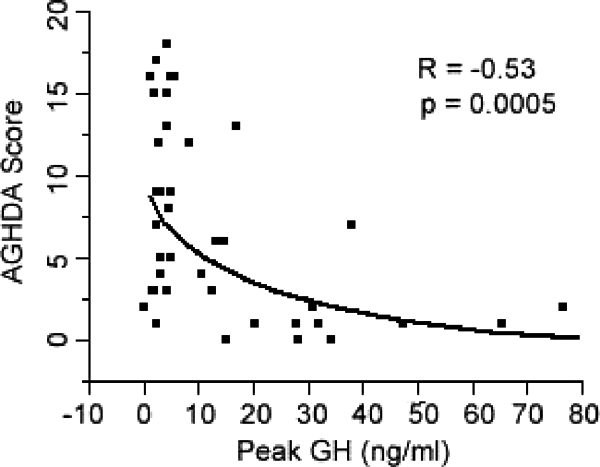
Results: Mean scores on all subscales of all questionnaires, except for the anger/hostility and anxiety subscales of the Symptom Questionnaire, showed significantly impaired quality of life in the GH-deficient group compared with the GH-sufficient group. Peak GH levels after GHRH-arginine stimulation levels were inversely associated with QoL-AGHDA scale scores (R = -0.53; P = 0.0005) and the Symptom Questionnaire Depression subscale scores (R = -0.35; P = 0.031) and positively associated with most SF-36 subscale scores.
Conclusions: Our data are the first to demonstrate a reduced quality of life in patients who develop GHD after cure of acromegaly compared to those who are GH sufficient. Further studies are warranted to determine whether GH replacement would improve quality of life for patients with GHD after cure from acromegaly.
Figures
References
-
- Blum WF, Shavrikova EP, Edwards DJ, Rosilio M, Hartman ML, Marín F, Valle D, van der Lely AJ, Attanasio AF, Strasburger CJ, Henrich G, Herschbach P 2003 Decreased quality of life in adult patients with growth hormone deficiency compared with general populations using the new, validated, self-weighted questionnaire, questions on life satisfaction hypopituitarism module. J Clin Endocrinol Metab 88:4158–4167 - PubMed
-
- Gilchrist FJ, Murray RD, Shalet SM 2002 The effect of long-term untreated growth hormone deficiency (GHD) and 9 years of GH replacement on the quality of life (QoL) of GH-deficient adults. Clin Endocrinol (Oxf) 57:363–370 - PubMed
-
- Rosen T, Wiren L, Wilhelmsen L, Wiklund I, Bengtsson BA 1994 Decreased psychological well-being in adult patients with growth hormone deficiency. Clin Endocrinol (Oxf) 40:111–116 - PubMed
-
- Badia X, Lucas A, Sanmarti A, Roset M, Ulied A 1998 One-year follow-up of quality of life in adults with untreated growth hormone deficiency. Clin Endocrinol (Oxf) 49:765–771 - PubMed
-
- Bjork S, Jonsson B, Westphal O, Levin JE 1989 Quality of life of adults with growth hormone deficiency: a controlled study. Acta Paediatr Scand Suppl 356:55–59; discussion 60, 73–54 - PubMed
