Pathogen recognition and inflammatory signaling in innate immune defenses
- PMID: 19366914
- PMCID: PMC2668232
- DOI: 10.1128/CMR.00046-08
Pathogen recognition and inflammatory signaling in innate immune defenses
Abstract
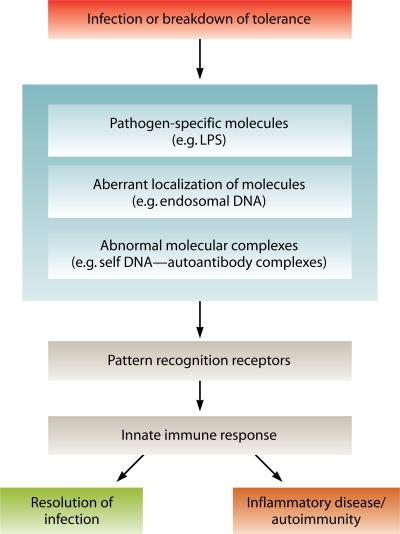
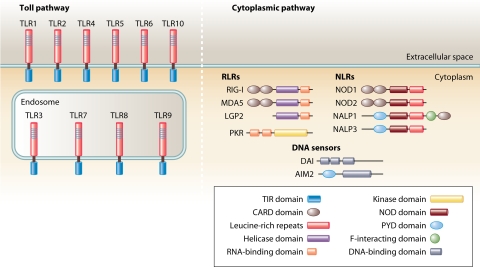
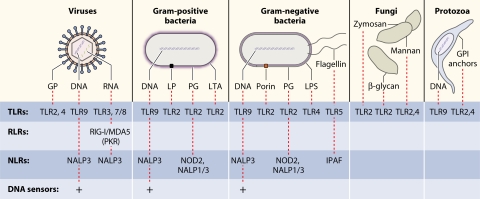
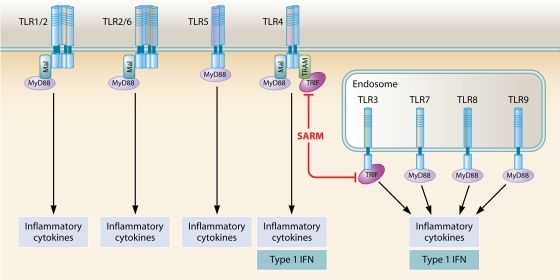
The innate immune system constitutes the first line of defense against invading microbial pathogens and relies on a large family of pattern recognition receptors (PRRs), which detect distinct evolutionarily conserved structures on pathogens, termed pathogen-associated molecular patterns (PAMPs). Among the PRRs, the Toll-like receptors have been studied most extensively. Upon PAMP engagement, PRRs trigger intracellular signaling cascades ultimately culminating in the expression of a variety of proinflammatory molecules, which together orchestrate the early host response to infection, and also is a prerequisite for the subsequent activation and shaping of adaptive immunity. In order to avoid immunopathology, this system is tightly regulated by a number of endogenous molecules that limit the magnitude and duration of the inflammatory response. Moreover, pathogenic microbes have developed sophisticated molecular strategies to subvert host defenses by interfering with molecules involved in inflammatory signaling. This review presents current knowledge on pathogen recognition through different families of PRRs and the increasingly complex signaling pathways responsible for activation of an inflammatory and antimicrobial response. Moreover, medical implications are discussed, including the role of PRRs in primary immunodeficiencies and in the pathogenesis of infectious and autoimmune diseases, as well as the possibilities for translation into clinical and therapeutic applications.
Figures
References
-
- Abbott, D. W., A. Wilkins, J. M. Asara, and L. C. Cantley. 2004. The Crohn's disease protein, NOD2, requires RIP2 in order to induce ubiquitinylation of a novel site on NEMO. Curr. Biol. 14:2217-2227. - PubMed
-
- Abraham, N., D. F. Stojdl, P. I. Duncan, N. Methot, T. Ishii, M. Dube, B. C. Vanderhyden, H. L. Atkins, D. A. Gray, M. W. McBurney, A. E. Koromilas, E. G. Brown, N. Sonenberg, and J. C. Bell. 1999. Characterization of transgenic mice with targeted disruption of the catalytic domain of the double-stranded RNA-dependent protein kinase, PKR. J. Biol. Chem. 274:5953-5962. - PubMed
-
- Adcock, I. M., and G. Caramori. 2001. Cross-talk between pro-inflammatory transcription factors and glucocorticoids. Immunol. Cell Biol. 79:376-384. - PubMed
-
- Agnese, D. M., J. E. Calvano, S. J. Hahm, S. M. Coyle, S. A. Corbett, S. E. Calvano, and S. F. Lowry. 2002. Human Toll-like receptor 4 mutations but not CD14 polymorphisms are associated with an increased risk of gram-negative infections. J. Infect. Dis. 186:1522-1525. - PubMed
-
- Agostini, L., F. Martinon, K. Burns, M. F. McDermott, P. N. Hawkins, and J. Tschopp. 2004. NALP3 forms an IL-1beta-processing inflammasome with increased activity in Muckle-Wells autoinflammatory disorder. Immunity 20:319-325. - PubMed
Publication types
MeSH terms
Substances
LinkOut - more resources
Full Text Sources
Other Literature Sources