


Physical activity decreases diverticular complications
- PMID: 19367267
- PMCID: PMC3144158
- DOI: 10.1038/ajg.2009.121
Physical activity decreases diverticular complications
Abstract
Objectives: Little is known about the effect of physical activity on diverticular complications. This study prospectively examined the associations between physical activity and diverticular bleeding and diverticulitis.
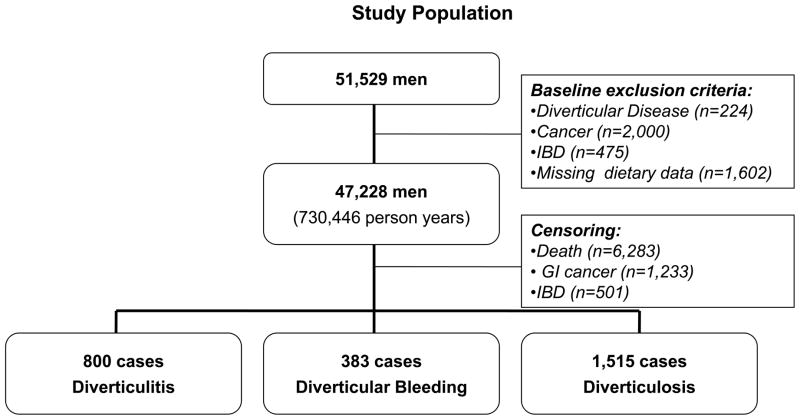
Methods: We studied 47,228 US males in the Health Professionals Follow-up Study cohort who were aged 40-75 years and free of diverticular disease, gastrointestinal cancer, and inflammatory bowel disease at baseline in 1986. Men reporting newly diagnosed diverticular disease on biennial follow-up questionnaires were sent supplemental questionnaires outlining details of diagnosis and treatment. Physical activity was assessed every 2 years. Men recorded the average time per week spent in eight recreational activities, and flights of stairs climbed per day. Cox proportional hazards regression was used to calculate relative risks (RRs).
Results: During 18 years of follow-up, 800 cases of diverticulitis and 383 cases of diverticular bleeding were identified. Total cumulative physical activity was associated with a decreased risk of diverticulitis and diverticular bleeding. After adjustment for potential confounders, the RR for men in the highest quintile of total activity (> or = 57.4 metabolic equivalent hours per week (MET-h/week) was 0.75 (95% confidence interval, CI, 0.58-0.95) for diverticulitis and 0.54 (95% CI, 0.38-0.77) for bleeding, as compared with men in the lowest quintile (< or = 8.2 MET-h/week). Vigorous activity was inversely related to diverticulitis in a high vs. low comparison (multivariable RR, 0.66; 95% CI, 0.51-0.86) and bleeding (multivariable RR, 0.61; 95% CI, 0.41-0.90), whereas nonvigorous activity was not. These results were similar for recent (simple updated) and baseline activity.
Conclusions: Data from this large prospective cohort suggest that physical activity lowers the risk of diverticulitis and diverticular bleeding. Vigorous activity appears to account for this association.
Figures
References
-
- Burkitt DP, Walker AR, Painter NS. Effect of dietary fibre on stools and the transit-times, and its role in the causation of disease. Lancet. 1972;2:1408–12. - PubMed
-
- Aldoori WH, Giovannucci EL, Rockett HR, et al. A prospective study of dietary fiber types and symptomatic diverticular disease in men. J Nutr. 1998;128:714–9. - PubMed
-
- Hyland JM, Taylor I. Does a high fibre diet prevent the complications of diverticular disease? Br J Surg. 1980;67:77–9. - PubMed
Publication types
MeSH terms
Grants and funding
LinkOut - more resources
Full Text Sources
Medical
Miscellaneous
