


TP53 mutations predict disease control in metastatic colorectal cancer treated with cetuximab-based chemotherapy
- PMID: 19367287
- PMCID: PMC2676556
- DOI: 10.1038/sj.bjc.6605008
TP53 mutations predict disease control in metastatic colorectal cancer treated with cetuximab-based chemotherapy
Abstract
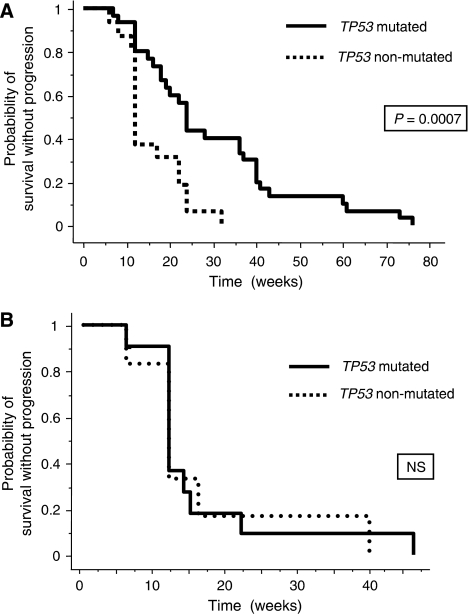
Recent studies have suggested that activation of the EGFR pathway leads to malignant transformation only if the p53 protein is inactivated. Therefore, we evaluated the impact of TP53 mutations on cetuximab-based chemotherapy (CT) sensitivity in combination with KRAS mutations that have been associated with cetuximab resistance. KRAS and TP53 status were assessed in tumours from 64 metastatic colorectal cancer patients treated with cetuximab-based CT and correlated to clinical response using the Fisher's exact test. Times to progression (TTPs) according to gene status were calculated using the Kaplan-Meier method and compared with log-rank test. TP53 mutations were found in 41 patients and were significantly associated with controlled disease (CD), as defined as complete response, partial response or stable disease (P=0.037) and higher TTP (20 vs 12 weeks, P=0.004). Remarkably, in the subgroup of 46 patients without KRAS mutation, but not in patients with KRAS mutation, TP53 mutations were also associated with CD (P=0.008) and higher TTP (24 vs 12 weeks, P=0.0007). This study suggests that TP53 mutations are predictive of cetuximab sensitivity, particularly in patients without KRAS mutation, and that TP53 genotyping could have a clinical interest to select patients who should benefit from cetuximab-based CT.
Figures
References
-
- Amado GR, Wolf M, Peeters M, Van Cutsem E, Siena S, Freeman DJ, Juan T, Sikorski R, Suggs S, Radinsky R, Patterson SD, Chang DD (2008) Wild-type KRAS is required for panitumumab efficacy in patients with metastatic colorectal cancer. J Clin Oncol 26: 1626–1634 - PubMed
-
- Benvenuti S, Sartore-Bianchi A, Di Nicolantonio F, Zanon C, Moroni M, Veronese S, Siena S, Bardelli A (2007) Oncogenic activation of the RAS/RAF signaling pathway impairs the response of metastatic colorectal cancers to anti-epidermal growth factor receptor antibody therapies. Cancer Res 67: 2643–2648 - PubMed
-
- Cappuzzo F, Finocchiaro G, Rossi E, Jänne PA, Carnaghi C, Calandri C, Bencardino K, Ligorio C, Ciardiello C, Pressiani T, Destro A, Roncalli M, Crino L, Franklin WA, Santoro A, Varella-Garcia M (2008a) EGFR FISH assay predicts for response to cetuximab in chemotherapy refractory colorectal cancer patients. Ann Oncol 19: 717–723 - PubMed
-
- Cappuzzo F, Varella Gracia M, Finocchiaro G, Skokan M, Gajapathy S, Carnaghi C, Rimassa L, Rossi E, Ligorio C, Di Tommaso L, Holmes AJ, Toschi L, Destro A, Roncalli M, Santoro A, Jänne PA (2008b) Primary resistance to cetuximab therapy in EGFR FISH-positive colorectal cancer patients. Br J Cancer 99: 83–89 - PMC - PubMed
Publication types
MeSH terms
Substances
LinkOut - more resources
Full Text Sources
Other Literature Sources
Medical
Research Materials
Miscellaneous
