


Risk of type 2 diabetes among individuals with high and low glomerular filtration rates
- PMID: 19367385
- PMCID: PMC6685435
- DOI: 10.1007/s00125-009-1361-4
Risk of type 2 diabetes among individuals with high and low glomerular filtration rates
Abstract
Aims/hypothesis: Metabolic abnormalities frequently develop prior to the diagnosis of type 2 diabetes and chronic kidney disease. However, it is not known whether GFR predicts the onset of type 2 diabetes.
Methods: Incident diabetes was ascertained in the Insulin Resistance Atherosclerosis Study (IRAS) (n = 864; age 40-69 years; median follow-up 5.2 years [4.5-6.6 years]; 141 incident cases of diabetes). GFR was estimated by the Modification of Diet in Renal Disease equation. We assessed the relationship between GFR and incident diabetes by logistic regression analysis. Results were adjusted for age, sex, ethnicity, clinic location, BMI, systolic blood pressure, antihypertensive treatment, family history of diabetes, insulin sensitivity and secretion, albumin to creatinine ratio, and levels of triacylglycerols, HDL-cholesterol, plasminogen activator inhibitor-1, and fasting and 2 h glucose.
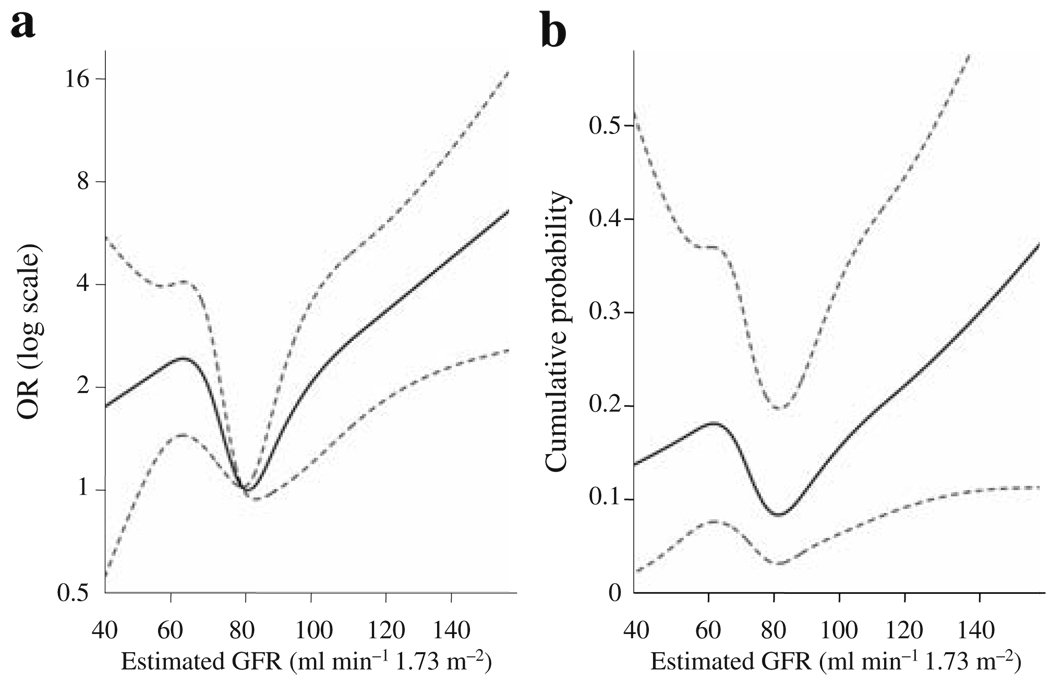
Results: The relationship between GFR and incident diabetes was not linear. This relationship was statistically significant (p = 0.039) using a restricted cubic polynomial spline for GFR as a regression modelling strategy. Participants were stratified by GFR quintiles. Mean values for GFR from the first to the fifth quintile were 60.8, 71.6, 79.8, 88.2 and 109.0 ml min(-1) 1.73 m(-2). Relative to the fourth quintile, the odds ratios of incident diabetes for the first, second, third and fifth quintiles were 2.32 (95% CI 1.06-5.05), 1.76 (95% CI 0.80-3.88), 1.26 (95% CI 0.56-2.84) and 2.59 (95% CI 1.18-5.65), respectively.
Conclusions/interpretation: Individuals in the upper and lower ranges of GFR are at increased risk of future diabetes. GFR and type 2 diabetes may share common pathogenic mechanisms.
Figures
References
-
- American Medical Association. Standards of medical care in diabetes—2006. Diabetes Care. 2006;29:S4–S42. - PubMed
-
- Levey AS, Coresh J, Balk E, et al. National Kidney Foundation practice guidelines for chronic kidney disease: evaluation, classification, and stratification. Ann Intern Med. 2003;139:137–147. - PubMed
-
- Klausen K, Borch-Johnsen K, Feldt-Rasmussen B, et al. Very low levels of microalbuminuria are associated with increased risk of coronary heart disease and death independently of renal function, hypertension, and diabetes. Circulation. 2004;110:32–35. - PubMed
-
- Gerstein HC, Mann JF, Yi Q, et al. Albuminuria and risk of cardiovascular events, death, and heart failure in diabetic and nondiabetic individuals. JAMA. 2001;286:421–426. - PubMed
-
- Festa A, D'Agostino R, Howard G, Mykkanen L, Tracy RP, Haffner SM. Inflammation and microalbuminuria in nondiabetic and type 2 diabetic subjects: The Insulin Resistance Atherosclerosis Study. Kidney Int. 2000;58:1703–1710. - PubMed
Publication types
MeSH terms
Grants and funding
- M01 RR431/RR/NCRR NIH HHS/United States
- M01 RR 01346/RR/NCRR NIH HHS/United States
- HL-47892/HL/NHLBI NIH HHS/United States
- HL-47902/HL/NHLBI NIH HHS/United States
- HL-47889/HL/NHLBI NIH HHS/United States
- HL-47887/HL/NHLBI NIH HHS/United States
- KL2 RR 025766/RR/NCRR NIH HHS/United States
- U01 HL047902/HL/NHLBI NIH HHS/United States
- UL1 TR000149/TR/NCATS NIH HHS/United States
- KL2 RR025766/RR/NCRR NIH HHS/United States
- HL-47890/HL/NHLBI NIH HHS/United States
- U01 HL047892/HL/NHLBI NIH HHS/United States
- M01 RR001346/RR/NCRR NIH HHS/United States
- KL2 TR000118/TR/NCATS NIH HHS/United States
- UL1 RR025767/RR/NCRR NIH HHS/United States
LinkOut - more resources
Full Text Sources
Medical
Miscellaneous
