. 2009 Oct;33(5):1441-4.
doi: 10.1007/s00264-009-0776-3. Epub 2009 Apr 15.

Results of the proximal femoral nail anti-rotation (PFNA) in elderly Chinese patients

Affiliations

Results of the proximal femoral nail anti-rotation (PFNA) in elderly Chinese patients

Jin-Song Pu et al. Int Orthop. 2009 Oct.

Abstract

A prospective study is presented of 87 unstable intertrochanteric fractures treated with the proximal femoral nail anti-rotation (PFNA) with a follow-up of one year. Of the patients 76% were female. The average age was 75.3 years. The fracture was treated by closed reduction and intramedullary fixation. Pre-injury activity level was recovered in 77% of the patients. Fractures united in all patients. Mechanical failure and cut-out were not observed. A technical problem related to the mismatch of the proximal end of the nail was observed in 11 cases. Nine patients presented with thigh pain due to the redundant proximal end of the nail. The results of the PFNA were satisfactory in most elderly Chinese patients. However, the proximal end of the nail was not matched with the specific anatomy of some short elderly patients. Further modifications of the nail are necessary for the elderly Chinese population.


Figures
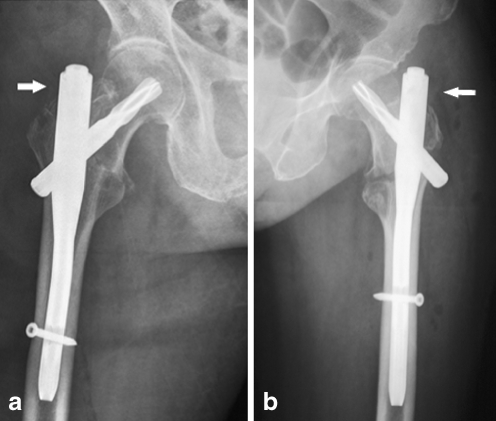
Fig. 1
Fig. 1
a The proximal end of the nail remained 1 cm outside the greater trochanter when a very small nail (length 170 mm) was used in a short elderly patient. b A small version nail (length 200 mm) remained 2 cm outside of the bone, the arrow indicates the redundant proximal end of the nail
Fig. 2
Fig. 2
The helical blades were placed in the lower third of the femoral neck, when the proximal end of the nail was wholly inserted into the tip of the greater trochanter. a A very small version nail (length 170 mm). b A small version nail (length 200 mm)
Fig. 3
Fig. 3
X-ray shows excessive bowing of the femoral shaft with the tip of the nail abutting the lateral wall. A small version nail was chosen to avoid passing beyond the apex of the curvature of the natural anterior bow of the femur. a Anteroposterior (AP) view. b Axial view

References

    1. Andreas A, Norbert S, Martin B, et al. Complications after intramedullary stabilization of proximal femur fractures: a retrospective analysis of 178 patients. Eur J Trauma Emerg Surg. 2007;33:262–267. doi: 10.1007/s00068-007-6010-3. - DOI - PubMed
    1. Baumgaertner MR, Curtin SL, Lindskog DM, et al. The value of the tip-apex distance in predicting failure of fixation of peritrochanteric fractures of the hip. J Bone Joint Surg (Am) 1995;78:1058–1064. - PubMed
    1. Beatrix H, Andre G. Complications following the treatment of trochanteric fractures with the gamma nail. Arch Orthop Trauma Surg. 2004;124:692–698. doi: 10.1007/s00402-004-0744-8. - DOI - PubMed
    1. Brunner A, Jockel JA, Babst R. The PFNA proximal femur nail in treatment of unstable proximal femur fractures—3 cases of postoperative perforation of the helical blade into the hip joint. J Orthop Trauma. 2008;22:731–736. doi: 10.1097/BOT.0b013e3181893b1b. - DOI - PubMed
    1. Domingo L, Cecilia D, Herrera A, et al. Trochanteric fractures treated with a proximal femoral nail. Int Orthop. 2001;25:298–301. doi: 10.1007/s002640100275. - DOI - PMC - PubMed

MeSH terms
