


Seasonal and circadian variation in salivary testosterone in rural Bolivian men
- PMID: 19367574
- PMCID: PMC3771338
- DOI: 10.1002/ajhb.20927
Seasonal and circadian variation in salivary testosterone in rural Bolivian men
Abstract
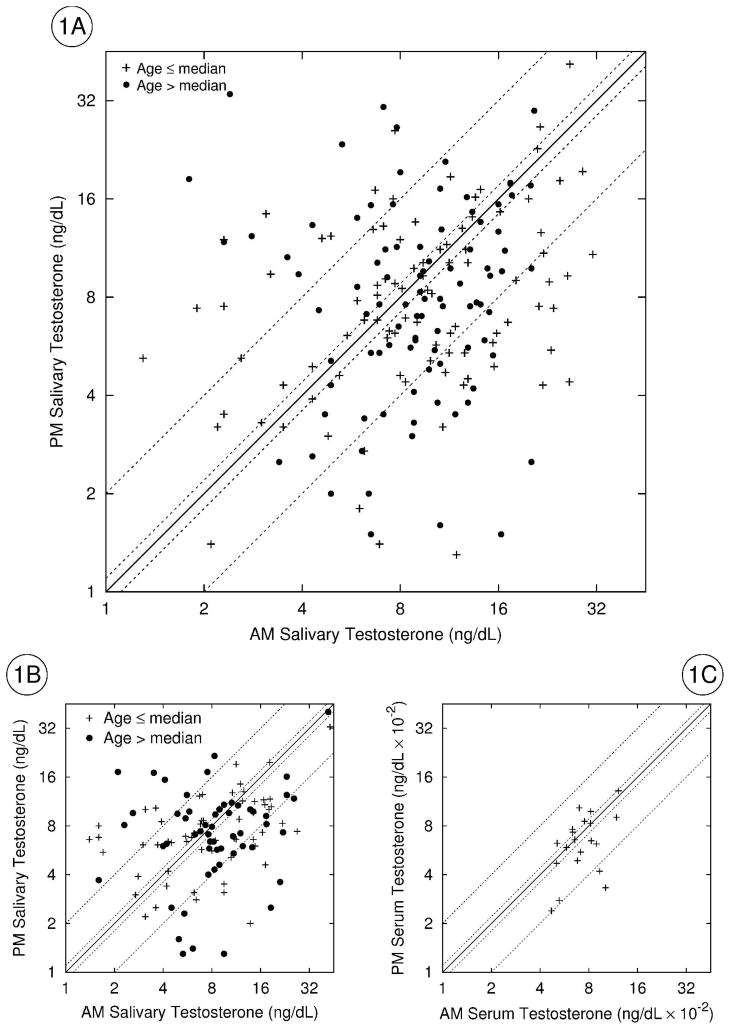
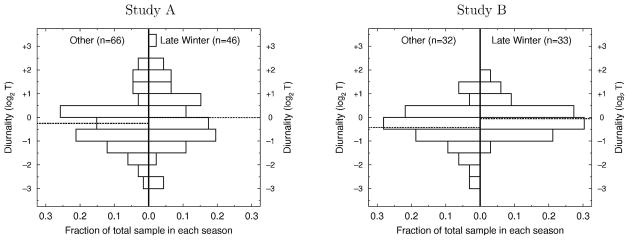
Testosterone (T) plays a key role in the increase and maintenance of muscle mass and bone density in adult men. Life history theory predicts that environmental stress may prompt a reallocation of such investments to those functions critical to survival. We tested this hypothesis in two studies of rural Bolivian adult men by comparing free T levels and circadian rhythms during late winter, which is especially severe, to those in less arduous seasons. For each pair of salivary T(AM)/T(PM) samples (collected in a approximately 12-h period), circadian rhythm was considered classic (C(CLASSIC)) if T(AM) > 110%T(PM), reverse (C(REVERSE)) if T(PM) > 110%T(AM), and flat (C(FLAT)) otherwise. We tested the hypotheses that mean T(AM) > mean T(PM) and that mean T(LW) < mean T(OTHER) (LW = late winter, OTHER = other seasons). In Study A, of 115 T(PM)-T(AM) pairs, 51% = C(CLASSIC), 39% = C(REVERSE), 10% = C(FLAT); in Study B, of 184 T(AM)-T(PM) pairs, 55% = C(CLASSIC), 33% = C(REVERSE), 12% = C(FLAT). Based on fitting linear mixed models, in both studies T(OTHER-AM) > T(OTHER-PM) (A: P = 0.035, B: P = 0.0005) and T(OTHER-AM) > T(LW-AM) (A: P = 0.054, B: P = 0.007); T(PM) did not vary seasonally, and T diurnality was not significant during late winter. T diurnality varied substantially between days within an individual, between individuals and between seasons, but neither T levels nor diurnality varied with age. These patterns may reflect the seasonally varying but unscheduled, life-long, strenuous physical labor that typifies many non-industrialized economies. These results also suggest that single morning samples may substantially underestimate peak circulating T for an individual and, most importantly, that exogenous signals may moderate diurnality and the trajectory of age-related change in the male gonadal axis.
Figures
References
-
- Abbaticchio G, de Fini M, Giagulli VA, Santoro G, Vendola G, Giorgino R. Circannual rhythms in reproductive functions of human males, correlations among hormones and hormone-dependent parameters. Andrologia. 1987;19:353–361. - PubMed
-
- Andersson AM, Carlsen E, Petersen JH, Skakkebaek NE. Variation in levels of serum inhibin B, testosterone, estradiol, luteinizing hormone, follicle-stimulating hormone, and sex hormone-binding globulin in monthly samples from healthy men during a 17-month period: possible effects of seasons. J Clin Endocrinol Metab. 2003;88:932–937. - PubMed
-
- Axelsson J, Ingre M, Akerstedt T, Holmback U. Effects of acutely displaced sleep on testosterone. J Clin Endocrinol Metab. 2005;90:4530–4535. - PubMed
-
- Baker HW, Burger HG, de Kretser DM, Hudson B, O’Connor S, Wang C, Mirovics A, Court J, Dunlop M, Rennie GC. Changes in the pituitary testicular system with age. Clin Endocrinol. 1976;5:349–372. - PubMed
-
- Beall CM, Worthman CM, Stallings J, Strohl KP, Brittenham GM, Barragan M. Salivary testosterone concentration of Aymara men native to 3600 m. Ann Hum Biol. 1992;19:67–78. - PubMed
Publication types
MeSH terms
Substances
Grants and funding
LinkOut - more resources
Full Text Sources
Other Literature Sources
