Comparative Study
. 2009 Apr 15;29(15):4836-45.
doi: 10.1523/JNEUROSCI.0178-09.2009.

Dopamine D1 versus D4 receptors differentially modulate the encoding of salient versus nonsalient emotional information in the medial prefrontal cortex

Affiliations
Comparative Study

Dopamine D1 versus D4 receptors differentially modulate the encoding of salient versus nonsalient emotional information in the medial prefrontal cortex

Nicole M Lauzon et al. J Neurosci. .

Abstract

Dopamine (DA) transmission plays a critical role in the processing of emotionally salient information and in associative learning and memory processes. Within the mammalian brain, neurons within the medial prefrontal cortex (mPFC) are involved critically in the encoding, expression, and extinction of emotionally salient learned information. Within the mPFC, dopaminergic transmission is involved importantly in controlling attentional and motivational processes, particularly within the context of emotionally salient sensory information. Considerable evidence suggests differential roles for DA D(1)-like versus D(2)-like receptors, including the D(4) receptor subtype, in the regulation of neuronal activity and emotional processing within the mPFC. Using an olfactory fear-conditioning assay in rats, we compared the roles of DA D(1) versus D(4) receptor activation during the encoding and recall phases of emotional learning and memory. We report that specific activation of DA D(4) receptors within the mPFC strongly potentiates the salience of normally nonsalient emotional associative fear memories and blocks the encoding of suprathreshold conditioned fear associations. However, D(4) receptor activation has no effect on the recall of previously learned emotionally salient conditioned memories. In contrast, intra-mPFC D(1) receptor activation failed to increase the emotional salience of subthreshold fear stimuli but completely blocked the expression of previously learned emotionally relevant information, demonstrating that DA D(4) versus D(1) subtype receptor transmission within the mPFC plays distinct functional roles in the processing of emotionally salient versus nonsalient associative information and differentially modulates the encoding versus recall phases of emotional memory within the mPFC.


Figures
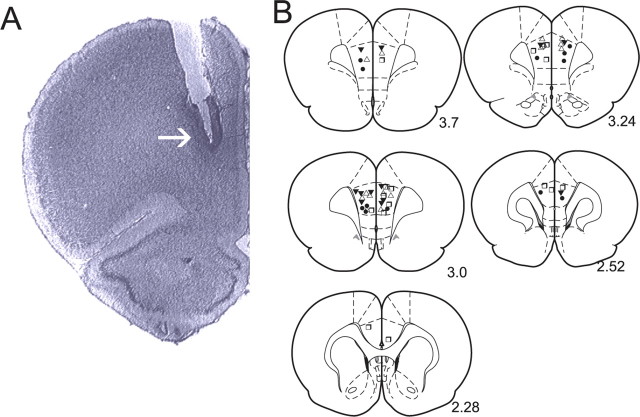
Figure 1.
Figure 1.
Histological analysis of intra-mPFC microinjection sites. A, Microphotograph of a representative injector placement within the mPFC. B, Schematic illustration showing representative bilateral placements of microinjection cannulae. For illustrative clarity, only a subset of experimental groups is presented. Symbols represent separate experimental groups: ▵, PD 168077, 50 ng/0.5 μl versus acquisition of subthreshold stimuli; □, SKF 38393, 1000 ng/0.5 μl versus acquisition of subthreshold stimuli; ▾, PD 168077, 50 ng/0.5 μl versus acquisition of suprathreshold stimuli; •, SKF 38393, 1000 ng/0.5 μl versus expression of suprathreshold stimuli.
Figure 2.
Figure 2.
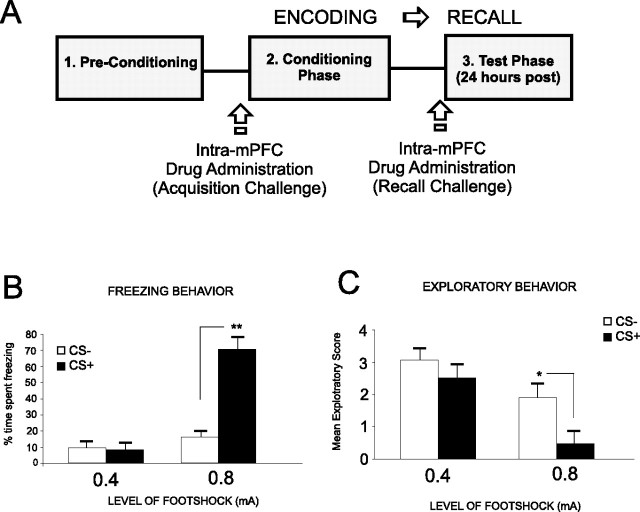
Experimental protocol summary and footshock sensitivity level assay. A, Schematic representation showing experimental associative fear conditioning assay and timeline for examining acquisition (encoding) versus expression (recall) phases of associative olfactory fear memory. B, C, Behavioral sensitivity assay demonstrating that although subthreshold (0.4 mA) footshock stimuli produce neither conditioned freezing behavior (B) nor conditioned suppression of exploratory behavior (C), presentation of a suprathreshold (0.8 mA) footshock level produces significant levels of freezing (B) and suppression of exploratory behavior (C). Error bars represent SEM for this and all subsequent figures. For this and all subsequent figures, *p < 0.05; **p < 0.01.
Figure 3.
Figure 3.
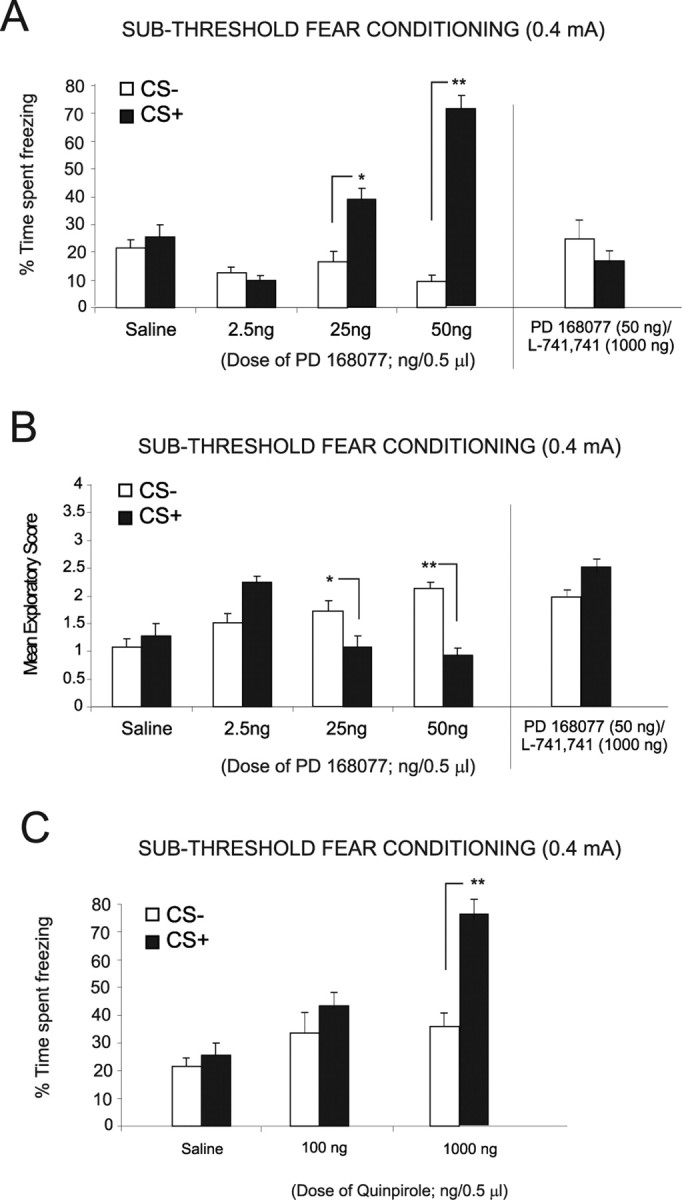
Bilateral intra-mPFC DA D4 and D2 receptor manipulations versus subthreshold levels of fear-conditioning stimuli. A, Bilateral intra-mPFC microinfusions of the DA D4 receptor agonist PD 168077 (2.5, 25, and 50 ng/0.5 μl) dose-dependently potentiated the acquisition of subthreshold (0.4 mA footshock) olfactory fear conditioning. Both saline controls and rats receiving a lower dose of PD 168077 (2.5 ng/0.5 μl) display no significant difference in time freezing to the CS+ relative to the CS− presentations. In contrast, rats receiving higher doses of PD 168077 (25 ng and 50 ng/0.5 μl) display significantly greater levels of freezing specifically in response to presentation of the CS+ relative to CS−. In a separate control experiment, this D4 receptor-induced potentiation was blocked when the D4 receptor antagonist L-741,741 (1000 ng/0.5 μl) was coadministered with PD 168077 (50 ng/0.5 μl), as rats display no significant difference in conditioned freezing behavior in response to the CS+ relative to CS− presentations. B, Measurement of exploratory behavior in response to the CS+ and CS− odors revealed saline control rats and rats receiving the lower two doses of PD 168077 (2.5 and 25 ng/0.5 μl) showed no significant difference in exploratory scores. However, with the 50 ng/0.5 μl PD 168077 dose, there was a significant decrease in spontaneous exploratory behavior after CS+ relative to CS− presentation. Similarly, intra-mPFC coadministration with the D4 receptor antagonist L-741,741 (1000 ng/0.5 μl) with PD 168077 (50 ng/0.5 μl) blocked conditioned suppression of exploratory behavior, demonstrated by no significant difference between exploratory behavior in response to CS+ and CS− presentations. C, Bilateral intra-mPFC microinfusions of the D2-like receptor agonist quinpirole failed to potentiate subthreshold fear-conditioning acquisition at a lower dose of 100 ng/0.5 μl, demonstrated by no significant freezing response to CS+ versus CS− presentations. However, bilateral intra-mPFC microinfusions of quinpirole at a higher (nonspecific) dose (1000 ng/0.5 μl) resulted in a potentiation of subthreshold fear stimuli as demonstrated by a significant increase in the time spent freezing to the CS+ relative to the CS−.
Figure 4.
Figure 4.
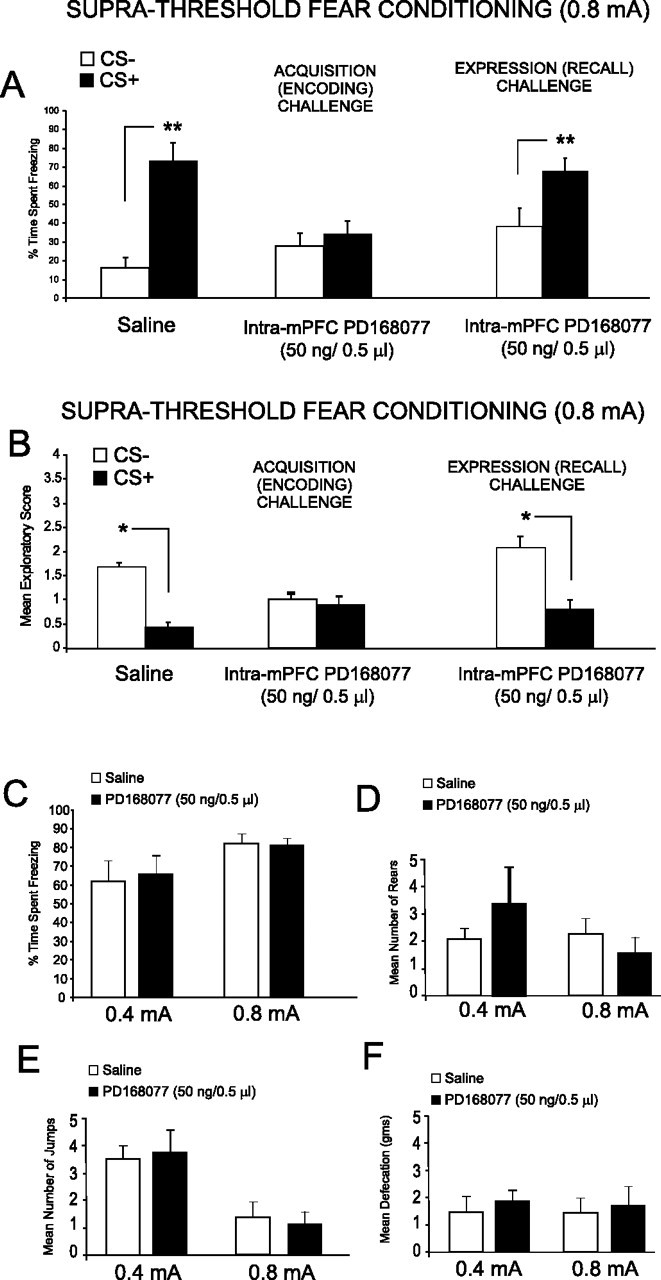
Intra-mPFC D4 agonist effects on suprathreshold olfactory fear conditioning and footshock sensitivity analyses. A, Saline control rats showed significant freezing behavior to CS+ versus CS− presentations after conditioning with suprathreshold footshock (0.8 mA) levels. In contrast, preconditioning microinfusion of intra-mPFC PD 168077 (50 ng/0.5 μl) blocked the acquisition of suprathreshold olfactory fear conditioning as demonstrated by no significant difference in the percentage of time spent freezing to the CS+ relative to the CS− at testing. However, intra-mPFC PD 168077 (50 ng/0.5 μl) microinfusions immediately before testing did not block the expression (recall) of suprathreshold olfactory fear conditioning. B, Analysis of exploratory activity after CS+ or CS− presentation revealed that whereas saline control rats showed significant conditioned suppression of exploratory behavior in response to CS+ versus CS− presentations, this effect was blocked in rats receiving intra-mPFC PD 168077 (50 ng/0.5 μl) immediately before conditioning. In contrast, intra-mPFC PD 168077 (50 ng/0.5 μl) administered immediately before testing did not block the expression (recall) of suprathreshold olfactory fear conditioning observed as a significant decrease in exploratory behavior in response to CS+ presentations. C, Footshock sensitivity testing (see Materials and Methods) revealed no significant differences between control groups receiving a subthreshold footshock (0.4 mA) versus intra-mPFC saline control (n = 5) or intra-mPFC PD 168077 (50 ng/μl; n = 5) or between control groups receiving a suprathreshold level of footshock (0.8 mA) versus intra-mPFC saline control (n = 6) or intra-mPFC PD 168077 (50 ng/μl, n = 6) in the percentage of time spent freezing in response to footshock presentations. D, Similarly, no significant differences were observed in the mean number of rears between groups in response to either level of footshock. E, No significant differences were observed between the mean numbers of jumps between groups in response to either level of footshock. F, No significant differences were observed in the mean amount of defecation between groups in response to either level of footshock.
Figure 5.
Figure 5.
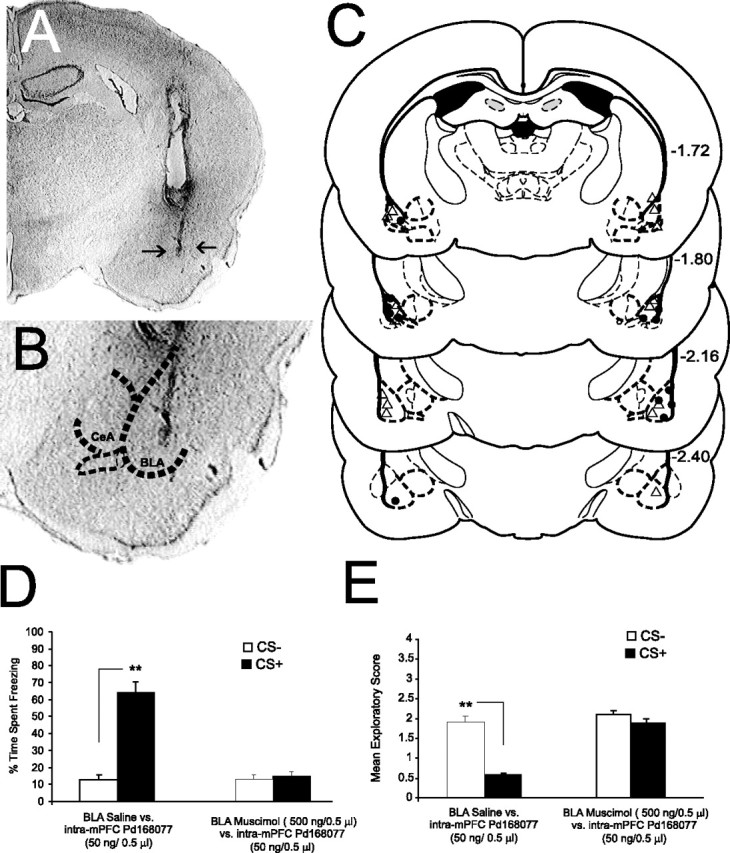
Histological analysis of intra-BLA cannulae placements and effects of BLA inactivation on D4-mediated emotional associative learning potentiation. A, A microphotograph of a coronal section of the BLA showing a representative microinjection site (arrows). B, Microphotograph of the BLA at higher magnification with a superimposed outline of the anatomical boundaries of the BLA relative to the adjacent central nucleus of the amygdala (CeA). C, Representative schematic diagram showing representative intra-BLA microinjection sites: ▵, BLA saline control placements; •, intra-BLA muscimol (500 ng/0.5 μl) injector locations. D, Intra-BLA saline administration before intra-mPFC PD 168077 (50 ng/0.5 μl) had no significant effect on the ability of mPFC D4 receptor activation to potentiate subthreshold (0.4 mA) olfactory fear-conditioning freezing behavior, as rats displayed significant levels of freezing after CS+ presentations. Intra-BLA muscimol administration (500 ng/0.5 μl) before intra-mPFC PD 168077 (50 ng/0.5 μl) significantly blocked the ability of mPFC D4 receptor activation to potentiate subthreshold olfactory fear conditioning, as rats displayed no differences in freezing behavior to CS+ versus CS− presentations. E, Similar to the effects observed with freezing behavior, intra-BLA saline did not affect the ability of intra-mPFC D4 activation to potentiate emotional associative learning, as rats showed significantly greater conditioned suppression of exploratory behavior in response to CS+ relative to CS− presentations. In contrast, this associative response was blocked in rats receiving intra-BLA muscimol before intra-mPFC PD 168077 (50 ng/0.5 μl).
Figure 6.
Figure 6.
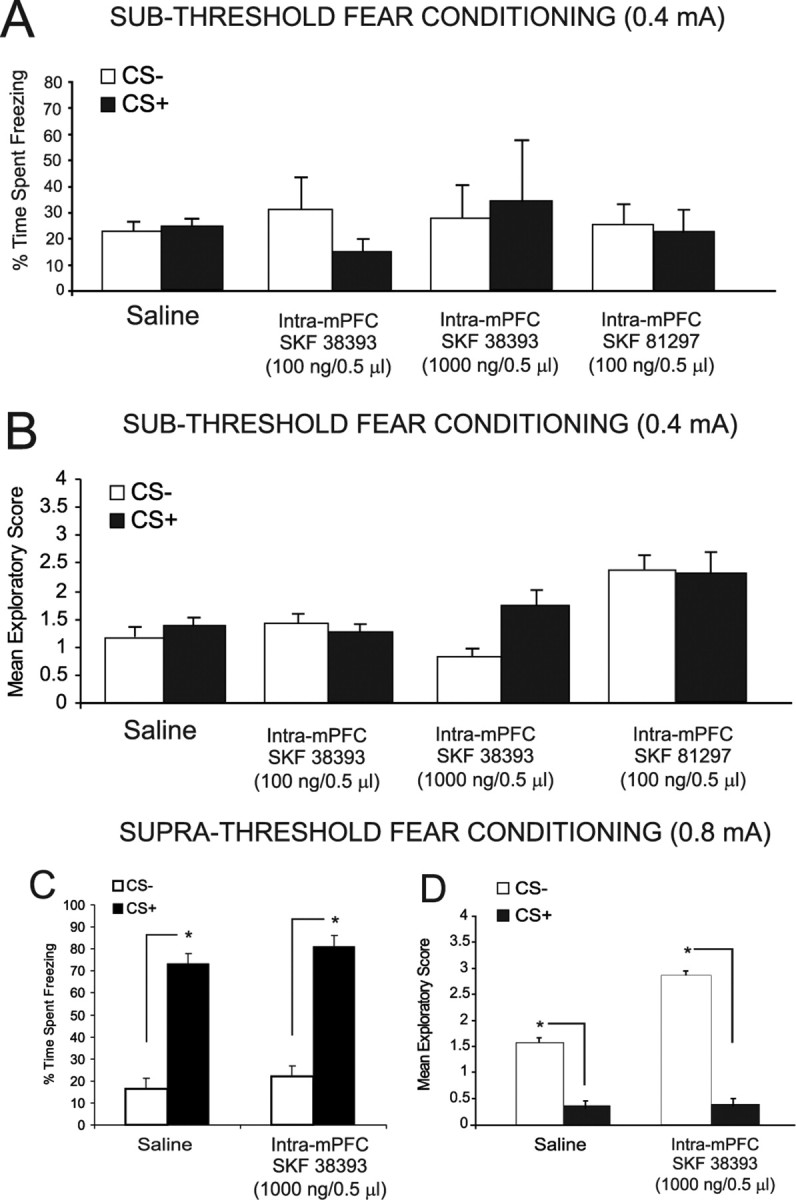
Behavioral effects of bilateral intra-mPFC DA D1 receptor activation on the acquisition of salient or nonsalient associative fear conditioning memory. A, Intra-mPFC DA D1 agonist SKF 38393 (100 and 1000 ng/0.5 μl; n = 7 and n = 8, respectively) had no effect on the percentage of time spent freezing to CS+ versus CS− presentations after olfactory fear conditioning with subthreshold footshock levels (0.4 mA). Bilateral intra-mPFC administration of another D1 receptor agonist, SKF 81297 (100 ng/0.5 μl), similarly had no effect on conditioning to a subthreshold level of footshock. B, Intra-mPFC SKF 38393 (100 and 1000 ng/0.5 μl) had no effect on mean exploratory scores after CS+ versus CS− presentations after olfactory fear conditioning with subthreshold footshock stimuli. Bilateral intra-mPFC administration of the D1 receptor agonist SKF 81297 (100 ng/0.5 μl) similarly had no effect on exploratory scores after CS+ or CS− presentations when conditioned with this subthreshold footshock level. C, Intra-mPFC saline control and intra-mPFC SKF 38393 (1000 ng/0.5 μl) groups displayed a significant increase in freezing in response to CS+ versus CS− presentations after fear conditioning with suprathreshold footshock levels (0.8 mA). D, In addition, intra-mPFC saline control and intra-mPFC SKF 38393 (1000 ng/0.5 μl) groups displayed a significant decrease in exploratory behavior in response to CS+ versus CS− presentations after fear conditioning with suprathreshold levels of footshock.
Figure 7.
Figure 7.
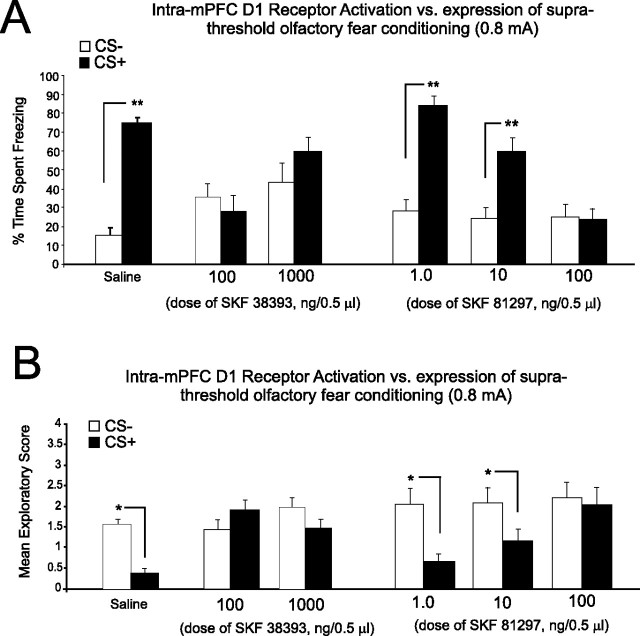
Behavioral effects of bilateral intra-mPFC DA D1 receptor activation on the expression (recall) of suprathreshold associative fear-conditioning memory. A, Rats receiving intra-mPFC saline displayed normal expression (recall) of suprathreshold (0.8 mA footshock) fear conditioning when administered saline immediately before testing. In contrast, administration of a D1 agonist (SKF 38393; 100–1000 ng/0.5 μl) immediately before testing completely blocked the expression (recall) of previously acquired emotional learning, with rats displaying no significant difference in freezing behavior in response to CS+ relative to CS− presentations. Similarly, bilateral intra-mPFC administration of the full D1 receptor agonist SKF 81297 (1–100 ng/0.5 μl) produced a dose-dependent attenuation of emotional memory recall at the highest dose of 100 ng, but not at subthreshold doses (1–10 ng/0.5 μl). B, Similar effects were observed in conditioned suppression of exploratory behavior scores after CS+ versus CS− presentations, with intra-mPFC D1 receptor activation blocking conditioned suppression of exploratory behavior after pretesting microinfusions of SKF 38393 (100–1000 ng/0.5 μl), relative to saline controls. Bilateral intra-mPFC administration of another D1 receptor agonist, SKF 81297 (1–100 ng/0.5 μl), also produced a dose-dependent attenuation of emotional memory recall reflected in conditioned suppression of exploratory behavior, at the highest dose of 100 ng but not at subthreshold doses of 1–10 ng/0.5 μl.

Comment in

References

    1. Antoniadis EA, McDonald RJ. Discriminative fear conditioning to context expressed by multiple measures of fear in the rat. Behav Brain Res. 1999;101:1–13. - PubMed
    1. Arnsten AFT, Cai JX, Murphy BL, Goldman-Rakic PS. Dopamine D1 receptor mechanisms in the cognitive performance of young adult and aged monkeys. Psychopharmacology. 1994;116:143–151. - PubMed
    1. Cai JX, Arnsten AFT. Dose-dependent effects of the dopamine D1 receptor agonists A77636 or SKF81297 on spatial working memory in aged monkeys. J Pharmacol Exp Ther. 1990;282:1–7. - PubMed
    1. Ceci A, Brambilla A, Duranti P, Grauert M, Grippa N, Borsini F. Effect of antipsychotic and selective dopaminergic antagonists on dopamine-induced facilitatory activity in prelimbic cortical pyramidal neurons: an in vitro study. Neuroscience. 1999;93:107–115. - PubMed
    1. Durstewitz D, Seamans JK. The dual-state theory of prefrontal cortex dopamine function with relevance to catechol-O-methytransferase genotypes and schizophrenia. Biol Psychiatry. 2008;64:739–749. - PubMed

Publication types

MeSH terms

LinkOut - more resources