. 2009 Oct 1;47(4):1341-51.
doi: 10.1016/j.neuroimage.2009.04.024. Epub 2009 Apr 14.

Implicit reference-based group-wise image registration and its application to structural and functional MRI

Affiliations

Implicit reference-based group-wise image registration and its application to structural and functional MRI

Xiujuan Geng et al. Neuroimage. .

Abstract

In this study, an implicit reference group-wise (IRG) registration with a small deformation, linear elastic model was used to jointly estimate correspondences between a set of MRI images. The performance of pair-wise and group-wise registration algorithms was evaluated for spatial normalization of structural and functional MRI data. Traditional spatial normalization is accomplished by group-to-reference (G2R) registration in which a group of images are registered pair-wise to a reference image. G2R registration is limited due to bias associated with selecting a reference image. In contrast, implicit reference group-wise (IRG) registration estimates correspondences between a group of images by jointly registering the images to an implicit reference corresponding to the group average. The implicit reference is estimated during IRG registration eliminating the bias associated with selecting a specific reference image. Registration performance was evaluated using segmented T1-weighted magnetic resonance images from the Nonrigid Image Registration Evaluation Project (NIREP), DTI and fMRI images. Implicit reference pair-wise (IRP) registration-a special case of IRG registration for two images-is shown to produce better relative overlap than IRG for pair-wise registration using the same small deformation, linear elastic registration model. However, IRP-G2R registration is shown to have significant transitivity error, i.e., significant inconsistencies between correspondences defined by different pair-wise transformations. In contrast, IRG registration produces consistent correspondence between images in a group at the cost of slightly reduced pair-wise RO accuracy compared to IRP-G2R. IRG spatial normalization of the fractional anisotropy (FA) maps of DTI is shown to have smaller FA variance compared with G2R methods using the same elastic registration model. Analyses of fMRI data sets with sensorimotor and visual tasks show that IRG registration, on average, increases the statistical detectability of brain activation compared to G2R registration.


Figures
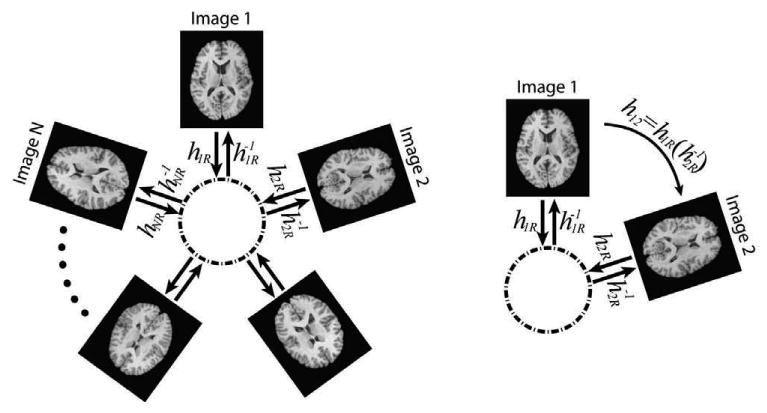
Figure 1
Figure 1
Implicit reference group-wise (IRG) registration method framework. Transformations hiR from each image to an implicit space are estimated; the transformation hij between every pair of images is obtained by concatenating transformations, hij(x)=hiR(hjR1(x)).
Figure 2
Figure 2
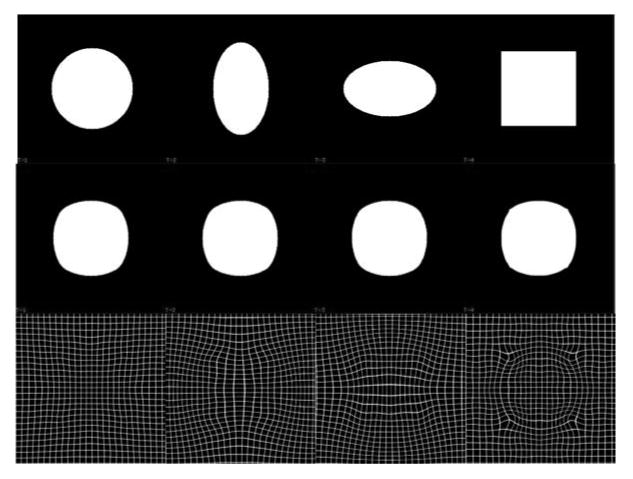
IRG registration of four 2D phantom shapes. The top row shows the original four shapes that were registered with the IRG method. The middle row shows the deformed images produced by applying the estimated transformation hiR to image i above it. The images in the middle row correspond to the implicit reference image. The bottom row shows the transformation hiR applied to a rectangular grid.
Figure 3
Figure 3
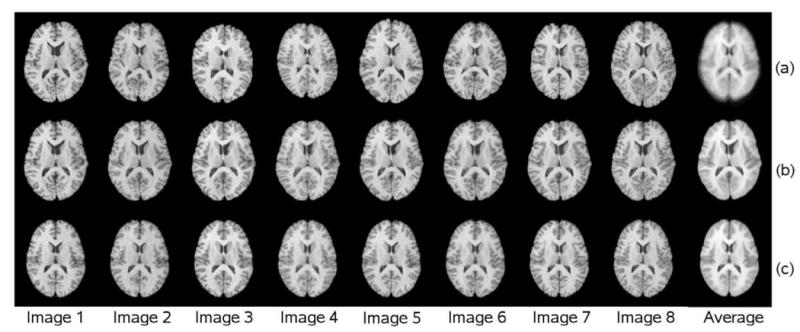
G2R and IRG registration results. Row (a) shows 8 of the 16 MRI images from the NA0 database after rigid G2R registration and the average intensity of the 16 images after rigid registration. Row (b) shows the corresponding 8 deformed images after PW-G2R registration using the first image as the reference and the average intensity computed from the 16 images in the coordinate space of image 1. Row (c) shows the corresponding 8 deformed images after IRG registration and the average of the 16 IRG registered images in the coordinate system of the implicit-reference space.
Figure 4
Figure 4
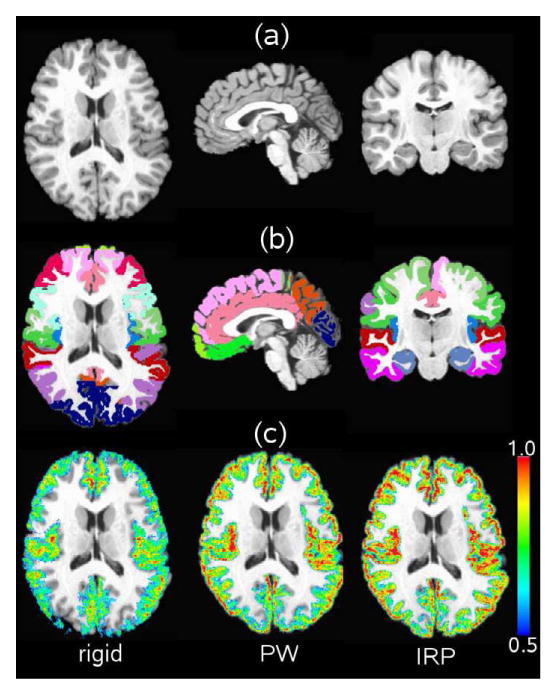
Region of Interest (ROI) overlap comparison between rigid, PW, and IRP registration. Panel (a) shows the T1-weighted MRI reference image; panel (b) shows the gray matter ROIs associated with the reference image; and panel (c) shows the overlap of the ROIs produced by mapping the other 15 MRI data sets to the reference image using rigid, PW, and IRP registration. The overlap of the the ROIs are show for a range of 0.5 to 1.0 where 0.5 corresponds to 50% agreement and 1.0 corresponds to 100% agreement.
Figure 5
Figure 5
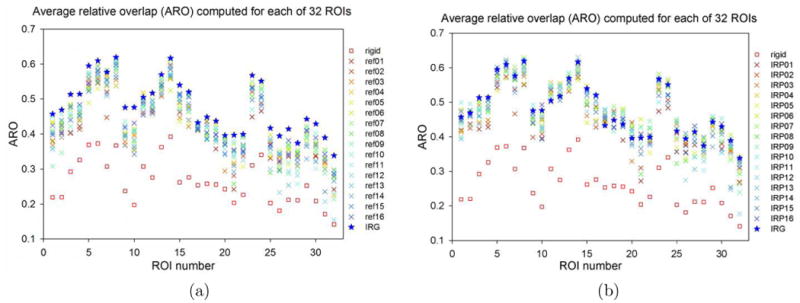
Comparison of (a) IRG to PW-G2R registration and (b) IRG to IRP-G2R registration methods by average relative overlap (ARO) for the 32 region of interests (ROIs) in the NIREP NA0 evaluation database. For each ROI, the square represents the ARO after rigid alignment, the star denotes the ARO using IRG registration, and the 16 “X”-shaped points denote to AROs using G2R registrations, where each color corresponds to a reference-based registration using one of the 16 images as the reference.
Figure 6
Figure 6
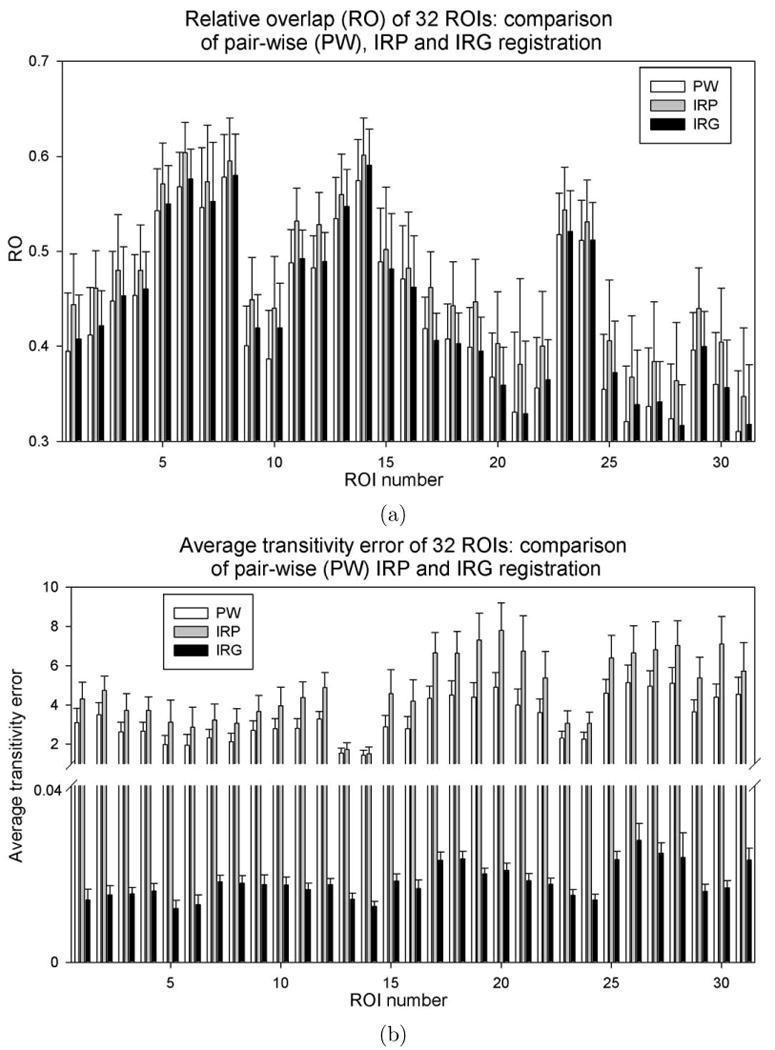
Comparison of pair-wise transformations produced by the PW, IRP, and IRG registration methods with respect to (a) relative overlap (RO) and (b) average transitivity error (ATE). Average and standard deviation of RO and ATE are plotted for each ROI corresponding to 16 × 15 pair-wise transformations in the population.
Figure 7
Figure 7
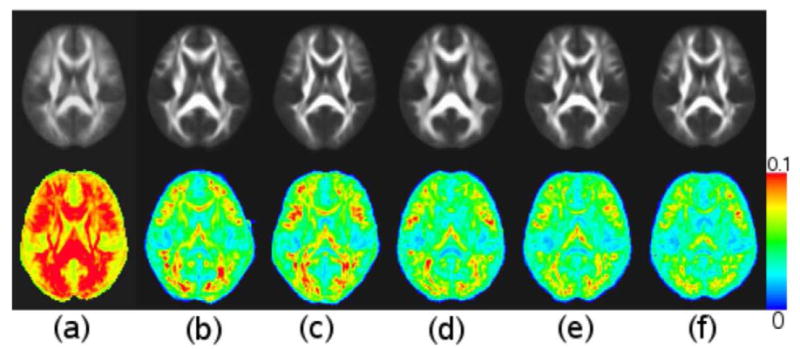
Comparison of average and standard deviation of deformed FA images after different registration methods. Top row includes average deformed FA images after (a) affine registration, (b) G2R registration using standard image as reference with B-spline free form deformation (FFD) model, (c) G2R registration using “most representative” image as reference with FFD model, (d) G2R registration using standard image as reference with small deformation elastic (SDE) model, (e) G2R registration using “most representative” image as reference with SDE model, and (f) IRG registration with SDE model. Bottom row contains standard deviation of FA images after registrations in the same order as in the top row.
Figure 8
Figure 8
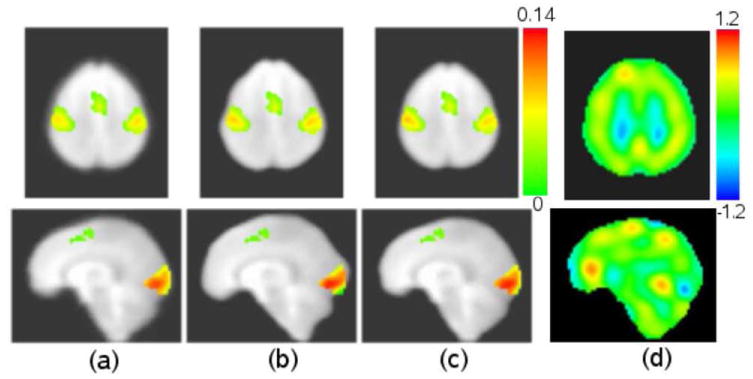
Functional activation maps with different registration methods: (a) affine alignment; (b) G2R registration with one of the group images as reference; (c) IRG registration; (d) log-Jacobian of a transformation from one image to the implicit reference. All activation maps are overlaid on the average of the deformed EPI data sets using IRG registration. (a), (b) and (c) are color coded by β values.
Figure 9
Figure 9
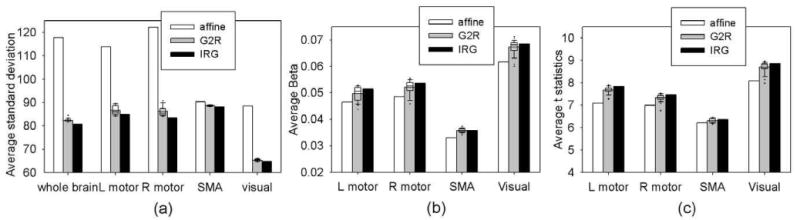
The average of (a) intensity standard deviation, (b) the β weights, and (c) t-statistics on different regions. In each panel, the first bar displays the measurement using affine alignment, the second bar shows the average measurements using 29 G2R registrations (with box plot on the top showing the median, the 5th, 25th, 75th, and 95th percentiles and outliers) and the third bar displays the measurement using IRG registration.

References

    1. Allen JS, Damasio H, Grabowski TJ. Normal neuroanatomical variation in the human brain: an MRI-volumetric study. Am J Phys Anthropol. 2002;118:341–58. - PubMed
    1. Allen JS, Damasio H, Grabowski TJ, Bruss J, Zhang W. Sexual dimorphism and asymmetries in the gray white composition of the human cerebrum. NeuroImage. 2003;18:880–894. - PubMed
    1. Avants B, Gee JC. Geodesic estimation for large deformation anatomical shape averaging and interpolation. NeuroImage. 2004;23:S139–S150. - PubMed
    1. Avants BB, Epstein CL, Grossman M, Gee JC. Symmetric diffeomorphic image registration with cross-correlation: Evaluating automated labeling of elderly and neurodegenerative brain. Medical Image Analysis. 2008;12(1):26–41. - PMC - PubMed
    1. Basser PJ, Pierpaoli C. Microstructural and physiological features of tissues elucidated by quantitative-diffusion-tensor MRI. Journal of Magnetic Resonance Series B. 1996;111:209–219. - PubMed

Publication types

MeSH terms