Surgical treatments for men with benign prostatic enlargement: cost effectiveness study
- PMID: 19372131
- PMCID: PMC2669854
- DOI: 10.1136/bmj.b1288
Surgical treatments for men with benign prostatic enlargement: cost effectiveness study
Abstract
Objective: To determine which surgical treatment for lower urinary tract symptoms suggestive of benign prostate enlargement is cost effective.
Design: Care pathways describing credible treatment strategies were decided by consensus. Cost-utility analysis used Markov modelling and Monte Carlo simulation.
Data sources: Clinical effectiveness data came from a systematic review and an individual level dataset. Utility values came from previous economic evaluations. Costs were calculated from National Health Service (NHS) and commercial sources.
Methods: The Markov model included parameters with associated measures of uncertainty describing health states between which individuals might move at three monthly intervals over 10 years. Successive annual cohorts of 25,000 men were entered into the model and the probability that treatment strategies were cost effective was assessed with Monte Carlo simulation with 10,000 iterations.
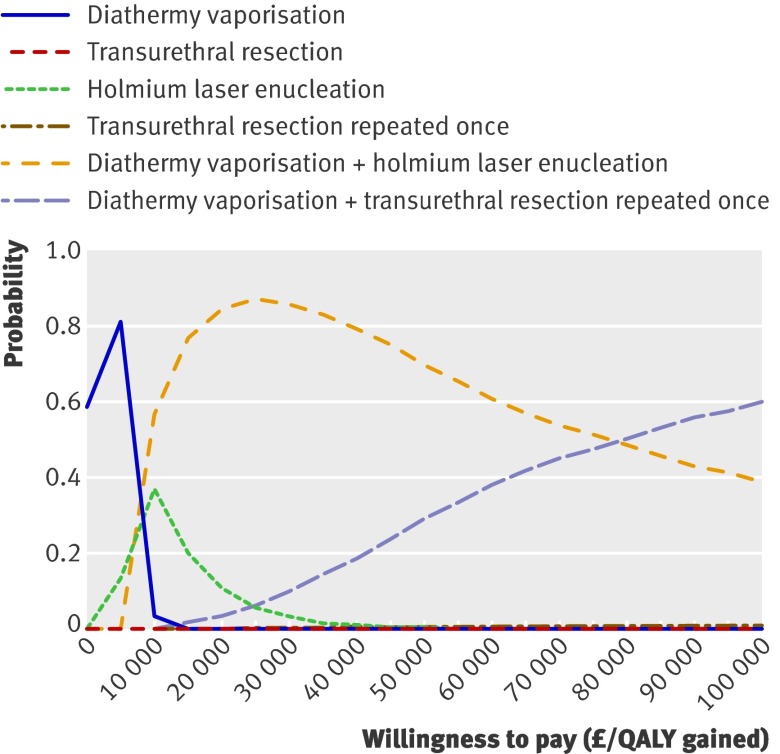
Results: A treatment strategy of initial diathermy vaporisation of the prostate followed by endoscopic holmium laser enucleation of the prostate in case of failure to benefit or subsequent relapse had an 85% probability of being cost effective at a willingness to pay value of pound20,000 (euro21,595, $28,686)/quality adjusted life year (QALY) gained. Other strategies with diathermy vaporisation as the initial treatment were generally cheaper and more effective than the current standard of transurethral resection repeated once if necessary. The use of potassium titanyl phosphate laser vaporisation incurred higher costs and was less effective than transurethral resection, and strategies involving initial minimally invasive treatment with microwave thermotherapy were not cost effective. Findings were unchanged by wide ranging sensitivity analyses.
Conclusion: The outcome of this economic model should be interpreted cautiously because of the limitations of the data used. The finding that initial vaporisation followed by holmium laser enucleation for failure or relapse might be advantageous both to men with lower urinary tract symptoms and to healthcare providers requires confirmation in a good quality prospective clinical trial before any change in current practice. Potassium titanyl phosphate laser vaporisation was unlikely to be cost effective in our model, which argues against its unrestricted use until further evidence of effectiveness and cost reduction is obtained.
Conflict of interest statement
Competing interests: None declared.
Figures
Comment in
-
Words of wisdom. Re: Surgical treatments for men with benign prostatic enlargement: cost effectiveness study.Eur Urol. 2009 Oct;56(4):741-2. doi: 10.1016/j.eururo.2009.07.009. Eur Urol. 2009. PMID: 19995523 No abstract available.
References
-
- Boyle P, Robertson C, Mazzetta C, Keech M, Hobbs FD, Fourcade R, et al. The prevalence of lower urinary tract symptoms in men and women in four centres. The UrEpik study. BJU Int 2003;92:409-14. - PubMed
-
- Emberton M, Andriole GL, De La Rosette J, Djavan B, Hoefner K, Vela NR, et al. Benign prostatic hyperplasia: a progressive disease of aging men. Urology 2003;61:267-73. - PubMed
-
- Mebust WK, Holtgrewe HL, Cockett AT, Peters PC. Transurethral prostatectomy: immediate and postoperative complications. A cooperative study of 13 participating institutions evaluating 3,885 patients. J Urol 1989;141:243-7. - PubMed
Publication types
MeSH terms
Grants and funding
LinkOut - more resources
Full Text Sources
Medical