


EGFR pathway polymorphisms and bladder cancer susceptibility and prognosis
- PMID: 19372140
- PMCID: PMC2704279
- DOI: 10.1093/carcin/bgp077
EGFR pathway polymorphisms and bladder cancer susceptibility and prognosis
Abstract
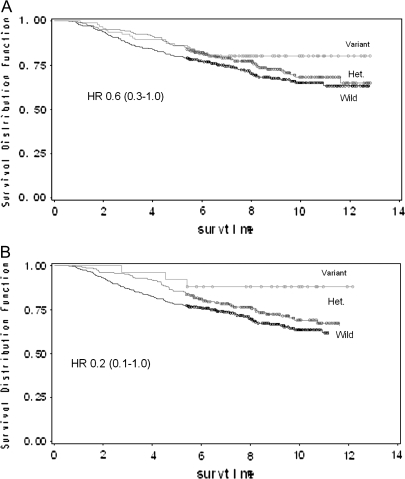
The epidermal growth factor receptor (EGFR) pathway has recently been appreciated as a central mediator of tumorigenesis and an important drug target; however, the influence of genetic variation in this pathway on bladder cancer is not understood. Pathway activation leads to cell proliferation, angiogenesis and is antiapoptotic. We sought to test the hypothesis that bladder cancer susceptibility and survival are modified by inherited variations in the sequence of the EGFR and its pathway members. We tested associations using a population-based study of 857 bladder cancer cases and 1191 controls from New Hampshire. Multifactor dimensionality reduction software was used to predict gene-gene interactions. We detected an increased risk of bladder cancer associated with variant genotypes for the single nucleotide polymorphisms EGFR_03 [adjusted odds ratio (OR) 1.7 (95% confidence interval (CI) 1.0-2.8)] and EGFR_05 [adjusted OR 1.5 (95% CI 1.0-2.1)] compared with wild-type. EGFR variants experienced longer survival than those with wild-type alleles [e.g. adjusted hazard ratio EGFR_1808 0.3 (95% CI 0.1-0.9)]. In contrast, the variant form of the ligand, EGF_04, had worse survival [adjusted hazard ratio 1.5 (95% CI 1.0-2.3)] compared with wild-type. Our findings suggest modified bladder cancer risk and survival associated with genetic variation in the EGFR pathway. Understanding these genetic influences on increased bladder cancer susceptibility and survival may help in cancer prevention, drug development and choice of therapeutic regimen.
Figures
References
-
- Kirkali Z, et al. Bladder cancer: epidemiology, staging and grading, and diagnosis. Urology. 2005;66:4–34. - PubMed
-
- Kantor AF, et al. Familial and environmental interactions in bladder cancer risk. Int. J. Cancer. 1985;35:703–706. - PubMed
-
- Jemal A, et al. Cancer statistics, 2007. CA Cancer J. Clin. 2007;57:43–66. - PubMed
-
- Kawakami T, et al. Inactivation of the hMSH3 mismatch repair gene in bladder cancer. Biochem. Biophys. Res. Commun. 2004;325:934–942. - PubMed
Publication types
MeSH terms
Substances
Grants and funding
- P42 ES007373/ES/NIEHS NIH HHS/United States
- CA 102327/CA/NCI NIH HHS/United States
- R03 CA121382/CA/NCI NIH HHS/United States
- P42 ES005947/ES/NIEHS NIH HHS/United States
- K07 CA102327/CA/NCI NIH HHS/United States
- R01 CA057494/CA/NCI NIH HHS/United States
- R03 CA 121382/CA/NCI NIH HHS/United States
- CA 099500/CA/NCI NIH HHS/United States
- CA 078609/CA/NCI NIH HHS/United States
- R03 CA099500/CA/NCI NIH HHS/United States
- R01 CA078609/CA/NCI NIH HHS/United States
- P42 ES 05947/ES/NIEHS NIH HHS/United States
- P42 ES 007373/ES/NIEHS NIH HHS/United States
- R01 CA 57494/CA/NCI NIH HHS/United States
LinkOut - more resources
Full Text Sources
Other Literature Sources
Medical
Research Materials
Miscellaneous
