


Serum resistin concentrations and risk of new onset heart failure in older persons: the health, aging, and body composition (Health ABC) study
- PMID: 19372460
- PMCID: PMC2757290
- DOI: 10.1161/ATVBAHA.109.186783
Serum resistin concentrations and risk of new onset heart failure in older persons: the health, aging, and body composition (Health ABC) study
Abstract
Objective: Resistin is associated with inflammation and insulin resistance and exerts direct effects on myocardial cells including hypertrophy and altered contraction. We investigated the association of serum resistin concentrations with risk for incident heart failure (HF) in humans.
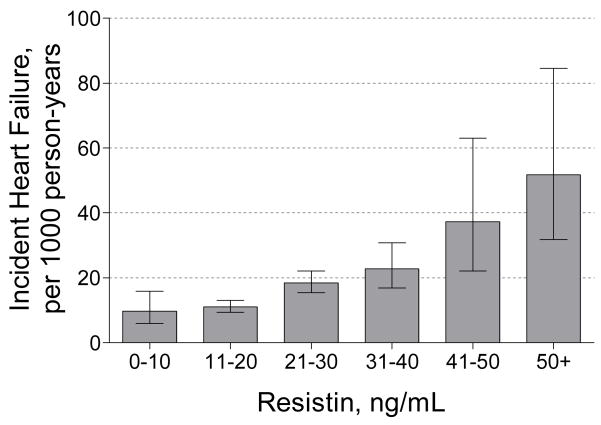
Methods and results: We studied 2902 older persons without prevalent HF (age, 73.6+/-2.9 years; 48.1% men; 58.8% white) enrolled in the Health, Aging, and Body Composition (Health ABC) Study. Correlation between baseline serum resistin concentrations (20.3+/-10.0 ng/mL) and clinical variables, biochemistry panel, markers of inflammation and insulin resistance, adipocytokines, and measures of adiposity was weak (all rho <0.25). During a median follow-up of 9.4 years, 341 participants (11.8%) developed HF. Resistin was strongly associated with risk for incident HF in Cox proportional hazards models controlling for clinical variables, biomarkers, and measures of adiposity (HR, 1.15 per 10.0 ng/mL in adjusted model; 95% CI, 1.05 to 1.27; P=0.003). Results were comparable across sex, race, diabetes mellitus, and prevalent and incident coronary heart disease subgroups. In participants with available left ventricular ejection fraction at HF diagnosis (265 of 341; 77.7%), association of resistin with HF risk was comparable for cases with reduced versus preserved ejection fraction.
Conclusions: Serum resistin concentrations are independently associated with risk for incident HF in older persons.
Conflict of interest statement
Conflict of interest: None
Figures
References
-
- Steppan CM, Bailey ST, Bhat S, Brown EJ, Banerjee RR, Wright CM, Patel HR, Ahima RS, Lazar MA. The hormone resistin links obesity to diabetes. Nature. 2001;409:307–312. - PubMed
-
- Jung HS, Park KH, Cho YM, Chung SS, Cho HJ, Cho SY, Kim SJ, Kim SY, Lee HK, Park KS. Resistin is secreted from macrophages in atheromas and promotes atherosclerosis. Cardiovasc Res. 2006;69:76–85. - PubMed
-
- Curat CA, Wegner V, Sengenes C, Miranville A, Tonus C, Busse R, Bouloumie A. Macrophages in human visceral adipose tissue: increased accumulation in obesity and a source of resistin and visfatin. Diabetologia. 2006;49:744–747. - PubMed
-
- Reilly MP, Lehrke M, Wolfe ML, Rohatgi A, Lazar MA, Rader DJ. Resistin is an inflammatory marker of atherosclerosis in humans. Circulation. 2005;111:932–939. - PubMed
-
- Weikert C, Westphal S, Berger K, Dierkes J, Mohlig M, Spranger J, Rimm EB, Willich SN, Boeing H, Pischon T. Plasma resistin levels and risk of myocardial infarction and ischemic stroke. J Clin Endocrinol Metab. 2008;93:2647–2653. - PubMed
Publication types
MeSH terms
Substances
Grants and funding
LinkOut - more resources
Full Text Sources
Medical
Research Materials
Miscellaneous
