


A prospective examination of distress tolerance and early smoking lapse in adult self-quitters
- PMID: 19372572
- PMCID: PMC2671465
- DOI: 10.1093/ntr/ntp041
A prospective examination of distress tolerance and early smoking lapse in adult self-quitters
Abstract
Introduction: A significant percentage of smokers attempting cessation lapse to smoking within a matter of days, and current models of relapse devote insufficient attention to such early smoking lapse. Studies attempting to relate severity of nicotine withdrawal symptoms to short-term smoking cessation outcomes have yielded equivocal results. How one reacts to the discomfort of nicotine withdrawal and quitting smoking (i.e., distress tolerance) may be a more promising avenue of investigation with important treatment implications.
Methods: The present investigation examined distress tolerance and early smoking lapse using a prospective design. Participants were 81 adult daily smokers recruited through newspaper advertisements targeted at smokers planning to quit smoking without assistance (i.e., no pharmacotherapy or psychosocial treatment; 42 males and 39 females; mean age = 42.6 years, SD = 12.20).
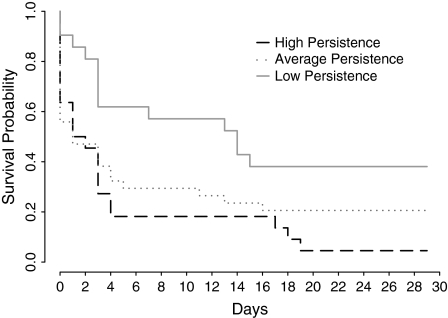
Results: As hypothesized, both greater breath-holding duration and carbon dioxide-enriched air persistence were associated with a significantly lower risk of smoking lapse following an unaided quit attempt. These effects were above and beyond the risk associated with levels of nicotine dependence, education, and history of major depressive disorder, suggesting that distress tolerance and task persistence may operate independently of risk factors such as nicotine dependence and depressive history. In contrast to expectation, persistence on the Paced Auditory Serial Addition Test (a psychological challenge task) was not a significant predictor of earlier smoking lapse.
Discussion: These results are discussed in relation to refining theoretical models of the role of distress tolerance in early smoking lapse and the utility of such models in the development of specialized treatment approaches for smoking cessation.
Figures
References
-
- Augustson E, Marcus S. Use of the current population survey to characterize subpopulations of continued smokers: A national perspective on the “hardcore” smoker phenomenon. Nicotine & Tobacco Research. 2004;6:621–629. - PubMed
-
- Baker TB, Brandon TH, Chassin L. Motivational influences on cigarette smoking. Annual Review of Psychology. 2004;55:463–491. - PubMed
-
- Baker TB, Piper ME, McCarthy DE, Majeskie MR, Fiore MC. Addiction motivation reformulated: An affective processing model of negative reinforcement. Psychological Review. 2004;111:33–51. - PubMed
-
- Brandon TH, Herzog TA, Juliano LM, Irvin JE, Lazev AB, Simmons VN. Pretreatment task persistence predicts smoking cessation outcome. Journal of Abnormal Psychology. 2003;112:448–456. - PubMed
-
- Brown RA. Comorbidity treatment: Skills training for coping with depression and negative moods. In: Abrams DB, Niaura RS, Brown RA, Emmons KM, Goldstein MG, Monti PM, editors. The tobacco dependence treatment handbook: A guide to best practices. New York: Guilford Press; 2003.
Publication types
MeSH terms
Grants and funding
LinkOut - more resources
Full Text Sources
Medical
Research Materials
