Inflammation, atherosclerosis, and arterial thrombosis: role of the scavenger receptor CD36
- PMID: 19376978
- PMCID: PMC2810530
- DOI: 10.3949/ccjm.76.s2.06
Inflammation, atherosclerosis, and arterial thrombosis: role of the scavenger receptor CD36
Abstract
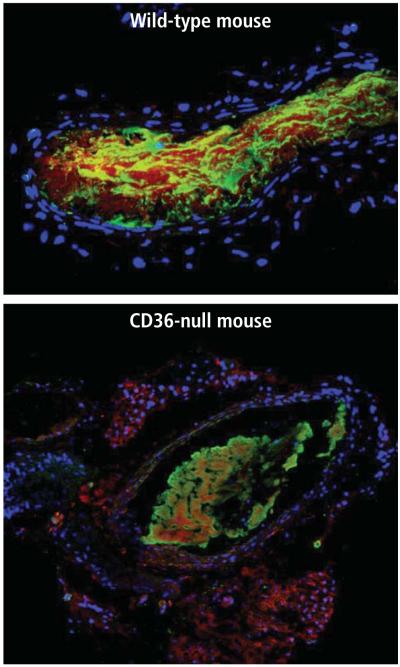
The CD36 scavenger receptor recognizes oxidized low-density lipoprotein (LDL) and cell-derived microparticles. It is expressed on macrophages and platelets and is a mediator of both atherogenesis and thrombosis. Macrophages from CD36-null mice have a defect in foam cell formation in response to exposure to oxidized LDL, and CD36-null mice fed an atherogenic Western diet have significantly less atherosclerosis than their wild-type counterparts. On platelets, CD36 recognition of oxidized LDL contributes to their activation and provides a mechanistic link between hyperlipidemia, oxidant stress, and the prothrombotic state. Cell-derived microparticles are also major ligands for CD36 and contribute to thrombus formation in a CD36-dependent manner even in the absence of hyperlipidemia. CD36 deficiency in mice is associated with inhibition of thrombus formation and with a reduction in microparticle accumulation in thrombi. Targeting CD36 is a promising avenue for the treatment of atheroinflammatory disorders.
Figures
References
-
- Tontonoz P, Nagy L, Alvarez JG, Thomazy VA, Evans RM. PPAR-gamma promotes monocyte/macrophage differentiation and uptake of oxidized LDL. Cell. 1998;93:241–252. - PubMed
-
- Steinberg D, Lewis A. Conner Memorial Lecture. Oxidative modification of LDL and atherogenesis. Circulation. 1997;95:1062–1071. - PubMed
-
- Silverstein RL, Febbraio M. CD36 and atherosclerosis. Curr Opin Lipidol. 2000;11:483–491. - PubMed
-
- Krieger M. The other side of scavenger receptors: pattern recognition for host defense. Curr Opin Lipidol. 1997;8:275–280. - PubMed
Publication types
MeSH terms
Substances
Grants and funding
LinkOut - more resources
Full Text Sources
Medical