Gene expression profiling reveals differences in microenvironment interaction between patients with chronic lymphocytic leukemia expressing high versus low ZAP70 mRNA
- PMID: 19377082
- PMCID: PMC2688570
- DOI: 10.3324/haematol.2008.002626
Gene expression profiling reveals differences in microenvironment interaction between patients with chronic lymphocytic leukemia expressing high versus low ZAP70 mRNA
Abstract
Background: Zeta-associated protein 70 (ZAP70) is a widely recognized prognostic factor in chronic lymphocytic leukemia, but mechanisms by which its higher expression leads to a poor outcome must still be fully explained.
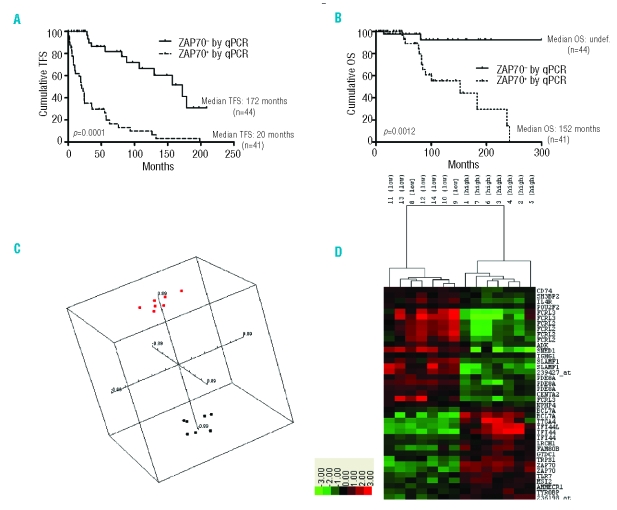
Design and methods: In an attempt to unveil unfavorable cellular properties linked to high ZAP70 expression, we used gene expression profiling to identify genes associated with disparities in B cells from chronic lymphocytic leukemia patients expressing high versus low ZAP70 mRNA, measured by quantitative real-time PCR. Two groups of 7 patients were compared, selected on the basis of either high or low ZAP70 mRNA expression.
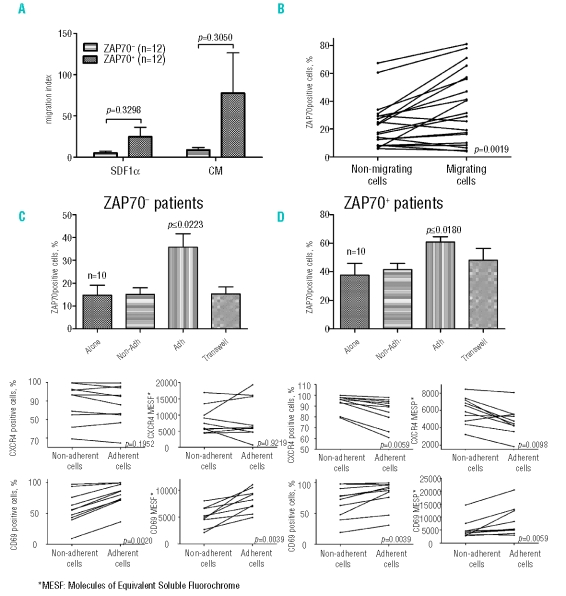
Results: Twenty-seven genes were differentially expressed with an FDR<10%, and several genes were significant predictors of treatment-free survival (TFS) and/or overall survival; PDE8A and FCRL family genes (down-regulated in ZAP70(+) patients) could predict TFS and overall survival; ITGA4 mRNA (up-regulated in ZAP70(+) patients) could significantly predict overall survival. Importantly, gene set enrichment analysis revealed overrepresentation of adhesion/migration genes. We therefore investigated in vitro adhesion/migration capacity of chronic lymphocytic leukemia cells into a stromal microenvironment or in response to conditioned medium. We showed that ZAP70(+) cells had better adhesion/migration capacities and only ZAP70(+) patient cells responded to microenvironment contact by CXCR4 downregulation.
Conclusions: We concluded that several prognostic factors are the reflection of microenvironment interactions and that the increased adhesion/migratory capacity of ZAP70(+) cells in their microenvironment can explain their better survival and thus the aggressiveness of the disease.
Figures
Comment in
-
Chronic lymphocytic leukemia microenvironment: shifting the balance from apoptosis to proliferation.Haematologica. 2009 Jun;94(6):752-6. doi: 10.3324/haematol.2009.006676. Haematologica. 2009. PMID: 19483151 Free PMC article. No abstract available.
References
-
- Wiestner A, Rosenwald A, Barry TS, Wright G, Davis RE, Henrickson SE, et al. ZAP-70 expression identifies a chronic lymphocytic leukemia subtype with unmutated immunoglobulin genes, inferior clinical outcome, and distinct gene expression profile. Blood. 2003;101:4944–51. - PubMed
-
- Bilban M, Heintel D, Scharl T, Woelfel T, Auer MM, Porpaczy E, et al. Deregulated expression of fat and muscle genes in B-cell chronic lymphocytic leukemia with high lipoprotein lipase expression. Leukemia. 2006;20:1080–8. - PubMed
-
- Damle RN, Wasil T, Fais F, Ghiotto F, Valetto A, Allen SL, et al. Ig V gene mutation status and CD38 expression as novel prognostic indicators in chronic lymphocytic leukemia. Blood. 1999;94:1840–7. - PubMed
-
- Calin GA, Ferracin M, Cimmino A, Di Leva G, Shimizu M, Wojcik SE, et al. A MicroRNA signature associated with prognosis and progression in chronic lymphocytic leukemia. N Engl J Med. 2005;353:1793–801. - PubMed
-
- Dohner H, Stilgenbauer S, Benner A, Leupolt E, Krober A, Bullinger L, et al. Genomic aberrations and survival in chronic lymphocytic leukemia. N Engl J Med. 2000;343:1910–6. - PubMed
Publication types
MeSH terms
Substances
LinkOut - more resources
Full Text Sources
Other Literature Sources
Molecular Biology Databases
Research Materials