. 2009 Jul 1;18(13):2443-51.
doi: 10.1093/hmg/ddp182. Epub 2009 Apr 18.

Ectopic expression of CGG containing mRNA is neurotoxic in mammals

Affiliations

Ectopic expression of CGG containing mRNA is neurotoxic in mammals

Vera Hashem et al. Hum Mol Genet. .

Abstract

Fragile X-associated Tremor/Ataxia Syndrome (FXTAS) is a progressive neurodegenerative disorder that has been diagnosed in a substantial fraction of older male fragile X premutation carriers. Patients affected by FXTAS have elevated levels of ribo-rCGG repeat containing FMR1 mRNA with normal to slightly reduced levels of FMRP in blood leukocytes. Coupled with the absence of FXTAS in fragile X syndrome patients, this suggests premutation-sized elongated rCGG repeats in the FMR1 transcript rather than alterations in the levels of FMRP are responsible for the FXTAS pathology. Mice expressing rCGG in the context of Fmr1 or the enhanced green fluorescent protein specifically in Purkinje neurons were generated to segregate the effects of rCGG from alterations in Fmr1 and to provide evidence that rCGG is necessary and sufficient to cause pathology similar to human FXTAS. The models exhibit the presence of intranuclear inclusions in Purkinje neurons, Purkinje neuron cell death and behavioral deficits. These results demonstrate that rCGG expressed in Purkinje neurons outside the context of Fmr1 mRNA can result in neuronal pathology in a mammalian system and demonstrate that expanded CGG repeats in RNA are the likely cause of the neurodegeneration in FXTAS.


Figures

Figure 1.
Figure 1.
Schematic representation of L7-(CGG)90 and L7 constructs. The transgenes were driven by and Purkinje cells specific, L7 promoter. A human genomic FMR1 DNA fragment containing 90 CGG repeats was inserted upstream of the Fmr1 or EGFP coding region between the transcriptional and translational start sites. The Fmr1 containing transgenes have a FLAG epitope engineered into the 5′ of the gene. A BGH polyadenylation site was inserted 3′ of the transgenes.
Figure 2.
Figure 2.
Expression of Fmr1 and EGFP transgenes. RT–PCR was performed using primers specific for Fmr1 and EGFP. RNA was isolated from mouse cerebellum of all listed genotypes. RT–PCR of GAPDH was also performed to as a control for RNA quality.
Figure 3.
Figure 3.
Staining for inclusion content. Immunohistochemistry demonstrates cerebellar Purkinje neuron inclusions stain with antibodies against (A) ubiquitin, (B) 20S subunit of the proteasome, (C) Hsp40 and (D) Rad23B in the line expressing the L7CGG90EGFP constructs as well as all L7CGG90Fmr1 (data not shown) lines.
Figure 4.
Figure 4.
Immunohistochemistry demonstrates rCGG repeat is necessary and sufficient to cause the formation of intranuclear inclusions. (A)L7Fmr1, (B) L7CGG90Fmr1, (C) L7EGFP and (D) L7CGG90EGFP.
Figure 5.
Figure 5.
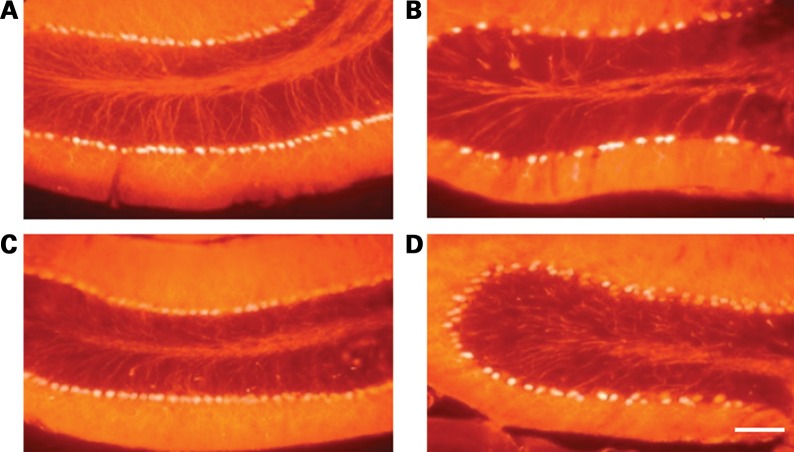
Purkinje cells stained with anti-calbindin Ab in sagittal cerebellum sections of 32-week-old mice. (A) L7Fmr1, (B) L7CGG90Fmr1, (C) L7EGFP and (D) L7CGG90EGFP. There was significant cell loss for L7CGG90Fmr1 mice compared with L7Fmr1 (P < 0.001). L7GCC90EGFP mice also show greater cell loss when compared with L7EGFP mice (P = 0.001).
Figure 6.
Figure 6.
Purkinje cell axonal swellings indicate ongoing cell damage in living cells. (A) L7CGG90Fmr1 and (B) L7CGG90EGFP.
Figure 7.
Figure 7.
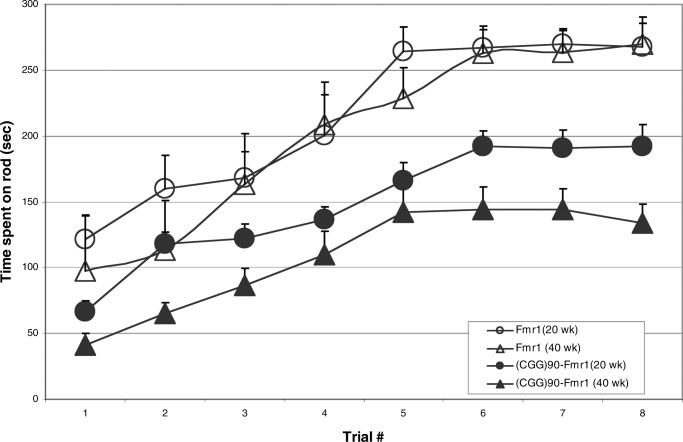
Age-dependent decline in motor learning on the accelerating Rotarod. L7Fmr1 20-week-old mice (open circle) and L7Fmr1 40-week-old mice (open triangle) do not show an age-related phenotype on the accelerating rod. L7CGG90Fmr1 20-week-old mice (closed circle) perform worse than L7CGG90Fmr1 40-week-old mice (closed triangle). The effect of age X genotype for the L7CGG90Fmr1 mice was significant (P = 0.005), whereas L7Fmr1 was not (P > 0.05).

References

    1. Grigsby J., Brega A.G., Jacquemont S., Loesch D.Z., Leehey M.A., Goodrich G.K., Hagerman R.J., Epstein J., Wilson R., Cogswell J.B., et al. Impairment in the cognitive functioning of men with fragile X-associated tremor/ataxia syndrome (FXTAS) J. Neurol. Sci. 2006;248:227–233. - PubMed
    1. Jacquemont S., Hagerman R.J., Leehey M., Grigsby J., Zhang L., Brunberg J.A., Greco C., Des Portes V., Jardini T., Levine R., et al. Fragile X premutation tremor/ataxia syndrome: molecular, clinical, and neuroimaging correlates. Am. J. Hum. Genet. 2003;72:869–878. - PMC - PubMed
    1. Brunberg J.A., Jacquemont S., Hagerman R.J., Berry-Kravis E.M., Grigsby J., Leehey M.A., Tassone F., Brown W.T., Greco C.M., Hagerman P.J. Fragile X premutation carriers: characteristic MR imaging findings of adult male patients with progressive cerebellar and cognitive dysfunction. Am. J. Neuroradiol. 2002;23:1757–1766. - PMC - PubMed
    1. Jacquemont S., Farzin F., Hall D., Leehey M., Tassone F., Gane L., Zhang L., Grigsby J., Jardini T., Lewin F., et al. Aging in individuals with the FMR1 mutation. Am. J. Ment. Retard. 2004;109:154–164. - PMC - PubMed
    1. Greco C.M., Berman R.F., Martin R.M., Tassone F., Schwartz P.H., Chang A., Trapp B.D., Iwahashi C., Brunberg J., Grigsby J., et al. Neuropathology of fragile X-associated tremor/ataxia syndrome (FXTAS) Brain. 2006;129:243–255. - PubMed

Publication types

MeSH terms

Substances