. 2009 May;27(5):465-71.
doi: 10.1038/nbt.1536. Epub 2009 Apr 19.

Diversity-based, model-guided construction of synthetic gene networks with predicted functions

Affiliations

Diversity-based, model-guided construction of synthetic gene networks with predicted functions

Tom Ellis et al. Nat Biotechnol. 2009 May.

Abstract

Engineering artificial gene networks from modular components is a major goal of synthetic biology. However, the construction of gene networks with predictable functions remains hampered by a lack of suitable components and the fact that assembled networks often require extensive, iterative retrofitting to work as intended. Here we present an approach that couples libraries of diversified components (synthesized with randomized nonessential sequence) with in silico modeling to guide predictable gene network construction without the need for post hoc tweaking. We demonstrate our approach in Saccharomyces cerevisiae by synthesizing regulatory promoter libraries and using them to construct feed-forward loop networks with different predicted input-output characteristics. We then expand our method to produce a synthetic gene network acting as a predictable timer, modifiable by component choice. We use this network to control the timing of yeast sedimentation, illustrating how the plug-and-play nature of our design can be readily applied to biotechnology.


Figures
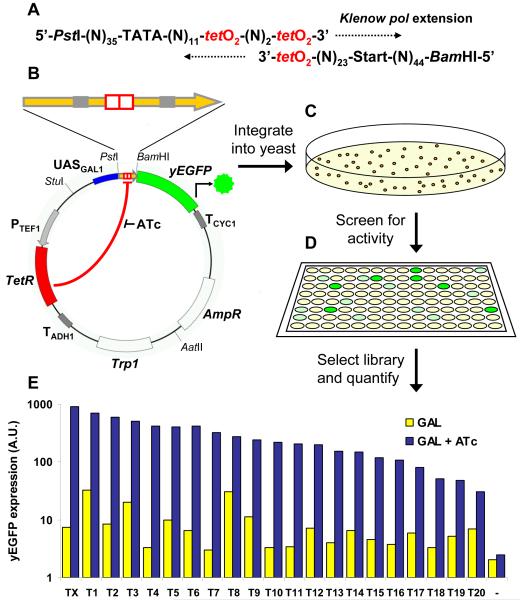
Figure 1
Figure 1. Regulatory promoter library synthesis, screening and characterization
Schematic design for TetR-regulated promoter synthesis. (A) Promoters are constructed by Klenow pol extension from two overlapping 110mer oligonucleotides synthesized with unspecified nucleotides (N) between defined motifs. (B) Promoters are ligated between the GAL1 upstream activation signal (UASGAL1) and the yEGFP coding sequence in the characterization vector, which also expresses TetR from the TEF1 promoter (PTEF1). (C) Transformation of yeast yields thousands of colonies with the genome-integrated vector. (D) Individual colonies are screened in 96-well format by measuring fluorescence in induction conditions after 22 hours growth (media supplemented with 2% galactose + 250 ng/ml ATc). (E) A library of 20 regulated promoters covering a range of expression levels is selected from screening data and quantitatively characterized using flow cytometry measurement of yEGFP expression after 22 hours growth in media supplemented with 2% galactose (GAL) and with 250 ng/ml ATc (GAL + ATc). TX = control promoter, T1-T20 = library promoters, and - = null promoter.
Figure 2
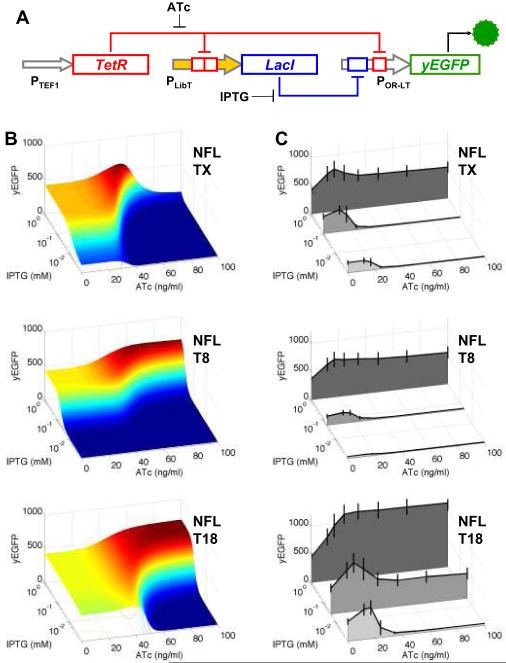
Figure 2. Modeling and synthesis of feedforward loop networks using a promoter library
TetR-regulated promoter library data were used in conjunction with in silico modeling to construct negative feedforward loop (NFL) gene networks with different predicted input-output functions. (A) Schematic of the network, where PTEF1 = TEF1 promoter, PLibT = TetR-regulated promoter library, and POR-LT = LacI-TetR dual-regulated promoter. (B) In silico modeling of the network from component properties predicts yEGFP expression (output) in response to varied concentrations of ATc and IPTG (inputs) when three different TetR-regulated promoters are used. (C) The three networks were assembled in S. cerevisiae, and median yEGFP expression was measured by flow cytometry after 22 hours growth of cells in media supplemented with 2% galactose plus varying concentrations of ATc and IPTG. Error bars show the standard deviation of the gated cell population.
Figure 3
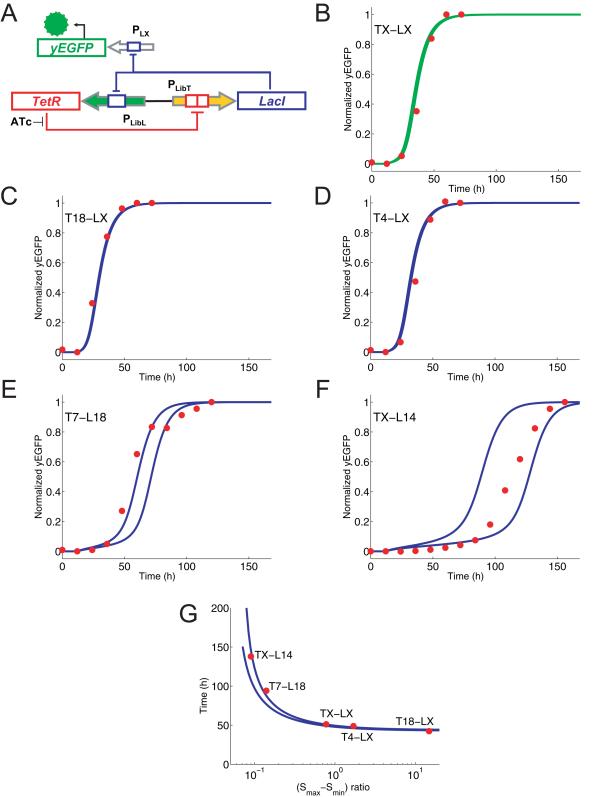
Figure 3. Predictable genetic timer networks constructed from two promoter libraries
TetR- and LacI-regulated promoter libraries were used to construct a mutually-repressive gene network that acts as a predictable timer. (A) Schematic of the timer network; PLibL = LacI-regulated promoter library, PLX = LacI-regulated control promoter, and PLibT = TetR-regulated promoter library. (B) In silico model of the network fitted to TX-LX experimental data (Supplementary Fig. 4) shows yEGFP expression changing over time after ATc induction is removed at time 0. Yeast cells with the TX-LX network genomically-integrated were grown for 36 hours with 250 ng/ml ATc to induce the network, washed three times and monitored starting from time 0 until the expression state reset to a maximum. Normalized yEGFP output (red circles), which was calculated from flow cytometry measurements taken every 12 hours, matches the model output (green lines) well. Both upper and lower bound of model fittings are plotted (details in Supplementary Information). (C,D,E,F) Median yEGFP expression (red circles) was measured by flow cytometry every 12 hours for four different promoter combinations (T18-LX, T4-LX, T7-L18 and TX-L14). Cultures were induced and treated the same as in (B). Blue lines are model predictions based on parameters inferred from (B). Lower and upper bounds use the parameters corresponding to lower and upper bounds in (B). (G) The relationship between the reset time and the ratio for all of its values is plotted. Lower and upper bounds use the parameters corresponding to lower and upper bounds in (B). The reset time can be approximated as T = C1 + C2/√(|r-C3|), where T = reset time, C1 = basal reset time, C2 = scale factor and C3 = bifurcation ratio (details in Supplementary Information).
Figure 4
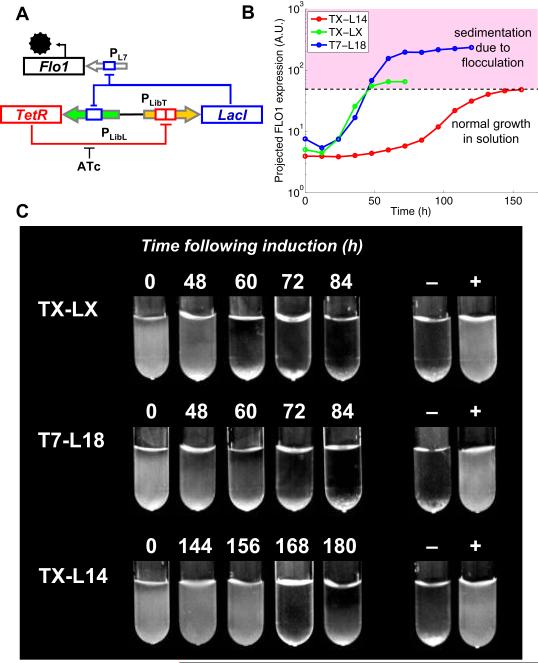
Figure 4. Controlling the timing of yeast sedimentation using a predictable gene network
The synthetic networks tested in Figure 3B,E,F were used to control the timing of yeast sedimentation caused by flocculation. (A) Schematic of flocculation gene networks. Flocculation is regulated by replacing yEGFP and PLX in the gene network shown in Figure 3A with FLO1 under the control of the L7 promoter (PL7). (B) Rescaled yEGFP data from Figure 3B,E,F were used to project temporal FLO1 expression levels and predict the timing of cell sedimentation due to flocculation (details in Supplementary Information). (C) The timing of sedimentation from the three synthetic networks. Cultures induced by growth with 250 ng/ml ATc for 36 hours were washed twice and grown at high OD600 with shaking and diluted into fresh media every 12 hours, until sedimentation cleared the suspension. Images shown here are 1ml cultures at 12 hour intervals, 10 minutes after brief vortexing. Controls: - = growth in 10 mM IPTG, + = growth in 250 ng/ml ATc.

Comment in

  • Overpowering the component problem.
    Bennett MR, Hasty J. Bennett MR, et al. Nat Biotechnol. 2009 May;27(5):450-1. doi: 10.1038/nbt0509-450. Nat Biotechnol. 2009. PMID: 19430449 Free PMC article. No abstract available.

References

    1. Andrianantoandro E, Basu S, Karig DK, Weiss R. Synthetic biology: new engineering rules for an emerging discipline. Mol Syst Biol. 2006;2 2006 0028. - PMC - PubMed
    1. Withers ST, Keasling JD. Biosynthesis and engineering of isoprenoid small molecules. Appl Microbiol Biotechnol. 2007;73:980–990. - PubMed
    1. Weber W, et al. A synthetic mammalian gene circuit reveals antituberculosis compounds. Proc Natl Acad Sci U S A. 2008;105:9994–9998. - PMC - PubMed
    1. Basu S, Gerchman Y, Collins CH, Arnold FH, Weiss R. A synthetic multicellular system for programmed pattern formation. Nature. 2005;434:1130–1134. - PubMed
    1. Lu TK, Collins JJ. Dispersing biofilms with engineered enzymatic bacteriophage. Proc Natl Acad Sci U S A. 2007;104:11197–11202. - PMC - PubMed

Publication types

LinkOut - more resources