. 2009;60(7):2191-202.
doi: 10.1093/jxb/erp097. Epub 2009 Apr 20.

Light-induced vegetative anthocyanin pigmentation in Petunia

Affiliations

Light-induced vegetative anthocyanin pigmentation in Petunia

Nick W Albert et al. J Exp Bot. 2009.

Abstract

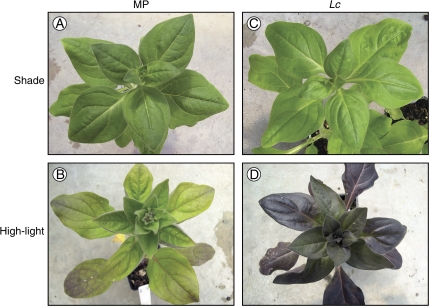
The Lc petunia system, which displays enhanced, light-induced vegetative pigmentation, was used to investigate how high light affects anthocyanin biosynthesis, and to assess the effects of anthocyanin pigmentation upon photosynthesis. Lc petunia plants displayed intense purple anthocyanin pigmentation throughout the leaves and stems when grown under high-light conditions, yet remain acyanic when grown under shade conditions. The coloured phenotypes matched with an accumulation of anthocyanins and flavonols, as well as the activation of the early and late flavonoid biosynthetic genes required for flavonol and anthocyanin production. Pigmentation in Lc petunia only occurred under conditions which normally induce a modest amount of anthocyanin to accumulate in wild-type Mitchell petunia [Petunia axillaris x (Petunia axillaris x Petunia hybrida cv. 'Rose of Heaven')]. Anthocyanin pigmentation in Lc petunia leaves appears to screen underlying photosynthetic tissues, increasing light saturation and light compensation points, without reducing the maximal photosynthetic assimilation rate (A(max)). In the Lc petunia system, where the bHLH factor Leaf colour is constitutively expressed, expression of the bHLH (Lc) and WD40 (An11) components of the anthocyanin regulatory system were not limited, suggesting that the high-light-induced anthocyanin pigmentation is regulated by endogenous MYB transcription factors.


Figures
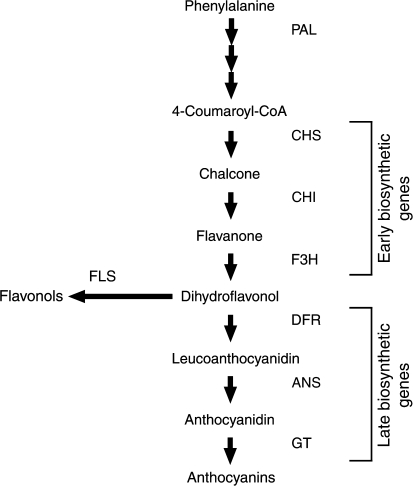
Fig. 1.
Fig. 1.
A stylized diagram of the flavonoid biosynthetic pathway. CHS is the first committed step towards flavonoid production, leading to the production of the major flavonoids, flavonols, and anthocyanins. Abbreviations: PAL, phenylalanine ammonia lyase; CHS, chalcone synthase; CHI, chalcone isomerase; F3H, flavanone 3-hydroxylase; FLS, flavonol synthase; DFR, dihydroflavonol 4-reductase; ANS, anthocyanidin synthase; GT, glycosyltransferases.
Fig. 2.
Fig. 2.
Wild-type Mitchell and Lc petunia grown under shade and high-light treatments, showing vegetative pigmentation phenotypes. (A, C) Mitchell and Lc petunia grown under shade conditions (50–350 μmol m−2 s−1). (B, D) Mitchell and Lc petunia grown under high-light conditions (750 μmol m−2 s−1). The individual plants shown are representative of the five plants grown per treatment.
Fig. 3.
Fig. 3.
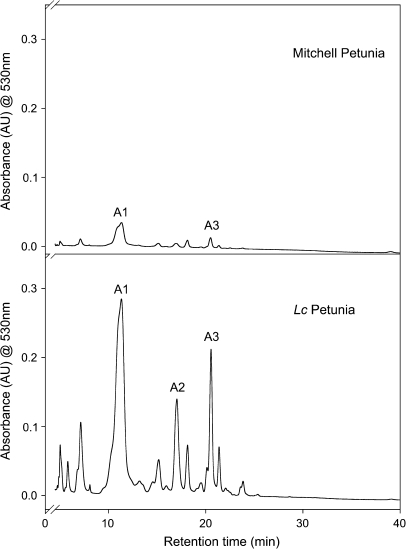
HPLC chromatograms for leaf extracts from Mitchell and Lc petunia grown under high light. The absorbance was monitored at 530 nm to detect anthocyanins. The major anthocyanin peaks are indicated. The major anthocyanin peaks are petunidin-3-rutinoside-5-glucoside acylated with p-coumaric acid (A1), caffeic acid (A2), or 4-O-glucosyl-p-coumaric acid (A3).
Fig. 4.
Fig. 4.
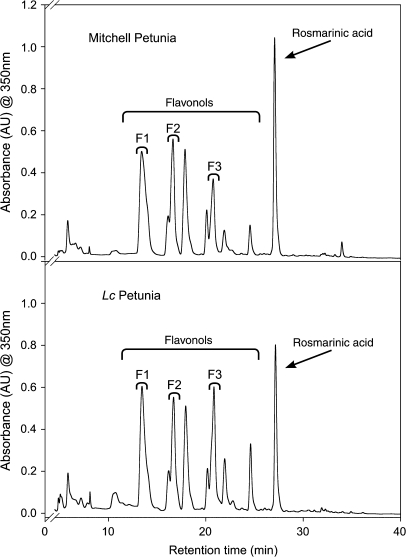
HPLC chromatograms for leaf extracts from Mitchell and Lc petunia grown under high light. Absorbance was monitored at 350 nm. The major flavonoids, the flavonols, and a non-flavonoid compound, rosmarinic acid, are indicated. F1, quercetin-3-O-(caffeoyl diglucoside); F2, quercetin-3-O-(2-O-caffeoyl 6-O-malonyl diglucoside); F3, kaempferol 3-O-(feruloyl diglucoside).
Fig. 5.
Fig. 5.
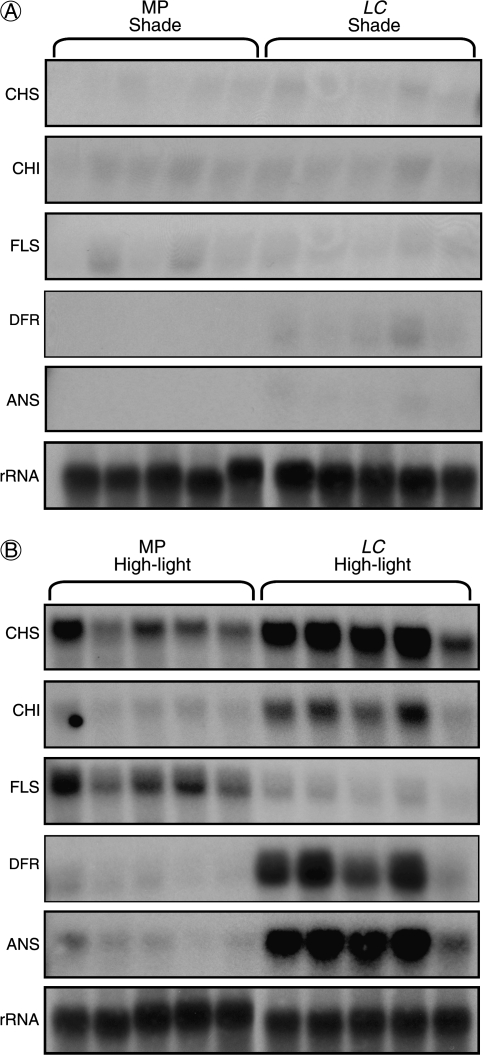
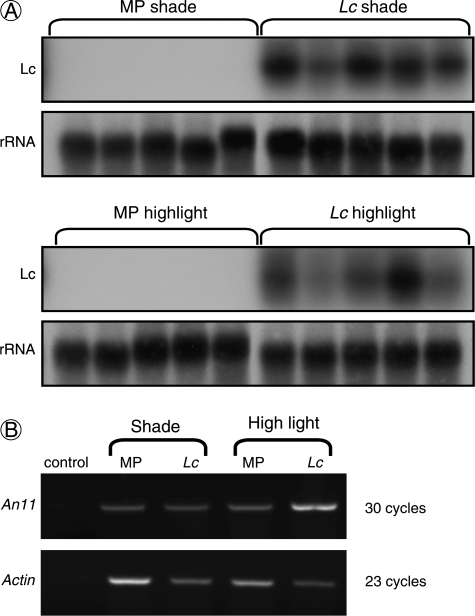
Northern blot analysis of flavonoid structural gene expression in Mitchell (MP) and Lc petunia plants under (A) shade or (B) high-light treatments. Each lane represents a different individual plant within each treatment. 25/26S rRNA is shown as a loading control.
Fig. 6.
Fig. 6.
Transcript abundance for anthocyanin regulation components. (A) Northern blot showing Leaf colour transcript abundance in Lc and Mitchell petunia (MP) grown under shade or high-light treatments. 25/26S rRNA is shown as a loading control. (B) Semi-quantitative RT-PCR of An11 transcripts in shade and high-light-grown Mitchell and Lc petunia leaves. Actin was amplified as a cDNA loading control. PCR cycles are indicated.
Fig. 7.
Fig. 7.
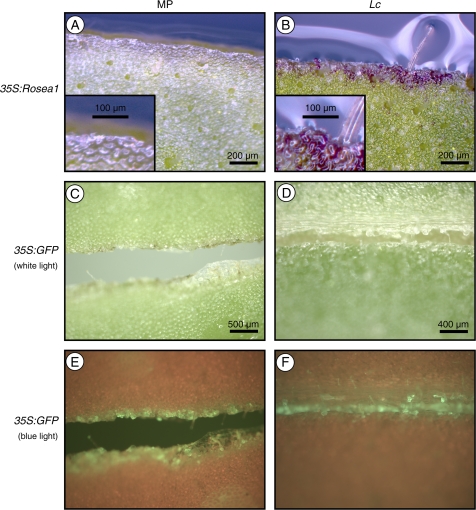
Light complementation experiments, utilizing Agrobacterium-mediated transformation of Mitchell (MP) and Lc petunia leaves. (A, B) MP and Lc leaf explants, respectively, transformed with CaMV35S:Rosea1. Inset images in (A) and (B) show higher magnification of cells at the cut surface of the leaves. MP and Lc leaf explants transformed with CaMV35S:GFP, viewed under white light (C, D) and blue light (E, F), respectively.

References

    1. Aida R, Yoshida K, Kondo T, Kishimoto S, Shibata M. Copigmentation gives bluer flowers on transgenic torenia plants with the antisense dihydroflavonol-4-reductase gene. Plant Science. 2000;160:49–56. - PubMed
    1. Ausubel FM, Bahnsen K, Hanson M, Mitchell A, Smith HJ. Cell and tissue culture of haploid and diploid Petunia ‘Mitchell’. Plant Molecular Biology Newsletter. 1980;1:26–32.
    1. Bloor SJ, Bradley JM, Lewis DH, Davies KM. Identification of flavonol and anthocyanin metabolites in leaves of Petunia ‘Mitchell’ and its Lc transgenic. Phytochemistry. 1998;49:1427–1430.
    1. Boase MR, Bradley JM, Borst NK. Genetic transformation mediated by Agrobacterium tumefaciens of florists’ chrysanthemum (Dendranthema grandiflorum) cultivar ‘Peach Margaret’. In Vitro Cellular and Developmental Biology-Plant. 1998;34:46–51.

    1. Bovy A, de Vos R, Kemper M, et al. High-flavonol tomatoes resulting from the heterologous expression of the maize transcription factor genes LC and C1. The Plant Cell. 2002;14:2509–2526. - PMC - PubMed

Publication types