. 2009;4(4):e5228.
doi: 10.1371/journal.pone.0005228. Epub 2009 Apr 21.

In vitro recombination catalyzed by bacterial class 1 integron integrase IntI1 involves cooperative binding and specific oligomeric intermediates

Affiliations

In vitro recombination catalyzed by bacterial class 1 integron integrase IntI1 involves cooperative binding and specific oligomeric intermediates

Véronique Dubois et al. PLoS One. 2009.

Abstract

Gene transfer via bacterial integrons is a major pathway for facilitating the spread of antibiotic resistance genes across bacteria. Recently the mechanism underlying the recombination catalyzed by class 1 integron recombinase (IntI1) between attC and attI1 was highlighted demonstrating the involvement of a single-stranded intermediary on the attC site. However, the process allowing the generation of this single-stranded substrate has not been determined, nor have the active IntI1*DNA complexes been identified. Using the in vitro strand transfer assay and a crosslink strategy we previously described we demonstrated that the single-stranded attC sequences could be generated in the absence of other bacterial proteins in addition to IntI. This suggests a possible role for this protein in stabilizing and/or generating this structure. The mechanism of folding of the active IntI*DNA complexes was further analyzed and we show here that it involves a cooperative binding of the protein to each recombination site and the emergence of different oligomeric species specific for each DNA substrate. These findings provide further insight into the recombination reaction catalyzed by IntI1.


Conflict of interest statement

Competing Interests: The authors have declared that no competing interests exist.

Figures

Figure 1
Figure 1
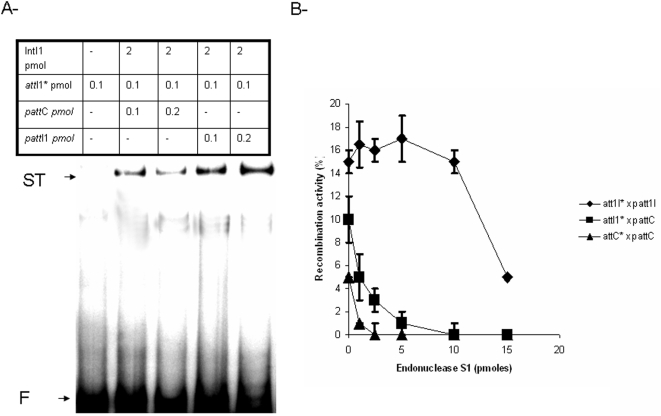
A- In vitro strand transfer catalyzed by IntI1 at attI1 and attC sites. Reactions were performed for 90 min in the presence of purified IntI1 (2 pmoles), 0.1 to 0.2 pmoles of either pGEM-T-attI1 or pGEM-T-attC (pattI1 and pattC in the figure) and 0.1 pmoles free 5′ 32P radiolabeled attI1 sites under the standard conditions described in materials and methods. Products were loaded on 1% agarose gel run at 200 V, for 2 hours at room temperature and autoradiographied. F: free recombination sites, ST: strand transfer products. B- Inhibition of in vitro strand transfer activity of IntI1 by nuclease S1. Strand transfer reactions were carried out as described in A but with increasing amounts of S1 nuclease (0 to 15 pmoles). Strand transfer products were quantified using DNAJ software and are plotted in the figure as percentage of the initial substrate. Results are the mean±standard deviation (error bars) of three independent experiments.
Figure 2
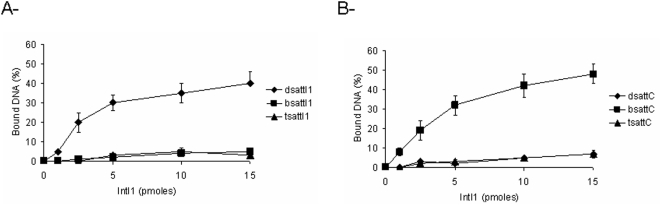
Figure 2. In vitro DNA binding of IntI1 with double- or single-stranded attI1 (A) and attC (B) sites.
Free 5′ 32P radiolabeled dsDNA fragments containing recombination sites (0.1 pmoles) were incubated with purified IntI1 (1–15 pmoles) at 4°C for 20 min before electrophoresis on 1% agarose gel run at 50 V, for 2 hours at 4°C. Gel shifted bands were then quantified using DNAJ software and are plotted in the figure as percentage of bound DNA. Results are the mean±standard deviation (error bars) of three independent experiments.
Figure 3
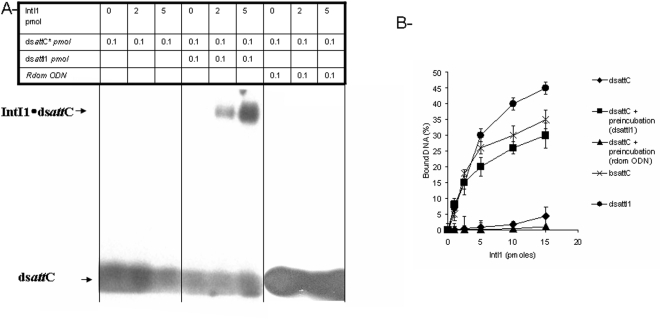
Figure 3. Cooperative binding of IntI1 to attI1/attC sites.
A- In vitro DNA binding of IntI1 with double-stranded attC fragment in presence or not of attI1 site. Free 5′ 32P radiolabeled dsDNA attC fragments containing recombination sites (0.1 pmoles) were incubated at 4°C for 20 min with purified IntI1 (0–5 pmoles) after or without preincubation with dsattI1 (0.1 pmole) or random ODN (0.1 pmole) at 4°C for 20 min. Products were then loaded on 1% agarose gel and electrophoresis was run at 50 V, for 2 hours at 4°C. B- Effect of preincubation with different att fragments on in vitro DNA binding of IntI1. Free 5′ 32P radiolabeled dsDNA fragments containing recombination sites dsattC, dsattI1, or bsattC (0.1 pmoles) were incubated at 4°C for 20 min with purified IntI1 (0–5 pmoles) after or without preincubation with dsattI1 (0.1 pmole) or with a random ODN (0.1 pmole) at 4°C for 20 min. DNA binding was measured by quantification of gel shifted bands using DNAJ software and also filter binging assay as described in materials and methods section. The percentage of bound DNA was then plotted in the graphic B. Results are the mean±standard deviation (error bars) of three independent experiments.
Figure 4
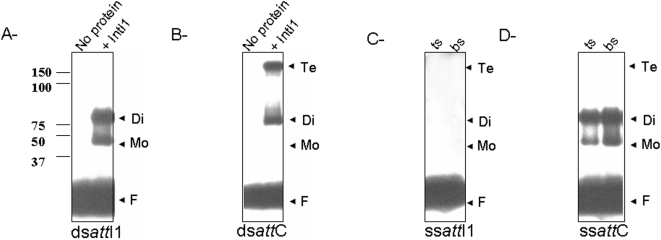
Figure 4. SDS-PAGE analysis of crosslinked IntI1•DNA complexes.
IN (2 pmoles) was preincubated with the 5′-end radiolabeled dsattI1 (A), dsattC (B), ssattI1 (C, bs and ts), ssattC (D, bs and ts) for 30 min in the presence of AHDAP at 37°C (final volume 20 µl). Products were separated by electrophoresis on 12% SDS-PAGE gel. The gel was then dried and autoradiographed. The positions of monomers, dimers and tetramers bound to DNA were determined by comparison with the migration distance of protein weight markers (BIO-RAD) submitted to electrophoresis under the same conditions. F: free substrate.
Figure 5
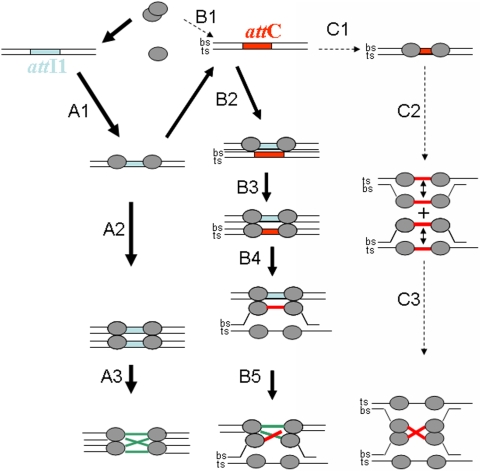
Figure 5. Model for the cooperative binding and the inti1 oligomers involved in the in vitro recombination catalyzed by IntI1.
In the attI1×attI1 recombination reaction IntI1 binds both dsattI1 fragment as a dimer and catalyzes the strand exchange and the formation of the HJ intermediate (lanes A1 to A3). In the case of attI1×attC recombination, IntI1 binds dsattC only slightly (B1). Interaction with the first attI1 substrate led to cooperative binding to the second attC site (B2), allowing the recruitment of a second IntI1 dimer on the second strand of the attC site (B3) and the formation of the tetrameric intermediate, leading in turn to the stabilization of a ssattC intermediate (B4). The strand exchange between dsattI1 and bsattC can then be catalyzed (B5). Recombination activity detected in presence of two attC sites suggests that the initial low binding of the enzyme to this site is sufficient for triggering all the subsequent recombination steps (way C). ts: top strand, bs: bottom strand.

References

    1. Hall RM, Collis CM. Mobile gene cassettes and integrons: capture and spread of genes by site-specific recombination. Mol Microbiol. 1995;15:593–600. - PubMed
    1. Hall RM, Collis CM, Kim MJ, Partridge SR, Recchia GD, et al. Mobile gene cassettes and integrons in evolution. Ann N Y Acad Sci. 1999;870 - PubMed
    1. Hall RM, Brookes DE, Stokes HW. Site-specific insertion of genes into integrons: role of the 59-base element and determination of the recombination cross-over point. Mol Microbiol. 1991;5:1941–1959. - PubMed
    1. Recchia GD, Stokes HW, Hall RM. Characterisation of specific and secondary recombination sites recognised by the integron DNA integrase. Nucleic Acids Res. 1994;22:2071–2078. - PMC - PubMed
    1. Collis CM, Hall RM. Expression of antibiotic resistance genes in the integrated cassettes of integrons. Antimicrob Agents Chemother. 1995;39:155–162. - PMC - PubMed