. 2010 Apr;14(4):982-91.
doi: 10.1111/j.1582-4934.2009.00751.x. Epub 2009 Mar 27.

Inhibition of fatty acid biosynthesis prevents adipocyte lipotoxicity on human osteoblasts in vitro

Affiliations

Inhibition of fatty acid biosynthesis prevents adipocyte lipotoxicity on human osteoblasts in vitro

Alexandre Elbaz et al. J Cell Mol Med. 2010 Apr.

Abstract

Although increased bone marrow fat in age-related bone loss has been associated with lower trabecular mass, the underlying mechanism responsible remains unknown. We hypothesized that marrow adipocytes exert a lipotoxic effect on osteoblast function and survival through the reversible biosynthesis of fatty acids (FA) into the bone marrow microenvironment. We have used a two-chamber system to co-culture normal human osteoblasts (NHOst) with differentiating pre-adipocytes in the absence or presence of an inhibitor of FA synthase (cerulenin) and separated by an insert that allowed unidirectional trafficking of soluble factors only and prevented direct cell-cell contact. Supernatants were assayed for the presence of FA using mass spectophotometry. After 3 weeks in co-culture, NHOst showed significantly lower levels of differentiation and function based on lower mineralization and expression of alkaline phosphatase, osterix, osteocalcin and Runx2. In addition, NHOst survival was affected by the presence of adipocytes as determined by MTS-formazan and TUNEL assays as well as higher activation of caspases 3/7. These toxic effects were inhibited by addition of cerulenin. Furthermore, culture of NHOst with either adipocyte-conditioned media alone in the absence of adipocytes themselves or with the addition of the most predominant FA (stearate or palmitate) produced similar toxic results. Finally, Runx2 nuclear binding was affected by addition of either adipocyte conditioned media or FA into the osteogenic media. We conclude that the presence of FA within the marrow milieu can contribute to the age-related changes in bone mass and can be prevented by the inhibition of FA synthase.


Figures
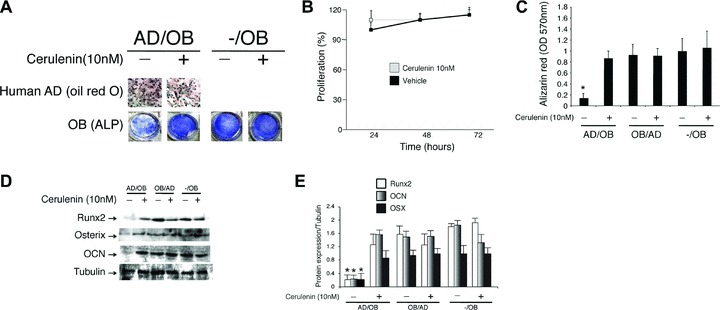
Fig 1
Fig 1
(A–C) Mature human osteoblasts were plated in co-culture with differentiating human adipocytes (AD) treated with either cerulenin (10 nM) or vehicle alone. After 3 weeks in co-culture, adipocytes were stained with oil red O (A, upper panels) to identify fat droplets and osteoblasts were stained with alkaline phosphatase (ALP) (A, lower panels) and alizarin red (C) to identify function and mineralization respectively. Addition of cerulenin to the adipocytes media did not affect adipocytes’ proliferation (B) and capacity to produce fat droplets (A, upper panels). In contrast, both osteoblast function and mineralization were significantly affected by the presence of adipocytes on top of the membrane. This inhibitory effect was prevented by addition of cerulenin (10 nM) to the media (P < 0.001). (D, E) Expression levels of Runx2, osterix (OSX) and osteocalcin (OCN) quantified by Western blot analysis were significantly reduced by the presence of adipocytes (*P < 0.001) and recovered by addition of cerulenin to the media. The data are representative of three different experiments.
Fig 2
Fig 2
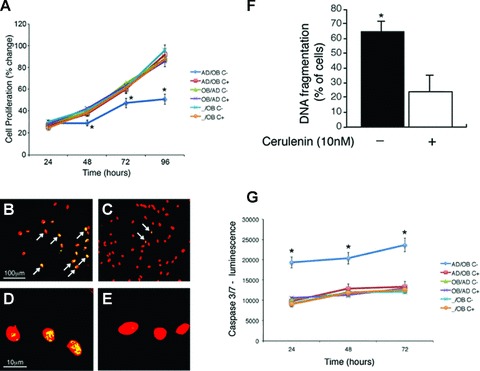
(A) Cerulenin prevents the inhibitory effect of adipocytes on osteoblasts survival– Supernatants were collected from the osteoblasts side of the membrane in the six different conditions (AD/OB, OB/AD, -/OB with and without cerulenin). Human osteoblasts were cultured for 24 hrs in 96-well plates. At 24 hrs, media were replaced with the supernatants and cell proliferation was measured at timed intervals (24–96 hrs). Cell proliferation was significantly decreased in osteoblasts cultured with the supernatant from the AD/OB untreated cells after 48, 72 and 96 hrs in culture (*P < 0.001). In contrast, osteoblasts exposed to supernatants from all other conditions either treated or untreated with cerulenin showed a progressive increase in cell proliferation at all timed intervals. (B–F) Inhibition of FA synthase prevents osteoblast apoptosis induced by adipocyte-secreted factors – Human osteoblasts were cultured in 2-well slides for 24 hrs. After 24 hrs, media were replaced with media obtained from normal confluent human adipocytes treated with either cerulenin (10 nM) or vehicle alone. After 72 hrs in culture, media were removed and cells showing apoptotic cells were identified (B–E) and quantified (F) using TUNEL assay. The TUNEL assay was able to detect a higher percentage of cells with DNA fragmentation (arrows) in the NHOst treated with supernatants obtained from untreated (B, D and F) as compared with cerulenin-treated (C, E and F) adipocytes (F) (*P < 0.01). (B and C: scale bar 100 μm), (D and E: 10 μm). (G) Caspase-3 and -7 activity was assayed using the Caspase-Glo luminescence assay and data represent the mean values (S.D.) of triplicate cultures. NHOst treated with supernatants obtained from untreated adipocytes (AD/OB-) showed higher caspase 3/7 activity as compared with cerulenin-treated adipocytes (*P < 0.001).
Fig 3
Fig 3
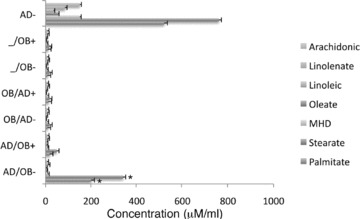
Fatty acid (FA) composition of supernatants collected from the osteoblast side in co-culture with human adipocytes treated with either cerulenin or vehicle alone and analysed by GC/MS showed the presence of seven FA. In addition, a significantly higher amount of two FA, palmitate and stearate, was found in the supernatants obtained from the AD/OB condition treated with vehicle alone (*P < 0.01; **P < 0.001 for untreated AD/OB versus all other conditions). The levels of these two FA were significantly reduced after treatment with cerulenin (δP < 0.001). MHD: Methylhexadecanoic acid.
Fig 4
Fig 4
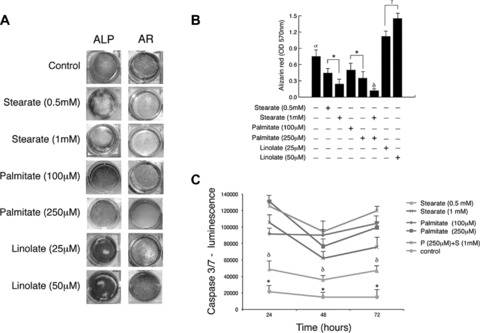
Stearate and palmitate affect osteoblasts function and mineralization – osteoblasts treated with either stearate or palmitate showed a significant reduction in alkaline phosphatase (ALP) (A, left panels) and alizarin red (A, right panels and B) as compared with both untreated and linolate -treated cells. Additionally, linolate-treated osteoblasts showed higher function and mineralization than untreated osteoblasts. Finally, combination of both FA was found to potentiate their negative effect on mineralization (B, δP < 0.001 versus all other conditions). *P < 0.001 for dose-dependent effect; **P < 0.01 untreated cells versus FA treated cells; γP < 0.01 for linolate dose-dependent effect; σP < 0.01 for control versus all other conditions. (C) Caspase-3/7 activity was assayed using the Caspase-Glo luminescence assay and data represent the mean values (S.D.) of triplicate cultures. NHOst treated with either stearate or palmitate showed higher caspase 3/7 activity as compared with untreated cells (*P < 0.001). δP < 0.01 Stearate (0.5 mM) versus all other conditions.
Fig 5
Fig 5
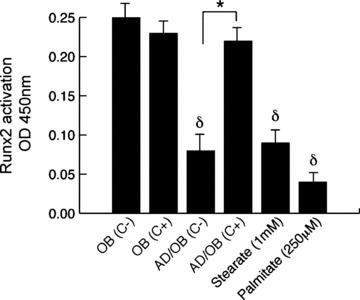
Effect of adipocyte-secreted factors on Runx2 nuclear-binding activity in human osteoblasts: Runx2 DNA-binding activity was determined using ELISA-based Runx2 activation kit and quantified by colorimetry. Osteoblasts exposed to supernatants obtained from adipocytes as well as treated with stearate and palmitate showed a significantly lower activity of the Runx2 nuclear complex in the nuclei as compared with controls. This effect was reverted by addition of cerulenin into the adipogenic media. Finally, addition of cerulenin into osteogenic media did not show a direct effect on the complex in normal osteoblasts. Values are mean ± S.E.M. of six wells per group in three independent experiments; *P < 0.001 cerulenin treated versus matched untreated cells. δP < 0.01 for cells exposed to adipogenic factors versus control (-/OB).

References

    1. Gimble JM, Robinson CE, Wu X, et al. The function of adipocytes in the bone marrow stroma: an update. Bone. 1996;19:421–8. - PubMed
    1. Cartwright MJ, Tchkonia T, Kirkland JL. Aging in adipocytes: potential impact of inherent, depot-specific mechanisms. Exp Gerontol. 2007;42:463–71. - PMC - PubMed
    1. Unger RH. Lipotoxic diseases. Annu Rev Med. 2002;53:319–23. - PubMed
    1. Duque G. Bone and fat connection, new perspectives on understanding age-related bone loss. Curr Op Rheum. 2008;20:429–34. - PubMed
    1. Gimble JM, Zvonic S, Floyd ZE, et al. Playing with bone and fat. J Cell Biochem. 2006;98:251–66. - PubMed

Publication types

MeSH terms