


The paradoxical increase in cortisol secretion induced by dexamethasone in primary pigmented nodular adrenocortical disease involves a glucocorticoid receptor-mediated effect of dexamethasone on protein kinase A catalytic subunits
- PMID: 19383776
- PMCID: PMC2708955
- DOI: 10.1210/jc.2009-0031
The paradoxical increase in cortisol secretion induced by dexamethasone in primary pigmented nodular adrenocortical disease involves a glucocorticoid receptor-mediated effect of dexamethasone on protein kinase A catalytic subunits
Abstract
Context: Primary pigmented nodular adrenocortical disease (PPNAD) results in most cases from mutations of the protein kinase A (PKA) regulatory subunit 1A (PRKAR1A) gene. Patients with PPNAD exhibit a paradoxical increase in cortisol secretion in response to dexamethasone.
Objective: The aim was to investigate the mechanism of the action of dexamethasone on adrenocortical cells removed from patients with PPNAD and a transgenic model of PPNAD [Tg(tTA/X2AS) mice].
Design and setting: We performed an in vitro study in an academic research laboratory.
Patients: Eleven patients with histologically proven PPNAD were included in the study.
Intervention: Cultured PPNAD cells were incubated with dexamethasone in the presence of various modulators of the cAMP/PKA pathway and the glucocorticoid receptor antagonist RU486.
Main outcome measure: Cortisol and corticosterone were measured by radioimmunological assays in cell culture supernatants.
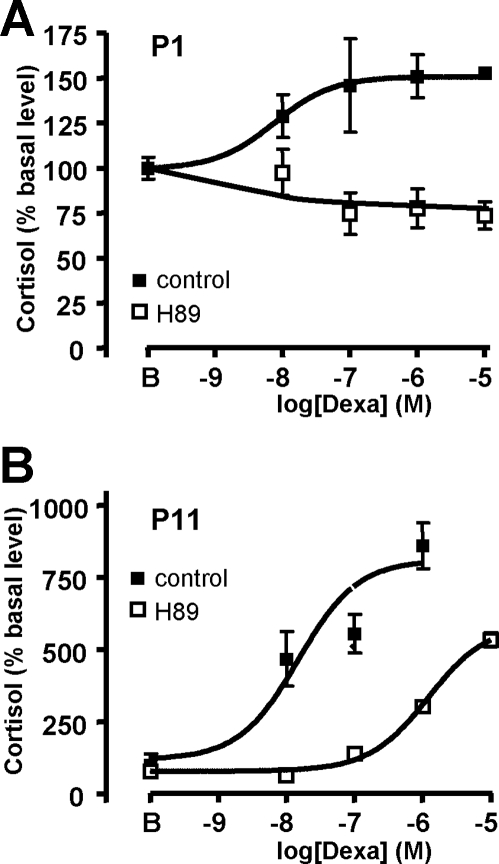
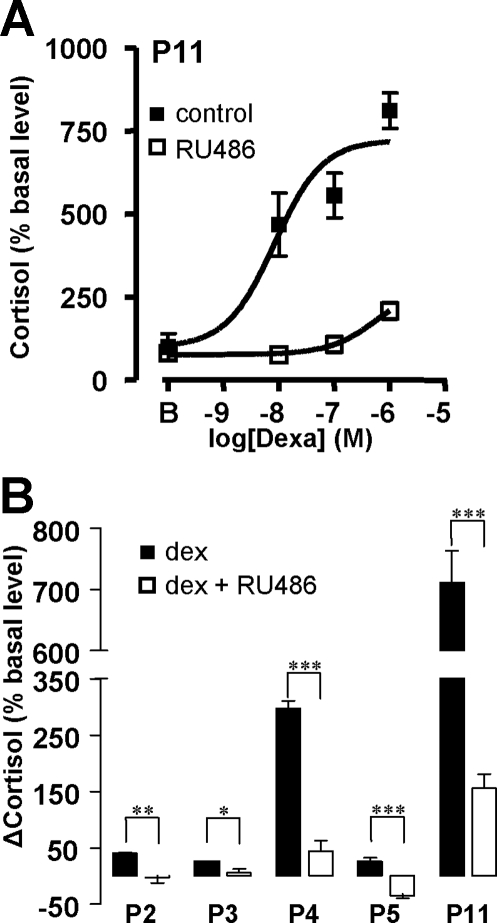
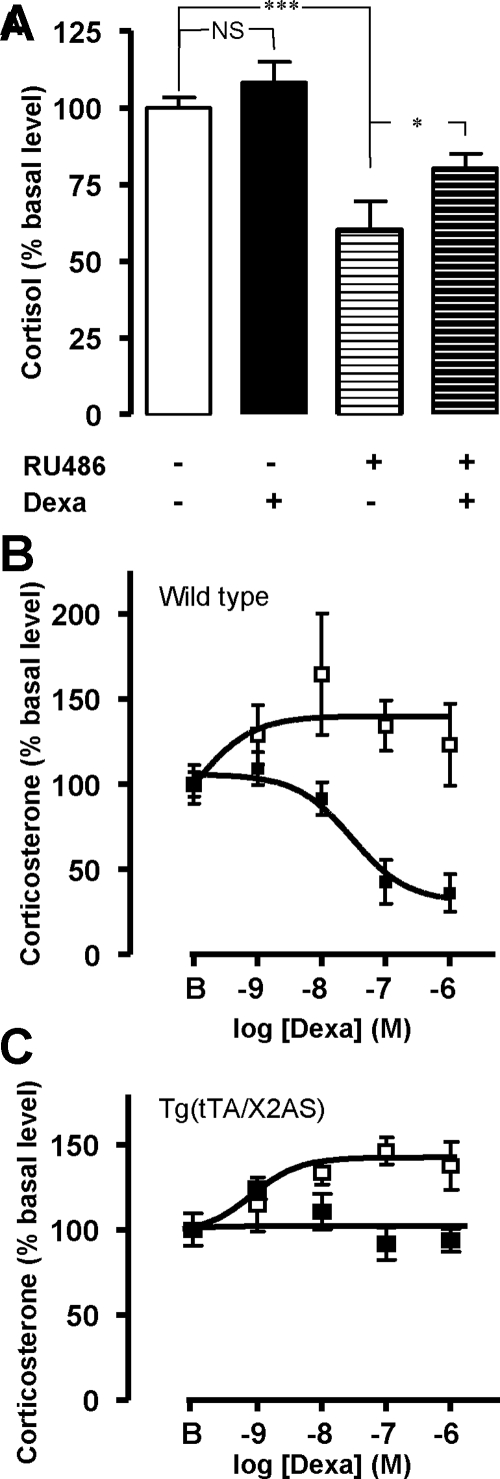
Results: Dexamethasone stimulated in vitro cortisol secretion from PPNAD tissues in six patients. The stimulatory effect of dexamethasone on cortisol release was not reduced by the adenylyl cyclase inhibitor SQ22536 or potentiated by the phosphodiesterase inhibitor IMBX and the cAMP analog 8Br-cAMP. Conversely, the PKA inhibitor H89 and RU486 inhibited the cortisol response to dexamethasone. Dexamethasone had no effect on cortisol production from normal human adrenocortical cells but stimulated corticosteroidogenesis in the presence of RU486. Similarly, dexamethasone failed to influence corticosterone release by adrenocortical cells removed from Tg(tTA/X2AS) mice but stimulated corticosteroidogenesis in the presence of RU 486.
Conclusions: These results indicate that, in human PPNAD tissues, dexamethasone paradoxically stimulates cortisol release through a glucocorticoid receptor-mediated effect on PKA catalytic subunits.
Figures

References
-
- Stratakis CA, Kirschner LS 1998 Clinical and genetic analysis of primary bilateral adrenal diseases (micro- and macronodular disease) leading to Cushing syndrome. Horm Metab Res 30:456–463 - PubMed
-
- Bertherat J, Horvath A, Groussin L, Grabar S, Boikos S, Cazabat L, Libe R, René-Corail F, Stergiopoulos S, Bourdeau I, Bei T, Clauser E, Calender A, Kirschner LS, Bertagna X, Carney JA, Stratakis CA 17 March 2009 Mutations in regulatory subunit type 1A of cyclic AMP-dependent protein kinase (PRKAR1A): phenotype analysis in 353 patients and 80 different genotypes. J Clin Endocrinol Metab 10.1210/jc.2008–2333 - PMC - PubMed
-
- Groussin L, Horvath A, Jullian E, Boikos S, Rene-Corail F, Lefebvre H, Cephise-Velayoudom FL, Vantyghem MC, Chanson P, Conte-Devolx B, Lucas M, Gentil A, Malchoff CD, Tissier F, Carney JA, Bertagna X, Stratakis CA, Bertherat J 2006 A PRKAR1A mutation associated with primary pigmented nodular adrenocortical disease in 12 kindreds. J Clin Endocrinol Metab 91:1943–1949 - PubMed
-
- Groussin L, Kirschner LS, Vincent-Dejean C, Perlemoine K, Jullian E, Delemer B, Zacharieva S, Pignatelli D, Carney JA, Luton JP, Bertagna X, Stratakis CA, Bertherat J 2002 Molecular analysis of the cyclic AMP-dependent protein kinase A (PKA) regulatory subunit 1A (PRKAR1A) gene in patients with Carney complex and primary pigmented nodular adrenocortical disease (PPNAD) reveals novel mutations and clues for pathophysiology: augmented PKA signaling is associated with adrenal tumorigenesis in PPNAD. Am J Hum Genet 71:1433–1442 - PMC - PubMed
-
- Stratakis CA, Boikos SA 2007 Genetics of adrenal tumors associated with Cushing’s syndrome: a new classification for bilateral adrenocortical hyperplasias. Nat Clin Pract Endocrinol Metab 3:748–757 - PubMed
Publication types
MeSH terms
Substances
Grants and funding
LinkOut - more resources
Full Text Sources
Medical
Molecular Biology Databases
Miscellaneous
