


Rare species are valued big time
- PMID: 19384416
- PMCID: PMC2668182
- DOI: 10.1371/journal.pone.0005215
Rare species are valued big time
Abstract
Background: It has recently been postulated that the value humans place on rarity could cause the extinction of rare species. This is because people are willing to pay the high costs of exploiting the last individuals. Many hobbies, such as ecotourism or the keeping of exotic pets may cause this effect--known as the anthropogenic Allee effect. However, the entire theory relies on the insofar undemonstrated assumption that people do value rarity.
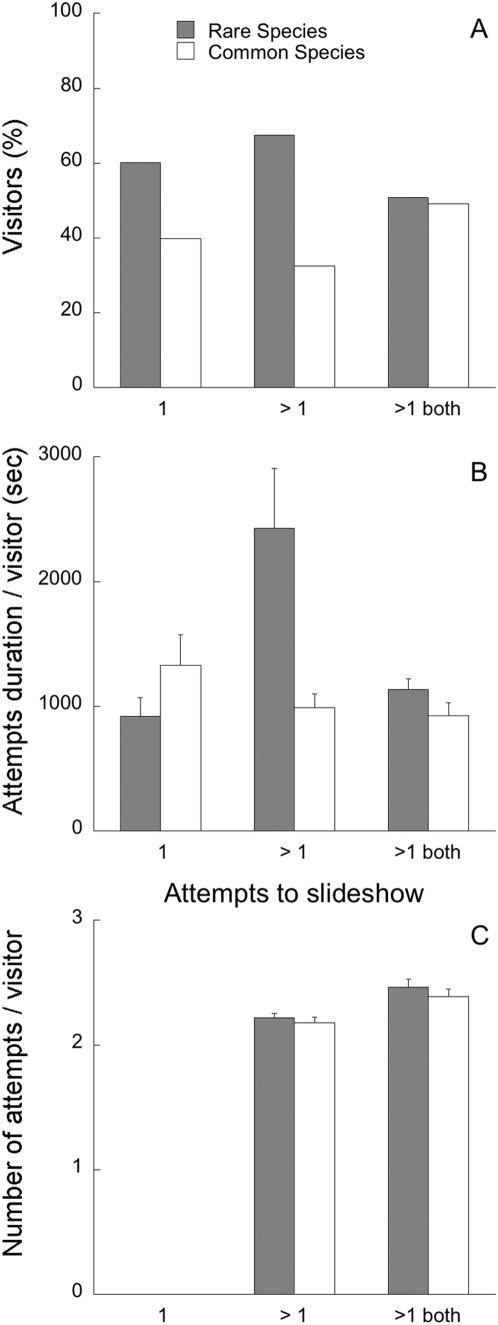
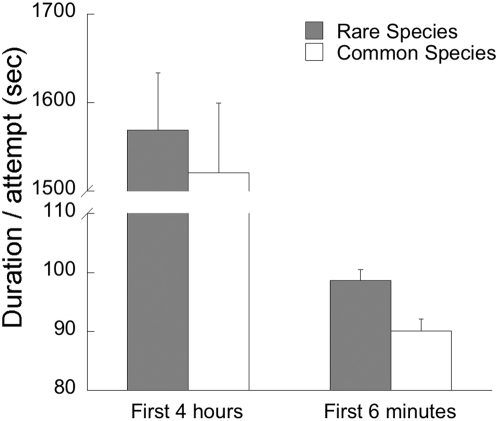
Methodology/principal findings: In order to quantify how much people valued rare species relative to common ones, we created online slideshows of photographs of either rare or common species on an Internet web site. The slideshow with photographs of rare species attracted more visitors, and visitors spent, in general, more time waiting to view it.
Conclusions/significance: We provide evidence that people value rare more than common species. As we did not target consumers of a specific market, this finding suggests that the anthropogenic Allee effect is likely be driven by a large part of the population. Given the substantial participation in our online experiment, we highlight the potential of the world wide web resource as a tool for conservation action. However, the evidence presented here that the general public value rare species, combined with the assumption that anthropogenic Allee effect is operating, implies that conservationists should be prudent when using rarity to promote conservation.
Conflict of interest statement
Figures
References
-
- Brook BW, Sodhi NS. Rarity bites. Nature. 2006;444:555–557. - PubMed
-
- Clark CW. Mathematical Bioeconomics: Optimal Management of Renewable Resources. Hoboken, New Jersey: Wiley; 1990. p. 386.
-
- Hall RJ, Milner-Gulland EJ, Courchamp F. Endangering the endangered: the effects of perceived rarity on species exploitation. Conservation Letters. 2008;1:75–81.
-
- Barnes JI. Changes in the economic use value of elephant in Botswana: the effect of international prohibition. Ecological Economics. 1996;18:215–230.
Publication types
MeSH terms
LinkOut - more resources
Full Text Sources
Research Materials
