


Teaching feedback to first-year medical students: long-term skill retention and accuracy of student self-assessment
- PMID: 19384559
- PMCID: PMC2686777
- DOI: 10.1007/s11606-009-0983-z
Teaching feedback to first-year medical students: long-term skill retention and accuracy of student self-assessment
Abstract
Background: Giving and receiving feedback are critical skills and should be taught early in the process of medical education, yet few studies discuss the effect of feedback curricula for first-year medical students.
Objectives: To study short-term and long-term skills and attitudes of first-year medical students after a multidisciplinary feedback curriculum.
Design: Prospective pre- vs. post-course evaluation using mixed-methods data analysis.
Participants: First-year students at a public university medical school.
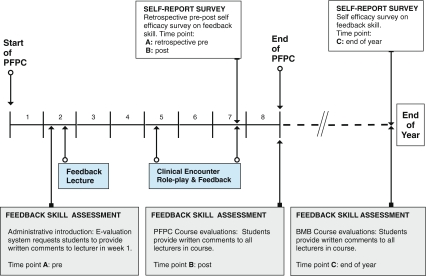
Interventions: We collected anonymous student feedback to faculty before, immediately after, and 8 months after the curriculum and classified comments by recommendation (reinforcing/corrective) and specificity (global/specific). Students also self-rated their comfort with and quality of feedback. We assessed changes in comments (skills) and self-rated abilities (attitudes) across the three time points.
Measurements and main results: Across the three time points, students' evaluation contained more corrective specific comments per evaluation [pre-curriculum mean (SD) 0.48 (0.99); post-curriculum 1.20 (1.7); year-end 0.95 (1.5); p = 0.006]. Students reported increased skill and comfort in giving and receiving feedback and at providing constructive feedback (p < 0.001). However, the number of specific comments on year-end evaluations declined [pre 3.35 (2.0); post 3.49 (2.3); year-end 2.8 (2.1)]; p = 0.008], as did students' self-rated ability to give specific comments.
Conclusion: Teaching feedback to early medical students resulted in improved skills of delivering corrective specific feedback and enhanced comfort with feedback. However, students' overall ability to deliver specific feedback decreased over time.
Figures
References
-
- {'text': '', 'ref_index': 1, 'ids': [{'type': 'DOI', 'value': '10.1016/j.ajog.2006.08.021', 'is_inner': False, 'url': 'https://doi.org/10.1016/j.ajog.2006.08.021'}, {'type': 'PubMed', 'value': '17547874', 'is_inner': True, 'url': 'https://pubmed.ncbi.nlm.nih.gov/17547874/'}]}
- Bienstock JL, Katz NT, Cox SM, Hueppchen N, Erickson S, Puscheck EE. To the point: medical education reviews–providing feedback. Am J Obstet Gynecol. 2007;196(6):508–13. - PubMed
-
- {'text': '', 'ref_index': 1, 'ids': [{'type': 'DOI', 'value': '10.1097/00001888-200212000-00005', 'is_inner': False, 'url': 'https://doi.org/10.1097/00001888-200212000-00005'}, {'type': 'PubMed', 'value': '12480619', 'is_inner': True, 'url': 'https://pubmed.ncbi.nlm.nih.gov/12480619/'}]}
- Branch WT, Paranjape A. Feedback and reflection: teaching methods for clinical settings. Acad Med. 2002;77(12):1185–8. - PubMed
-
- {'text': '', 'ref_index': 1, 'ids': [{'type': 'DOI', 'value': '10.1001/jama.250.6.777', 'is_inner': False, 'url': 'https://doi.org/10.1001/jama.250.6.777'}, {'type': 'PubMed', 'value': '6876333', 'is_inner': True, 'url': 'https://pubmed.ncbi.nlm.nih.gov/6876333/'}]}
- Ende J. Feedback in clinical medical education. JAMA. 1983;250(6):777–81. - PubMed
-
- {'text': '', 'ref_index': 1, 'ids': [{'type': 'PubMed', 'value': '18230092', 'is_inner': True, 'url': 'https://pubmed.ncbi.nlm.nih.gov/18230092/'}]}
- van de Ridder JMM, Stokking KM, McGaghie WC, ten Cate OTJ. What is feedback in clinical education. Med Educ. 2008;42(2):189–97. - PubMed
-
- None
- Askew S, Lodge C. Gifts, ping-pong and loops - linking feedback and learning. In: Askew S, ed. Feedback for Learning. London: Routledge/Falmer; 2000:1–17.
Publication types
MeSH terms
LinkOut - more resources
Full Text Sources
