. 2009 Apr 22:7:16.
doi: 10.1186/1741-7007-7-16.

Immunomodulatory parasites and toll-like receptor-mediated tumour necrosis factor alpha responsiveness in wild mammals

Affiliations

Immunomodulatory parasites and toll-like receptor-mediated tumour necrosis factor alpha responsiveness in wild mammals

Joseph A Jackson et al. BMC Biol. .

Abstract

Background: Immunological analyses of wild populations can increase our understanding of how vertebrate immune systems respond to 'natural' levels of exposure to diverse infections. A major recent advance in immunology has been the recognition of the central role of phylogenetically conserved toll-like receptors in triggering innate immunity and the subsequent recruitment of adaptive response programmes. We studied the cross-sectional associations between individual levels of systemic toll-like receptor-mediated tumour necrosis factor alpha responsiveness and macro- and microparasite infections in a natural wood mouse (Apodemus sylvaticus) population.

Results: Amongst a diverse group of macroparasites, only levels of the nematode Heligmosomoides polygyrus and the louse Polyplax serrata were correlated (negatively) with innate immune responsiveness (measured by splenocyte tumour necrosis factor alpha responses to a panel of toll-like receptor agonists). Polyplax serrata infection explained a strikingly high proportion of the total variation in innate responses. Contrastingly, faecal oocyst count in microparasitic Eimeria spp. was positively associated with innate immune responsiveness, most significantly for the endosomal receptors TLR7 and TLR9.

Conclusion: Analogy with relevant laboratory models suggests the underlying causality for the observed patterns may be parasite-driven immunomodulatory effects on the host. A subset of immunomodulatory parasite species could thus have a key role in structuring other infections in natural vertebrate populations by affecting the 'upstream' innate mediators, like toll-like receptors, that are important in initiating immunity. Furthermore, the magnitude of the present result suggests that populations free from immunosuppressive parasites may exist at 'unnaturally' elevated levels of innate immune activation, perhaps leading to an increased risk of immunopathology.


Figures
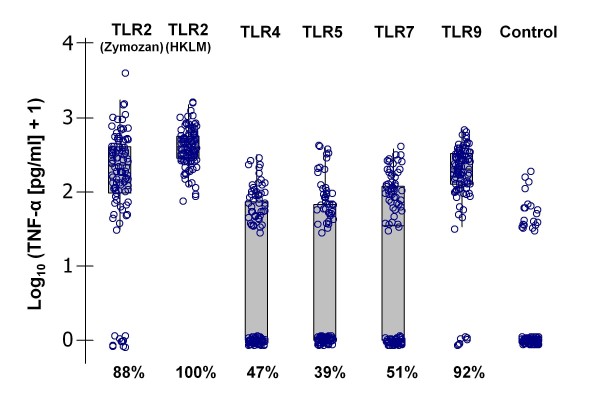
Figure 1
Figure 1
Scatter of individual ex vivo splenocyte tumour necrosis factor alpha responses to a panel of toll-like receptor agonists (Table 1). Box plots show the individual scatter of log-transformed data, the median (line), the interquartile range (box) and the range between the highest and lowest values (whiskers) excluding outliers (values differing by more than 1.5 times the interquartile range interval from the nearest limit of the interquartile range). Percentages given below each plot relate to the number of individuals producing an above-control response.
Figure 2
Figure 2
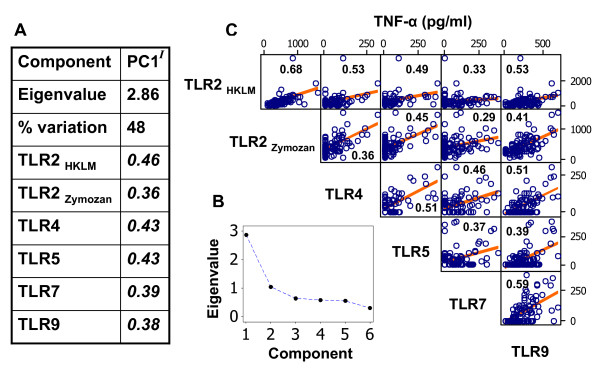
Strong positive covariation amongst toll-like receptor (TLR)-mediated responses. A) A principal components analysis (PCA) of log-transformed TLR-mediated responses showed a dominant first component (PC1I) accounting for 48% of total variation. For each TLR-mediated response, PC1I coefficients (shown alongside) are of similar magnitude and the same sign, indicating a general pattern of positive association. B) Scree plot of PCA eigenvalues, showing the predominance of the first component. C) Matrix of bivariate scatterplots between untransformed TLR-mediated responses with non-parametric correlation coefficient (Spearman's) and least squares regression line shown for reference.
Figure 3
Figure 3
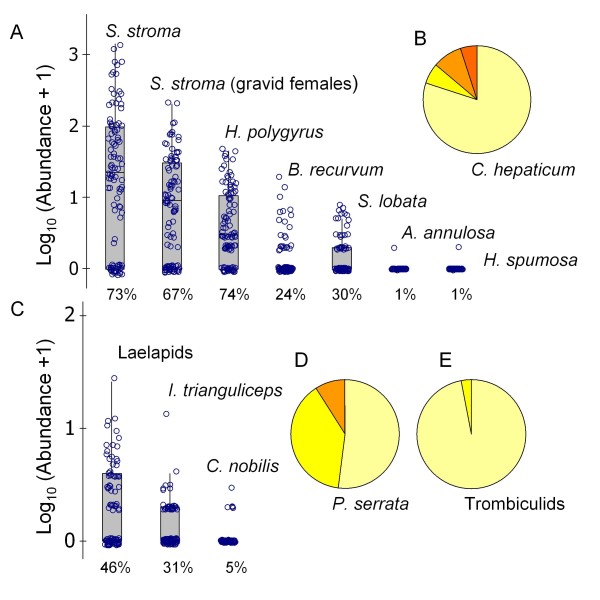
Amongst-host distributions of metazoan parasites in Apodemus sylvaticus (N = 100) at Cotgrave Forest, UK (+52.891, -1.041242) July–November 2007. A) Box plots of log-transformed individual counts for endoparasitic helminths occurring in the gut (Syphacia stroma, Heligmosomoides polygyrus, Brachylaemus recurvum, Skrjabinotaenia lobata, Aoncotheca annulosa, Heterakis spumosa). For S. stroma, results are presented for all stages and for gravid females alone. Percentage prevalence is given below each box plot. B) Pie chart representing proportional distribution of the A. sylvaticus sample amongst infection grades for the hepatozoic nematode Calodium hepaticum (see Methods). C) Box plots of log-transformed individual counts for laelapid mites, ticks (Ixodes trianguliceps) and fleas (Ctenophthalmus nobilis) occurring on the body surface. Percentage prevalence is given below each box plot. D-E) Pie charts representing proportional distribution of the A. sylvaticus sample amongst infection grades for lice (Polyplax serrata) (D) and trombiculid mites (E) (see Methods). Box plots show the individual scatter of data, the median (line), the interquartile range (box) and the range between the highest and lowest values (whiskers) excluding outliers (values differing by more than 1.5 times the interquartile range interval from the nearest limit of the interquartile range). The pie charts show increasing infection grade clockwise.
Figure 4
Figure 4
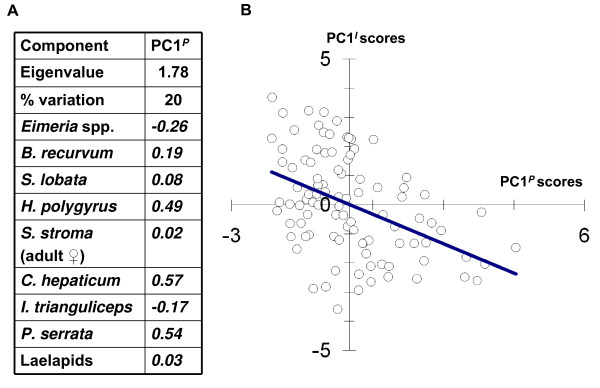
Structure in the parasite community and its relationship to toll-like receptor (TLR)-mediated responses. A) Limited structuring of the parasite community. Principal components analysis (PCA) of infection variables showed a first component (PC1P) accounting for 20% of total variation. Large PC1P positive coefficients (shown alongside individual infection variables) occurred for Heligmosomoides polygyrus, Calodium hepaticum and Polyplax serrata, indicating a pattern of positive covariation between these species. At the same time, a moderate negative coefficient for Eimeria spp. faecal oocyst count indicated a possible contrasting trend in coccidial oocyst shedding. Coefficients for Brachylaemus recurvum, Skjrabinotaenia lobata, Syphacia stroma, Ixodes trianguliceps and laelapid mites were small, indicating a lack of influence on PC1P. B) Strong association between infection status and toll-like receptor (TLR)-mediated responsiveness. When PC1P scores were used to represent a major aspect of variation in the parasite community and PC1I scores from a PCA of log-transformed TLR-mediated responses (see Figure 2) were used to represent overall innate immune responsiveness, there was a strong confounder-adjusted relationship between the two variables (general linear mixed model, P < 0.001). Plot shows the scatter of individual observations with a least square regression line for reference.
Figure 5
Figure 5
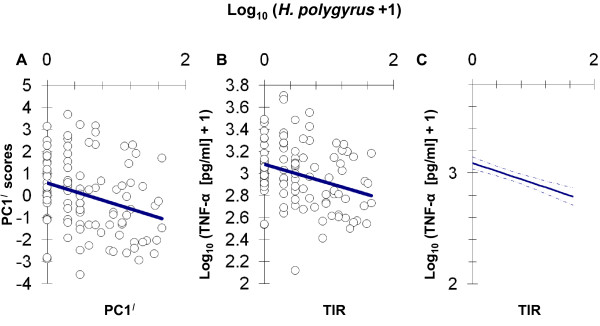
Negative relationship of toll-like receptor (TLR)-mediated responses with Heligmosomoides polygyrus abundance. A) Scatter of first principal component (PC1I) scores from a principal components analysis (PCA) of log-transformed TLR-mediated responses against log-transformed H. polygyrus abundance. Least squares regression line shown for reference. B) Scatter of log-transformed total TLR-mediated tumour necrosis factor alpha (TNF-α) response (summed across all six TLR variables), TIR, against log-transformed H. polygyrus abundance. Least squares regression line shown for reference. C) General linear mixed model prediction of the relationship (solid line) between log-transformed H. polygyrus abundance and log-transformed total TNF-α production. Dashed lines indicate 1 standard error above and below.
Figure 6
Figure 6
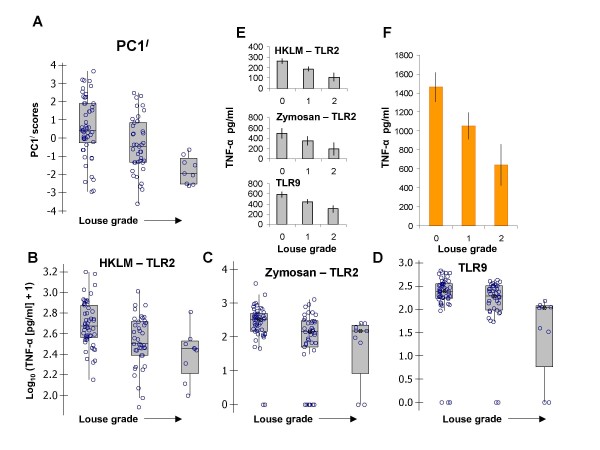
Negative relationship of toll-like receptor (TLR)-mediated responses with louse (Polyplax serrata) infection grade. A-D) Scatter of TLR-response variables at increasing louse infection grades. Box plots show the individual scatter of data, the median (line), the interquartile range (box) and the range between the highest and lowest values (whiskers) excluding outliers (values differing by more than 1.5 times the interquartile range interval from the nearest limit of the interquartile range). A) Overall TLR-mediated responsiveness represented by first principal component (PC1I) scores from a principal components analysis (PCA) of the six log-transformed TLR variables. B) Log-transformed TLR2 response against HKLM. C) Log-transformed TLR2 response against zymosan. D) Log-transformed TLR9 response against ODN2006. E-F) Confounder-adjusted general linear mixed model predictions for the effect of louse grade on untransformed TLR-mediated tumour necrosis factor alpha (TNF-α) responses (pg/ml) with other model terms averaged. One standard error is shown above and below each estimate. E) TLR2 and TLR9-mediated responses. F) Total TLR-mediated response (summed across all six TLR variables), TIR.

References

    1. Kemp AS, Mullins RJ, Weiner JM. The allergy epidemic: what is the Australian response? Med J Aust. 2006;185:226–227. - PubMed
    1. Gale EAM. The rise of childhood type 1 diabetes in the 20th century. Diabetes. 2002;51:3353–3361. doi: 10.2337/diabetes.51.12.3353. - DOI - PubMed
    1. Strachan D. Hay fever, hygiene and household size. BMJ. 1989;299:1259–1260. doi: 10.1136/bmj.299.6710.1259. - DOI - PMC - PubMed
    1. Maizels RM, Yazdanbakhsh M. Immune regulation by helminth parasites: cellular and molecular mechanisms. Nat Rev Immunol. 2003;3:733–744. doi: 10.1038/nri1183. - DOI - PubMed
    1. Bradley JE, Jackson JA. Immunity, immunoregulation and the ecology of trichuriasis and ascariasis. Parasite Immunol. 2004;26:429–441. doi: 10.1111/j.0141-9838.2004.00730.x. - DOI - PubMed

Publication types

LinkOut - more resources