Evaluation of a commercial blocking enzyme-linked immunosorbent assay to detect avian influenza virus antibodies in multiple experimentally infected avian species
- PMID: 19386796
- PMCID: PMC2691043
- DOI: 10.1128/CVI.00084-09
Evaluation of a commercial blocking enzyme-linked immunosorbent assay to detect avian influenza virus antibodies in multiple experimentally infected avian species
Abstract
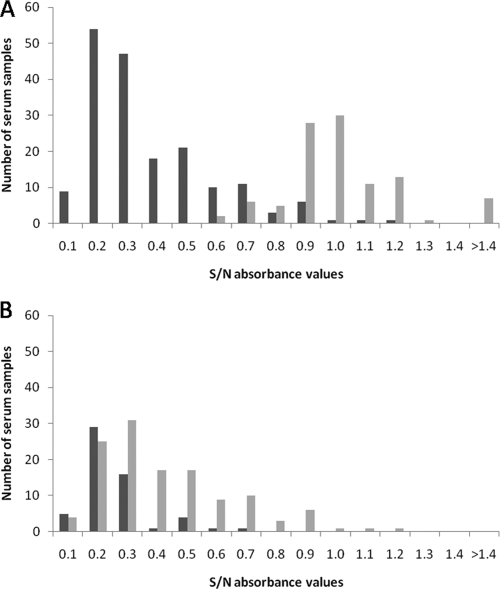
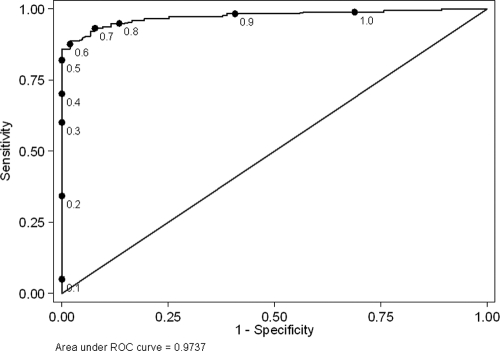
Wild birds of the orders Anseriformes and Charadriiformes are the natural reservoirs for avian influenza (AI) viruses. Traditionally, AI virus surveillance in wild birds has relied on virus identification strategies, including virus isolation and detection. To evaluate the accuracy of a commercial blocking enzyme-linked immunosorbent assay (bELISA) and the agar gel immunodiffusion (AGID) test for detection of antibodies in wild birds, which is indicative of AI virus infection, we tested 281 serum samples from various wild avian species that were experimentally infected with AI viruses. Included in these samples were 178 samples from birds with confirmed AI virus infections (122 infected with low-pathogenic AI [LPAI] viruses and 56 infected with highly pathogenic AI [HPAI] viruses) and 103 samples from birds that were uninfected, negative controls. The sensitivities of the bELISA and the AGID test were 0.820 (95% confidence interval [95% CI], 0.756 to 0.874) and 0.674 (95% CI, 0.600 to 0.742), respectively. Both tests had an estimated specificity of 1.00 (95% CI, 0.965 to 1.00). The bELISA was significantly more sensitive than the AGID test for both LPAI virus- and HPAI virus-infected birds. Both assays, however, had a higher sensitivity for birds infected with HPAI virus than for birds infected with LPAI virus. These results demonstrate the potential utility of the bELISA for detection of antibodies to both LPAI and HPAI viruses in multiple avian species, representing five avian orders and 17 genera. Additional studies are warranted to further evaluate the utility of the bELISA for use with naturally infected birds.
Figures
References
-
- Brown, J. D., D. E. Stallknecht, S. Valeika, and D. E. Swayne. 2007. Susceptibility of wood ducks to H5N1 highly pathogenic avian influenza virus. J. Wildl. Dis. 43660-667. - PubMed
-
- Brown, J. D., D. E. Stallknecht, and D. E. Swayne. 2008b. Transmission of H5N1 high pathogenicity avian influenza virus to herring gulls (Larus argentatus) through intranasal inoculation of virus and ingestion of virus-infected chicken meat. Avian Pathol. 37393-397. - PubMed
-
- Cattoli, G., and I. Capua. 2007. Diagnosing avian influenza in the framework of wildlife surveillance efforts and environmental samples. J. Wildl. Dis. 43(Supplement)S35-S39.
Publication types
MeSH terms
Substances
Grants and funding
LinkOut - more resources
Full Text Sources
Medical