


Perceived income adequacy among older adults in 12 countries: findings from the survey of health, ageing, and retirement in Europe
- PMID: 19386829
- PMCID: PMC2682171
- DOI: 10.1093/geront/gnp036
Perceived income adequacy among older adults in 12 countries: findings from the survey of health, ageing, and retirement in Europe
Abstract
Purpose: To validate a survey research measure of subjective income, as measured by perceived income adequacy, in an international context.
Design and methods: The study population comprised persons aged 50 years and older in 12 countries from the Survey of Health, Ageing and Retirement in Europe (n = 28,939). Perceived difficulty in making ends meet was regressed on sociodemographic variables, economic indicators, health status measures, and expectations regarding one's financial future. Country differences were also controlled.
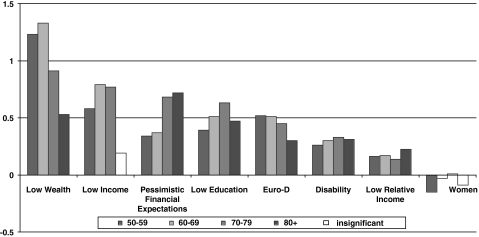
Results: The findings confirm a multidimensional explanation of perceived income adequacy but also point to the primacy of objective economic indicators in predicting household financial distress. Respondents aged 80 years and older report less financial difficulty. Poor health status and pessimistic financial expectations also predict greater household financial distress but to a lesser degree.
Implications: Self-rated economic status is a robust indicator of financial capacity in older age and can be used by practitioners to gain meaningful information. However, practitioners should keep in mind that the oldest-old may underestimate financial difficulties.
Figures
References
-
- Angel RJ, Frisco ML, Angel JL, Chiriboga DA. Financial strain and health among elderly Mexican-origin individuals. Journal of Health and Social Behavior, 2003;44:536–551. - PubMed
-
- Ballantyne P, Marshall VW. Subjective income security of (middle) aging and elderly Canadians. Canadian Journal on Aging. 2001;20:151–173.
-
- Bowling A, Stafford M. How do objective and subjective assessments of neighbourhood influence social and physical functioning in older age? Findings from a British survey of ageing. Social Science and Medicine. 2007;64:2533–2549. - PubMed
Publication types
MeSH terms
Grants and funding
LinkOut - more resources
Full Text Sources
Medical
