


Role of protein kinase C in the induction and maintenance of serotonin-dependent enhancement of the glutamate response in isolated siphon motor neurons of Aplysia californica
- PMID: 19386905
- PMCID: PMC2755541
- DOI: 10.1523/JNEUROSCI.4149-08.2009
Role of protein kinase C in the induction and maintenance of serotonin-dependent enhancement of the glutamate response in isolated siphon motor neurons of Aplysia californica
Abstract
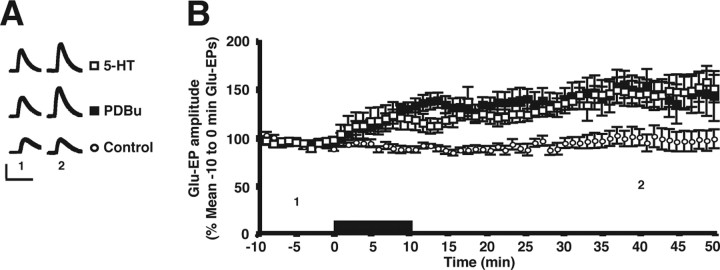
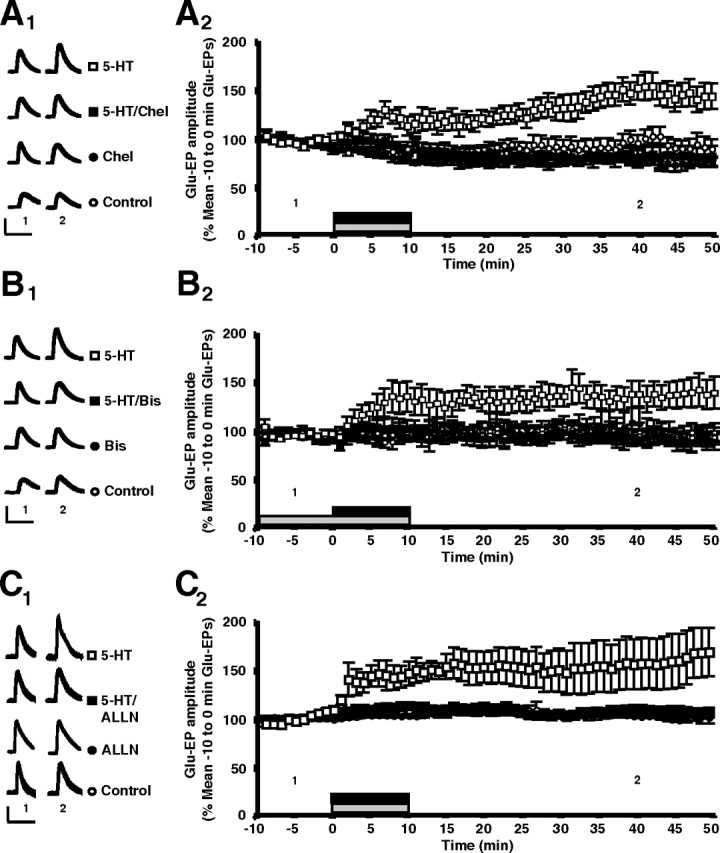
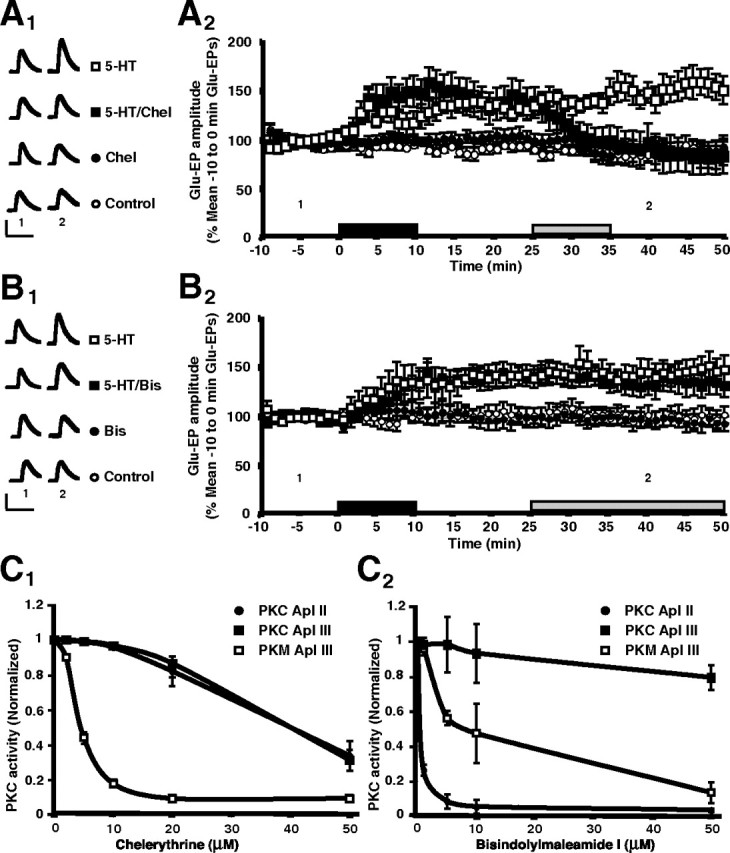
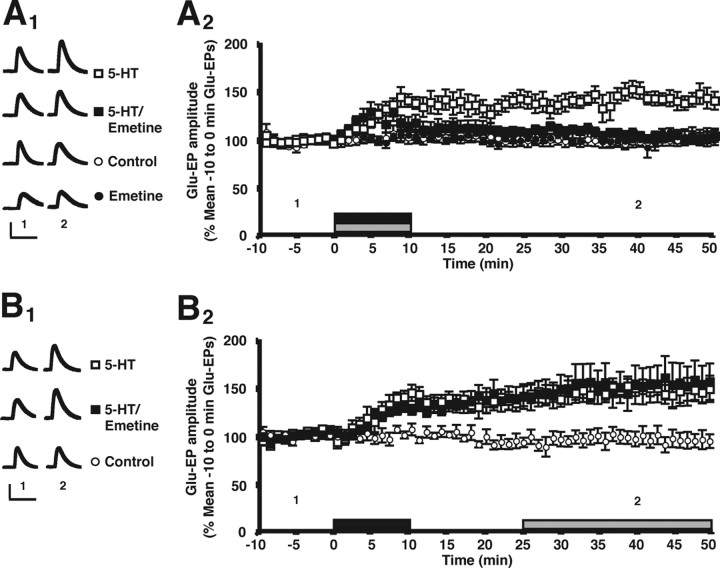
Serotonin (5-HT) mediates learning-related facilitation of sensorimotor synapses in Aplysia californica. Under some circumstances 5-HT-dependent facilitation requires the activity of protein kinase C (PKC). One critical site of PKC's contribution to 5-HT-dependent synaptic facilitation is the presynaptic sensory neuron. Here, we provide evidence that postsynaptic PKC also contributes to synaptic facilitation. We investigated the contribution of PKC to enhancement of the glutamate-evoked potential (Glu-EP) in isolated siphon motor neurons in cell culture. A 10 min application of either 5-HT or phorbol ester, which activates PKC, produced persistent (> 50 min) enhancement of the Glu-EP. Chelerythrine and bisindolylmaleimide-1 (Bis), two inhibitors of PKC, both blocked the induction of 5-HT-dependent enhancement. An inhibitor of calpain, a calcium-dependent protease, also blocked 5-HT's effect. Interestingly, whereas chelerythrine blocked maintenance of the enhancement, Bis did not. Because Bis has greater selectivity for conventional and novel isoforms of PKC than for atypical isoforms, this result implicates an atypical isoform in the maintenance of 5-HT's effect. Although induction of enhancement of the Glu-EP requires protein synthesis (Villareal et al., 2007), we found that maintenance of the enhancement does not. Maintenance of 5-HT-dependent enhancement appears to be mediated by a PKM-type fragment generated by calpain-dependent proteolysis of atypical PKC. Together, our results suggest that 5-HT treatment triggers two phases of PKC activity within the motor neuron, an early phase that may involve conventional, novel or atypical isoforms of PKC, and a later phase that selectively involves an atypical isoform.
Figures
References
-
- Bougie J, Lim T, Ferraro G, Manjunath V, Scott D, Sossin WS. Cloning and characterization of protein kinase C (PKC) Apl III, a homologue of atypical PKCs in Aplysia . Soc Neurosci Abstr. 2006;32:669–10.
-
- Bougie JK, Lim T, Manjunath V, Farah-Abi C, Nagakura I, Sossin WS. The role of atypical protein kinase C (PKC) zeta in synaptic plasticity in Aplysia . Soc Neurosci Abstr. 2007;33:208–5.
-
- Brunelli M, Castellucci V, Kandel ER. Synaptic facilitation and behavioral sensitization in Aplysia: possible role of serotonin and cyclic AMP. Science. 1976;194:1178–1181. - PubMed
Publication types
MeSH terms
Substances
Grants and funding
LinkOut - more resources
Full Text Sources
Miscellaneous
