


Sequence requirement and subtype specificity in the high-affinity interaction between human frizzled and dishevelled proteins
- PMID: 19388021
- PMCID: PMC2771301
- DOI: 10.1002/pro.109
Sequence requirement and subtype specificity in the high-affinity interaction between human frizzled and dishevelled proteins
Erratum in
- Protein Sci. 2009 Jun;18(6):1333
Abstract
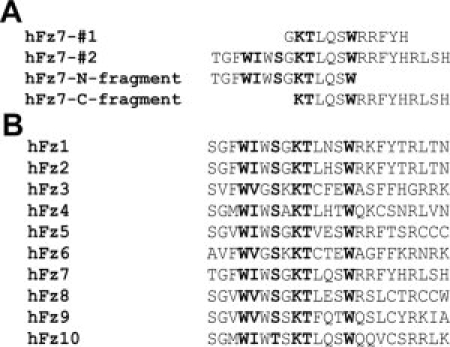
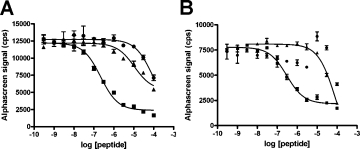
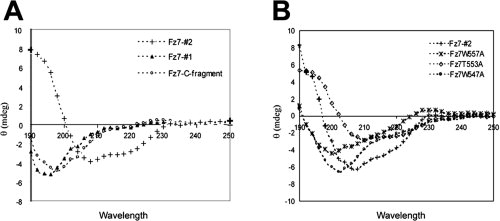
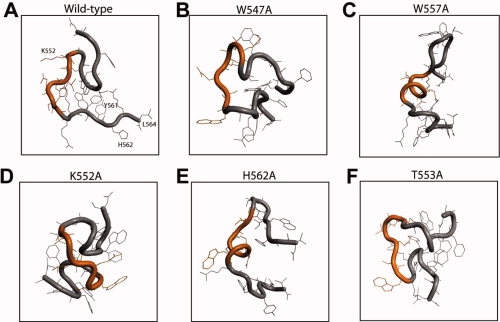
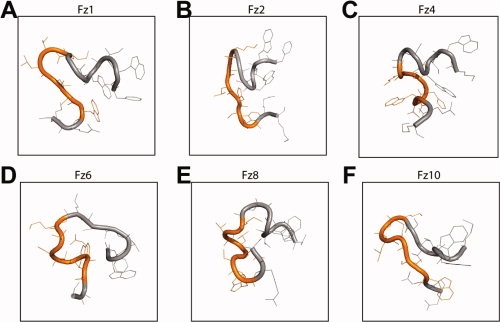
Members of the Wnt family of lipoglycoproteins initiate signaling by binding to Frizzled (Fz) receptors, and the signal is then relayed by Disheveled (Dvl). The Dvl PDZ domain is known to interact directly with a peptide derived from the KTXXXW motif of Fz7, which is conserved in all known Fz subtypes. We found that an extended region spanning the KTXXXW motif on both its N-terminal and C-terminal sides dramatically influences the affinity of peptides derived from Fz7 for Dvl PDZ. An alanine scanning study identified the specific residues external to the KTXXXW motif that are important for high-affinity binding. In a circular dichroism analysis, mutation of some of these critical residues resulted in peptide conformational changes, suggesting that the secondary structure of the peptides contributes to Fz-Dvl PDZ binding. Of the 10 known Fz subtypes, peptides derived from only Fz1, Fz2, Fz3, Fz4, and Fz7 directly bound to Dvl PDZ domain in our study. Other Fz subtypes, including some known to be involved in Wnt/beta-catenin signaling (Fz5, Fz9), did not bind to Dvl, suggesting that direct interaction with Dvl PDZ does not determine the subtype-specific functionality of Fz. Molecular modeling and circular dichroism studies indicated that the Fz peptides that bind to Dvl PDZ domain form specific conformations that are different from those of nonbinding peptides.
Figures
References
-
- Wodarz A, Nusse R. Mechanisms of Wnt signaling in development. Annu Rev Cell Dev Biol. 1998;14:59–88. - PubMed
-
- Luo J, Chen J, Deng ZL, Luo X, Song WX, Sharff KA, Tang N, Haydon RC, Luu HH, He TC. Wnt signaling and human diseases: what are the therapeutic implications? Lab Invest. 2007;87:97–103. - PubMed
-
- Gordon MD, Nusse R. Wnt signaling: multiple pathways, multiple receptors, and multiple transcription factors. J Biol Chem. 2006;281:22429–22433. - PubMed
-
- Veeman MT, Axelrod JD, Moon RT. A second canon. Functions and mechanisms of β-catenin-independent Wnt signaling. Dev Cell. 2003;5:367–377. - PubMed
-
- Yang-Snyder J, Miller JR, Brown JD, Lai CJ, Moon RT. A frizzled homolog functions in a vertebrate Wnt signaling pathway. Curr Biol. 1996;6:1302–1306. - PubMed
Publication types
MeSH terms
Substances
LinkOut - more resources
Full Text Sources
Molecular Biology Databases
