Review
. 2009 Jul;33(7):1125-35.
doi: 10.1111/j.1530-0277.2009.00936.x. Epub 2009 Apr 9.

Sizing up ethanol-induced plasticity: the role of small and large conductance calcium-activated potassium channels

Affiliations
Review

Sizing up ethanol-induced plasticity: the role of small and large conductance calcium-activated potassium channels

Patrick J Mulholland et al. Alcohol Clin Exp Res. 2009 Jul.

Abstract

Small (SK) and large conductance (BK) Ca(2+)-activated K(+) channels contribute to action potential repolarization, shape dendritic Ca(2+)spikes and postsynaptic responses, modulate the release of hormones and neurotransmitters, and contribute to hippocampal-dependent synaptic plasticity. Over the last decade, SK and BK channels have emerged as important targets for the development of acute ethanol tolerance and for altering neuronal excitability following chronic ethanol consumption. In this mini-review, we discuss new evidence implicating SK and BK channels in ethanol tolerance and ethanol-associated homeostatic plasticity. Findings from recent reports demonstrate that chronic ethanol produces a reduction in the function of SK channels in VTA dopaminergic and CA1 pyramidal neurons. It is hypothesized that the reduction in SK channel function increases the propensity for burst firing in VTA neurons and increases the likelihood for aberrant hyperexcitability during ethanol withdrawal in hippocampus. There is also increasing evidence supporting the idea that ethanol sensitivity of native BK channel results from differences in BK subunit composition, the proteolipid microenvironment, and molecular determinants of the channel-forming subunit itself. Moreover, these molecular entities play a substantial role in controlling the temporal component of ethanol-associated neuroadaptations in BK channels. Taken together, these studies suggest that SK and BK channels contribute to ethanol tolerance and adaptive plasticity.


Figures
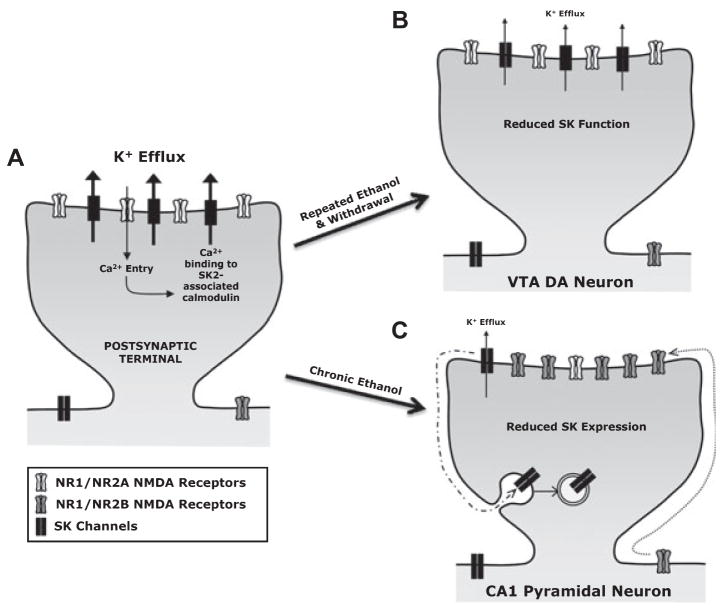
Fig. 1
Fig. 1
Disrupted function of SK2 channel–NMDA receptor feedback loop following chronic ethanol and withdrawal. (A) Studies have demonstrated that SK2 channels localize in the PSD of glutamatergic synapses and form a Ca2+-dependent negative feedback loop with synaptic NMDA receptors (Faber et al., 2005; Lin et al., 2008; Ngo-Anh et al., 2005). Ca2+entry through synaptic NMDA receptors is thought to bind to SK2-associated calmodulin and cause a confirmation change in calmodulin and SK2 channels that leads to K+ efflux. The increased K+ efflux hyperpolarizes the membrane potential and reduces excitability by promoting Mg2+re-block of NMDA receptors. (B) Chronic ethanol and withdrawal reduces SK channel function via an unknown mechanism in VTA DA neurons. The reduction in SK facilitates NMDA receptor-induced burst firing that may affect DA-mediated responses to ethanol or ethanol-related cues. (C) Proposed model for ethanol-induced homeostatic functional uncoupling of the synaptic SK2 channel-NMDA receptor feedback loop within hippocampal postsynaptic terminals. Chronic ethanol produces a homeostatic synaptic targeting of NR2B-containing NMDA receptors, and preliminary evidence suggests that chronic ethanol reduces surface SK2 channels. The opposing effects on SK2 channels and NMDA receptors represent a common homeostatic adaptive response to chronic ethanol exposure, and disruption of this feedback loop by ethanol likely contributes to the development of ethanol tolerance and to aberrant neuronal hyperexcitability during acute withdrawal.
Fig. 2
Fig. 2
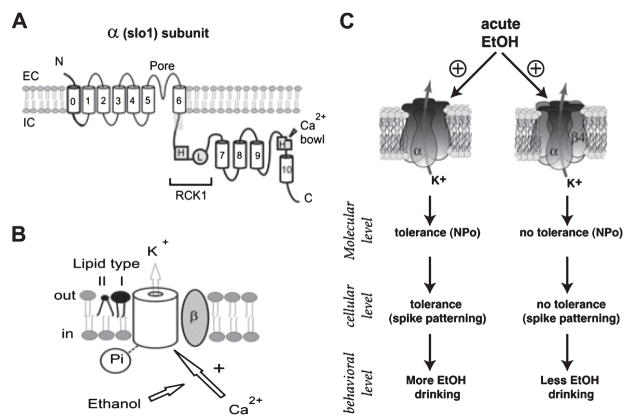
Molecular determinants of BK channel responses and adaptation to acute ethanol exposure. (A) Ethanol action on BK channels results from drug modulation of Ca2+-driven gating. Cartoon of the BK channel-forming α subunit, where bold traces highlight regions that are absent in voltage-gated TM6 K+ channels other than BK and control the ethanol sensitivity of this channel type. The main recognition sensors of divalents are labeled with H (high affinity) or L (low affinity); predominantly helical segments are shown as numbered cylinders; EC: extracellular, IC: intracellular. (B) Ethanol modulates Ca2+action after this divalent is recognized by sites shown above (see main text). Upon the fundamental Ca2+-slo1 subunit-ethanol interaction, final drug action is regulated by posttranslational modification of slo (phosphorylation), channel accessory β subunits, and the lipid microenvironment around the channel, with type-I and type-II lipids respectively facilitating and inhibiting ethanol-induced potentiation of channel activity. (C) Role of BK channel β4 subunit on acute ethanol tolerance. At the molecular level, acute ethanol increases α and αβ4 BK channel open probability in HEK-293 cells and MSNs. However, the activity of α BK channels (left column) returns to control levels shortly (7 to 8 minutes) after the beginning of drug exposure, indicating the development of tolerance, while that of αβ4 BK channels (right column) remains potentiated. At the cellular level, acute ethanol depresses excitability of striatal MSNs through its action on BK channels. This effect is transient in neurons expressing α, but not αβ4 BK channels. Behaviorally, in the absence of β4, the changes in locomotor activity following ethanol injection show acute tolerance, whereas acute tolerance of this behavioral measure is severely reduced in mice expressing the β4 subunit. Finally, β4 KO mice, exhibited a marked increase in ethanol consumption, compared to WT mice. Thus, the data at multiple levels of analysis establish the importance of BK β4 on acute ethanol tolerance, and support a link between acute tolerance and drinking behavior.

References

    1. Allen D, Fakler B, Maylie J, Adelman JP. Organization and regulation of small conductance Ca2+-activated K+ channel multiprotein complexes. J Neurosci. 2007;27:2369–2376. - PMC - PubMed
    1. Anderson NJ, Slough S, Watson WP. In vivo characterisation of the small-conductance KCa (SK) channel activator 1-ethyl-2-benzimidazolinone (1-EBIO) as a potential anticonvulsant. Eur J Pharmacol. 2006;546:48–53. - PubMed
    1. Bailey CP, Manley SJ, Watson WP, Wonnacott S, Molleman A, Little HJ. Chronic ethanol administration alters activity in ventral tegmental area neurons after cessation of withdrawal hyperexcitability. Brain Res. 1998;803:144–152. - PubMed
    1. Bailey CP, O’Callaghan MJ, Croft AP, Manley SJ, Little HJ. Alterations in mesolimbic dopamine function during the abstinence period following chronic ethanol consumption. Neuropharmacology. 2001;41:989–999. - PubMed
    1. Bond CT, Maylie J, Adelman JP. SK channels in excitability, pacemaking and synaptic integration. Curr Opin Neurobiol. 2005;15:305–311. - PubMed

Publication types

MeSH terms

Substances