CCR5 deletion protects against inflammation-associated mortality in dialysis patients
- PMID: 19389855
- PMCID: PMC2709675
- DOI: 10.1681/ASN.2008040432
CCR5 deletion protects against inflammation-associated mortality in dialysis patients
Abstract
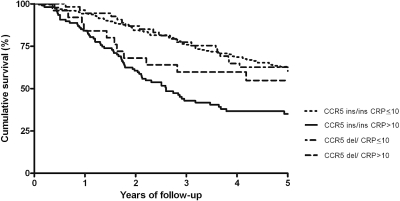
The CC-chemokine receptor 5 (CCR5) is a receptor for various proinflammatory chemokines, and a deletion variant of the CCR5 gene (CCR5 Delta 32) leads to deficiency of the receptor. We hypothesized that CCR5 Delta 32 modulates inflammation-driven mortality in patients with ESRD. We studied the interaction between CCR5 genotype and levels of high-sensitivity C-reactive protein (hsCRP) in 603 incident dialysis patients from the multicenter, prospective NEtherlands COoperative Study on the Adequacy of Dialysis (NECOSAD) cohort. CCR5 genotype and hsCRP levels were both available for 413 patients. During 5 yr of follow-up, 170 patients died; 87 from cardiovascular causes. Compared with the reference group of patients who had the wild-type CCR5 genotype and hsCRP <or= 10 mg/L (n = 225), those carrying the deletion allele with hsCRP <or= 10 mg/L (n = 55) had similar mortality, and those carrying the wild-type genotype with hsCRP > 10 mg/L (n = 108) had an increased risk for mortality (HR: 1.82; 95% CI: 1.29 to 2.58). However, those carrying the deletion allele with hsCRP > 10 mg/L (n = 25) had a mortality rate similar to the reference group; this seemingly protective effect of the CCR5 deletion was even more pronounced for cardiovascular mortality. We replicated these findings in an independent Swedish cohort of 302 ESRD patients. In conclusion, the CCR5 Delta 32 polymorphism attenuates the adverse effects of inflammation on overall and cardiovascular mortality in ESRD.
Figures
Comment in
-
Do genes allow inflammation to kill or not to kill?J Am Soc Nephrol. 2009 Jul;20(7):1429-31. doi: 10.1681/ASN.2009050510. Epub 2009 Jun 11. J Am Soc Nephrol. 2009. PMID: 19520751 No abstract available.
References
-
- Foley RN, Parfrey PS, Sarnak MJ: Epidemiology of cardiovascular disease in chronic renal disease. J Am Soc Nephrol 9: S16–S23, 1998 - PubMed
-
- Lacson E, Jr., Levin NW: C-reactive protein and end-stage renal disease. Semin Dial 17: 438–448, 2004 - PubMed
-
- Pearson TA, Mensah GA, Alexander RW, Anderson JL, Cannon RO, III, Criqui M, Fadl YY, Fortmann SP, Hong Y, Myers GL, Rifai N, Smith SC, Jr., Taubert K, Tracy RP, Vinicor F: Markers of inflammation and cardiovascular disease: Application to clinical and public health practice: A statement for healthcare professionals from the Centers for Disease Control and Prevention and the American Heart Association. Circulation 107: 499–511, 2003 - PubMed
-
- den Elzen WP, van Manen JG, Boeschoten EW, Krediet RT, Dekker FW: The effect of single and repeatedly high concentrations of C-reactive protein on cardiovascular and non-cardiovascular mortality in patients starting with dialysis. Nephrol Dial Transplant 21: 1588–1595, 2006 - PubMed
Publication types
MeSH terms
Substances
LinkOut - more resources
Full Text Sources
Medical
Research Materials