. 2009 Apr 15;23(8):939-50.
doi: 10.1101/gad.524609.

Compromised stability of DNA methylation and transposon immobilization in mosaic Arabidopsis epigenomes

Affiliations

Compromised stability of DNA methylation and transposon immobilization in mosaic Arabidopsis epigenomes

Jon Reinders et al. Genes Dev. .

Abstract

Transgenerational epigenetic inheritance has been defined by the study of relatively few loci. We examined a population of recombinant inbred lines with epigenetically mosaic chromosomes consisting of wild-type and CG methylation-depleted segments (epiRILs). Surprisingly, transposons that were immobile in the parental lines displayed stochastic movement in 28% of the epiRILs. Although analysis after eight generations of inbreeding, supported by genome-wide DNA methylation profiling, identified recombined parental chromosomal segments, these were interspersed with unexpectedly high frequencies of nonparental methylation polymorphism. Hence, epigenetic inheritance in hybrids derived from parents with divergent epigenomes permits long-lasting epi-allelic interactions that violate Mendelian expectations. Such persistently "unstable" epigenetic states complicate linkage-based epigenomic mapping. Thus, future epigenomic analyses should consider possible genetic instabilities and alternative mapping strategies.


Figures
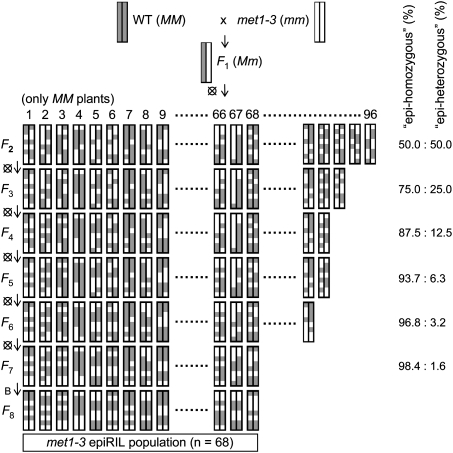
Figure 1.
Figure 1.
Construction of the epiRIL population, illustrated by one pair of chromosomes. Parental chromosomes and their segments are marked wild type (gray, WT, MM) and met1-3 (white, met1-3, mm). Eight generations of inbreeding (vertical) are marked as F2 to F8 (crossed circles at the left mark single-seed descent). A bulk harvest of individuals at F7 is marked by B. Predicted levels of “epi-homozygosity” and “epi-heterozygosity” at each generation are indicated on the right.
Figure 2.
Figure 2.
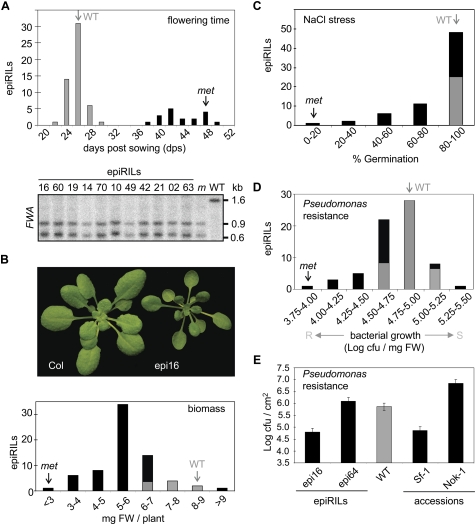
Phenotypic variation within the epiRILs (see the Supplemental Material for details). All graphs (except E) display trait variation (X-axis) and the number of epiRILs per trait interval (Y-axis). The proportions of epiRILs statistically equal to or different from wild type (95% confidence level) are marked by gray and black areas, respectively. The wild-type and met1-3 averages are indicated by marked gray and black arrows, respectively. (dps) Days post-sowing; (cfu) colony-forming units; (FW) fresh weight. (A) Flowering time (top panel) and Southern blot analysis at the FWA locus using CfoI-digested DNA (bottom panel). Late flowering epiRILs with numbers indicated above each lane were compared with the parental lines. (WT) Wild type; (m) met1-3. The FWA probe was designed as described previously (Soppe et al. 2000). (B) Biomass. Representative wild-type and epi16 plants at 35 dps are shown above the graph. (C) Salt-stress response. Germination rates of seeds (% Germination) in the presence of 150 mM NaCl at 4 dps. (D) Pseudomonas resistance. Resistant (R) and susceptible (S) responses are indicated (X-axis). (E) The resistance to Pseudomonas of epiRILs and selected Arabidopsis accessions. The average bacterial titer levels at 3 d post-infection (dpi) in Log cfu per square centimeter (error bars, SD; Fisher's LSD test; 95% confidence limit).
Figure 3.
Figure 3.
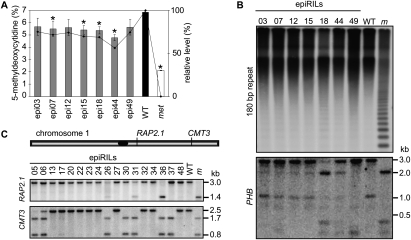
Inheritance of DNA methylation. (A) mC content in DNA of epiRILs and parental lines. (Left) mC relative to total C. (Right) mC relative to the parental lines (wild type, 100%; met1-3 level, 0%; error bars, SD) (B) Southern blots of HpaII-digested DNA hybridized to probes specific to the centromeric 180-bp repeat (top blot) or the PHB locus (bottom blot). (C) DNA methylation patterns at RAP2.1 and CMT3 loci. Southern blots of HpaII-digested DNA from 17 epiRILs (numbers above the lanes) and parental controls. (WT) Wild type; (m) met1-3. The loci positions are shown on the chromosome above the blot (centromere marked black). Restriction maps corresponding to the fragment sizes (shown at right) are shown in Supplemental Figure 5.
Figure 4.
Figure 4.
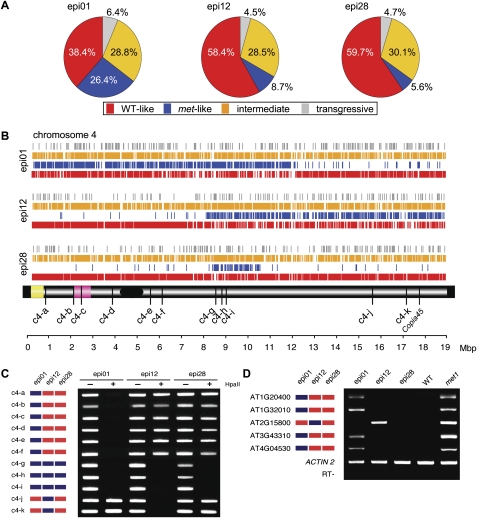
Epigenomic mapping of DNA methylation polymorphisms. (A) Genome-wide DNA methylation polymorphism composition (%) per epiRIL (for more detail, see Supplemental Table 3). (B) Distribution of signals along chromosome 4 for each of three epiRILs and a simplified chromosome 4 map below indicating the centromere (black), the heterochromatic knob (pink), and the nucleolus organizer region (yellow) (distances in Mbp shown at the bottom). The hybridization signals are color-coded as in A. (C) Validation of parental methylation polymorphisms (color-coded as in A and displayed on the left for each locus). PCR amplification was performed with undigested (−) and HpaII-digested (+) DNA. (D) EpiRIL transcription patterns. Methylation profiling patterns are shown on the left (as in C). The epiRIL transcripts were detected by RT–PCR and compared with the parental expression patterns. (WT) wild type; (met1) met1-3. Actin2 and RT are displayed for each locus (RT reactions without reverse transcriptase using primers for centromeric repeats as described before in Mathieu et al. (2007).
Figure 5.
Figure 5.
Inheritance of DNA methylation patterns at the Copia45 (AT4G37705) locus. (A) Hybridization signals of methylation profiling at Copia45 region for wild type, met1-3, epi01, epi12, and epi28. The parental assignment of informative tiles is provided below each signal graph of epiRILs (color-coded as in Fig. 4A; purple hybridization signal intensity). (B) HpaII restriction map of the Copia45 locus. The diagnostic HpaII site is marked by an asterisk in A and B. (C) Validation of the Copia45 methylation profiles by Southern blot analyses of F8 generation using HpaII-digested DNA isolated from 10 siblings per sample. (D) Southern blot revealing variation of DNA methylation patterns among F8 siblings. (E) Inheritance of DNA methylation patterns to F9 progeny. Four to five progeny (marked 1 to 5) were analyzed for each F8 progenitor plant (marked above the blot).
Figure 6.
Figure 6.
Inheritance of DNA methylation within wild-type-derived chromosome 5 region. (A) DNA methylation polymorphism distributions along chromosome 5 (color-coded as in Fig. 4A). The shared wild-type-derived chromosome 5 segments are marked by the red box (15.5–22.2 Mbp) (see also Supplemental Fig. 8B). Physical and genetic distances to the MET1 gene (Liu et al. 1996) for analyzed flanking loci are provided below. (B) Methylation polymorphisms in epi01, epi12, epi28, and an additional 17 epiRILs. Southern blots of HpaII-digested DNA hybridized with probes for loci c5-a to c5-c (details of probe design are given in Supplemental Table 2). Asterisks color-coded as for the methylation profiling indicate methylation patterns differing from wild type. (C) Transgenerational Southern blot analysis of DNA methylation patterns in epi12 (F3 to F9). (D) Southern blot methylation analysis of 10 individual plants of epi12 at F8.
Figure 7.
Figure 7.
Activation of CACTA transposition in epiRILs revealed by Southern blot analyses of EcoRV-digested DNA and probed as reported previously (Miura et al. 2001). (A) The parental lines wild type, second, and fourth generation met1-3 (WT, m2, and m4, respectively) (left panel), and four random epiRILs (right panel). (B) Transgenerational analysis (F3 to F9) of epi07 (see also Supplemental Fig. 10). (C) Stochastic onset of CACTA transposition in epi07 siblings at the F4 generation.

References

    1. Bao N., Lye K.W., Barton M.K. MicroRNA binding sites in Arabidopsis class III HD-ZIP mRNAs are required for methylation of the template chromosome. Dev. Cell. 2004;7:653–662. - PubMed
    1. Chan S.W., Henderson I.R., Jacobsen S.E. Gardening the genome: DNA methylation in Arabidopsis thaliana. Nat. Rev. Genet. 2005;6:351–360. - PubMed
    1. Chandler V., Alleman M. Paramutation: Epigenetic instructions passed across generations. Genetics. 2008;178:1839–1844. - PMC - PubMed
    1. Cokus S.J., Feng S., Zhang X., Chen Z., Merriman B., Haudenschild C.D., Pradhan S., Nelson S.F., Pellegrini M., Jacobsen S.E. Shotgun bisulphite sequencing of the Arabidopsis genome reveals DNA methylation patterning. Nature. 2008;452:215–219. - PMC - PubMed
    1. Fan J., Crooks C., Lamb C. High-throughput quantitative luminescence assay of the growth in planta of Pseudomonas syringae chromosomally tagged with Photorhabdus luminescens luxCDABE. Plant J. 2008;53:393–399. - PubMed

Publication types

Substances