. 2010 Mar-Apr;29(2):294-312.
doi: 10.1002/mas.20232.

The ion funnel: theory, implementations, and applications

Affiliations

The ion funnel: theory, implementations, and applications

Ryan T Kelly et al. Mass Spectrom Rev. 2010 Mar-Apr.

Abstract

The electrodynamic ion funnel has enabled the manipulation and focusing of ions in a pressure regime (0.1-30 Torr) that has challenged traditional approaches, and provided the basis for much greater mass spectrometer ion transmission efficiencies. The initial ion funnel implementations aimed to efficiently capture ions in the expanding gas jet of an electrospray ionization interface and radially focus them for efficient transfer through a conductance limiting orifice. We review the improvements in fundamental understanding of ion motion in ion funnels, the evolution in its implementations that have brought the ion funnel to its current state of refinement, as well as applications of the ion funnel for purposes such as ion trapping, ion cooling, low pressure electrospray, and ion mobility spectrometry.


Figures

Figure 1
Figure 1
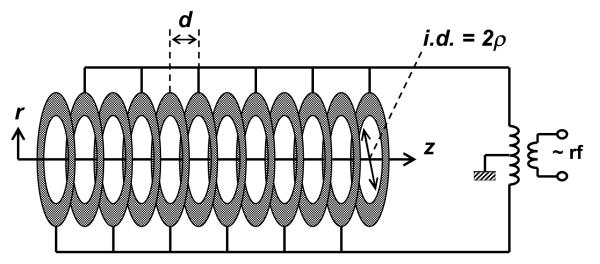
Diagram of a stacked ring rf ion guide.
Figure 2
Figure 2
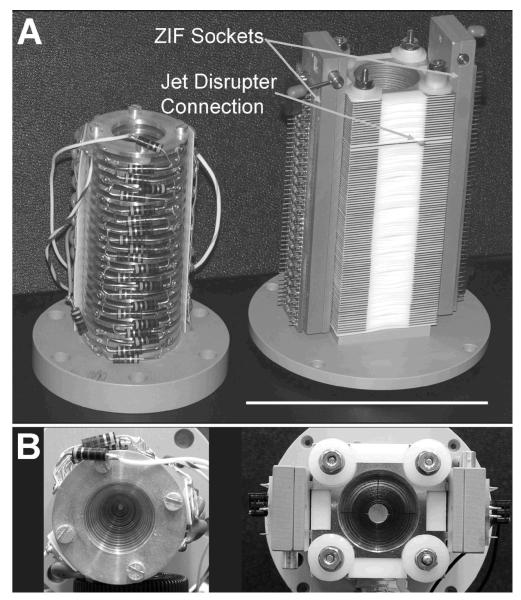
Ion funnel photographs. (A) Side-view images of the original 28 electrode prototype (left) and a currently used 100 electrode design with jet disrupter (right). Scale bar is 100 mm. (B) Corresponding top-view images. The jet disrupter electrode can be seen in the current design (right).
Figure 3
Figure 3
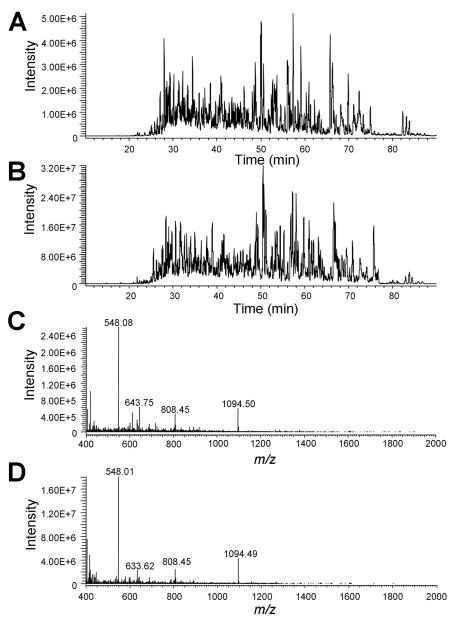
Base peak chromatograms from the LC—MS analysis of a global tryptic digest of S. oneidensis using the standard instrument interface (A) and the ion funnel interface (B). Representative mass spectra from (A) and (B) are shown in (C) and (D), respectively. Adapted with permission from (Page et al., 2007).
Figure 4
Figure 4
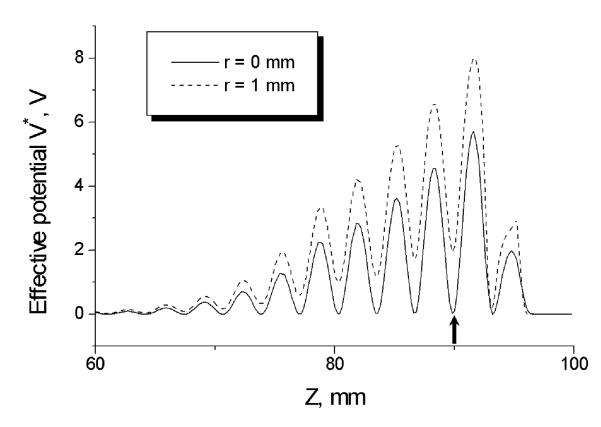
Effective rf potential along the ion funnel central (z) axis for the ion funnel prototype developed by Shaffer, et al. (1999). The effective potential is calculated according to equation (1), using numerically computed electric field intensity. The parameters are: m/z = 1000, Vrf =100 V, rf frequency = 700 kHz. The axial interval shown corresponds to the final 11 ring electrodes of the ion funnel and the 1-mm-i.d. conductance limit located at z = 96mm. The axial position of the largest axial well is indicated by the arrow. Adapted with permission from (Shaffer et al., 1999).
Figure 5
Figure 5
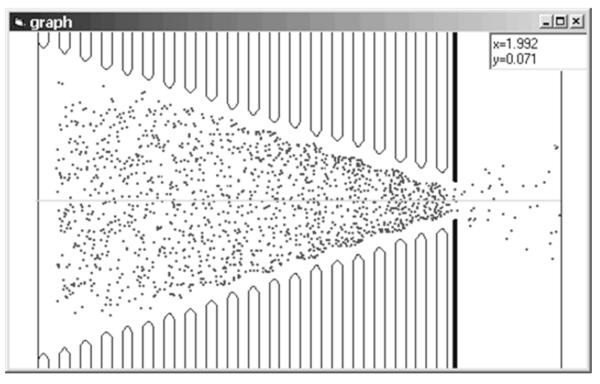
Screen capture of the ion funnel computer model simulation for the design of Kim, et al. (Kim, et al., 2000a). Vpp = 200V; frequency = 0.7 MHz; dc gradient = 30 V/cm; input current = 8 nA; m/z = 1000. Exit configuration: final rf ring = 2 mm i.d.; dc-only conductance limit (1.5 mm) positioned 0.5 mm from the final rf ring.
Figure 6
Figure 6
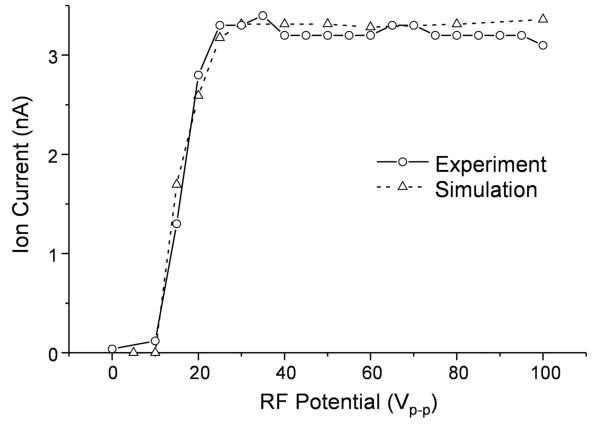
Experimental (circles) and simulated (triangles) dependence of ion transmission on rf potential for gramicidin ions using the 100 electrode ion funnel design (Kim, et al., 2000a). The ion current was measured after the ion funnel exit for P = 1 Torr; input current = 5 nA; frequency = 0.7 MHz; axial dc field = 16 V/cm. Simulations used the same conditions. Adapted with permission from (Tolmachev et al., 2000).
Figure 7
Figure 7
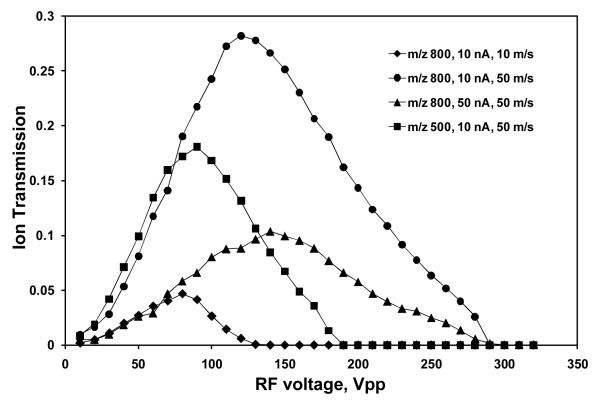
Ion transmission efficiency vs. rf voltage simulated using the computer model of the progressively spaced stacked ring ion guide. The ion m/z, current, and initial velocity corresponding to each curve are shown in the figure. The modeled configuration consisted of 11 ring rf electrodes, 5 mm i.d., with the spacing progressively increasing from 2 to 5 mm. The exit DC-only ring electrode, 2 mm i.d., is positioned 1.5 mm from the final rf ring electrode. The rf frequency was 700 kHz, gas pressure was 1 Torr (N2), and a uniform gas flow along z-axis was assumed. The initial ion cloud was 2.5 mm in diameter.
Figure 8
Figure 8
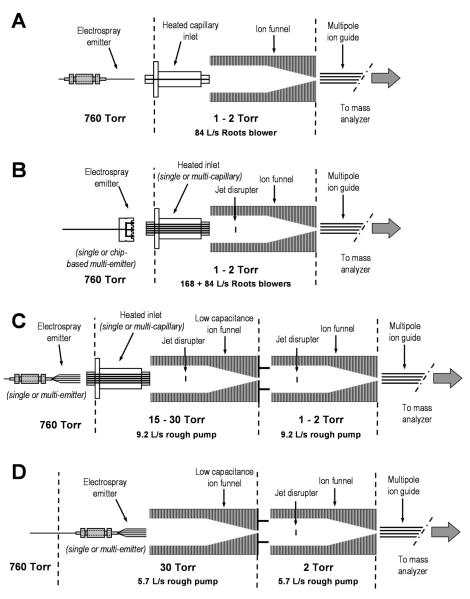
Drawings of various ESI/ion funnel interfaces. (A) The initial ion funnel design (Shaffer et al., 1998), using single capillary inlets and high-speed pumps. (B) Implementation of multiple heated inlet capillaries (Kim et al., 2000b), which increased ion transmission but also increased the pumping requirements, even when a jet disrupter electrode was used. (C) Higher pressure ion funnel operated in tandem with a standard ion funnel (Ibrahim et al., 2006). The additional pumping stage enables the use of low-speed pumps. (D) A low pressure ESI interface, in which the electrospray source sprays directly into an ion funnel, eliminating the transmission losses that normally occur at the inlet (Page et al., 2008b).
Figure 9
Figure 9
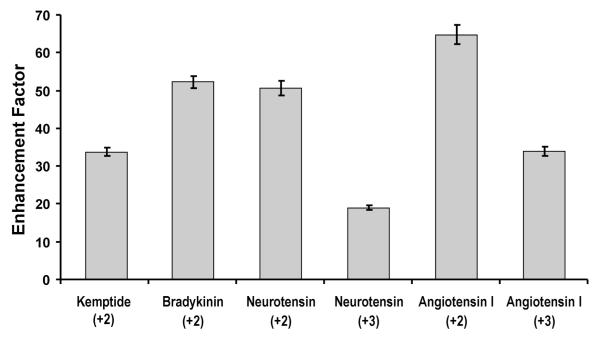
Sensitivity enhancements afforded by the use of a linear array of 19 emitters, a multi-capillary heated inlet, and high-pressure ion funnel interface compared with the commercial instrument configuration (Kelly et al., 2008a). The peptides in the mixture each had a concentration of 500 nM and the solution flow rate was 2 μL/min.
Figure 10
Figure 10
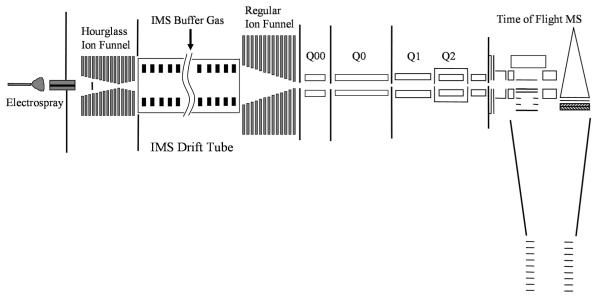
Schematic of the ESI-IMS-QTOF instrument with ion funnels at the entrance and exit of the ion mobility drift tube. Adapted with permission from (Tang et al., 2005).
Figure 11
Figure 11
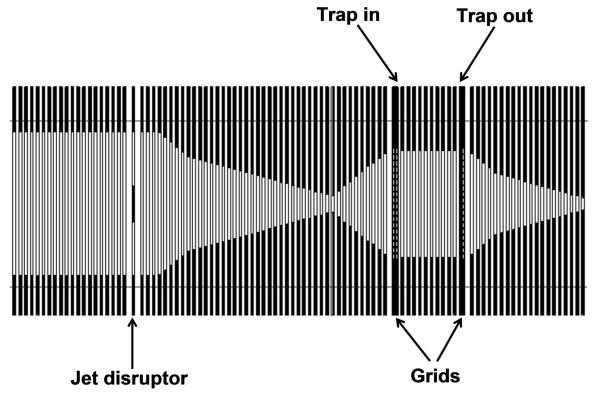
Diagram of an ion funnel trap. Adapted with permission from (Ibrahim et al., 2007).

References

    1. Almekinders JC, Jones C. Multiple jet electrohydrodynamic spraying and applications. J. Aerosol Sci. 1999;30:969–971.
    1. Andrews CL, Yu C-P, Yang E, Vouros P. Improved liquid chromatography—mass spectrometry performance in quantitative analysis using a nanosplitter interface. J. Chromatogr. A. 2004;1053:151–159. - PubMed
    1. Asbury GR, Hill HH. Evaluation of ultrahigh resolution ion mobility spectrometry as an analytical separation device in chromatographic terms. J. Microcolumn Sep. 2000;12:172–178.
    1. Baker ES, Hong JW, Gaylord BS, Bazan GC, Bowers MT. PNA/dsDNA complexes: Site specific binding and dsDNA biosensor applications. J. Am. Chem. Soc. 2006;128:8484–8492. - PubMed
    1. Baker ES, Bowers MT. B-DNA helix stability in a solvent-free environment. J. Am. Soc. Mass Spectrom. 2007;18:1188–1195. - PubMed

Publication types

MeSH terms

LinkOut - more resources