. 2009 Apr 24:10:121.
doi: 10.1186/1471-2105-10-121.

SNP HiTLink: a high-throughput linkage analysis system employing dense SNP data

Affiliations

SNP HiTLink: a high-throughput linkage analysis system employing dense SNP data

Yoko Fukuda et al. BMC Bioinformatics. .

Abstract

Background: During this recent decade, microarray-based single nucleotide polymorphism (SNP) data are becoming more widely used as markers for linkage analysis in the identification of loci for disease-associated genes. Although microarray-based SNP analyses have markedly reduced genotyping time and cost compared with microsatellite-based analyses, applying these enormous data to linkage analysis programs is a time-consuming step, thus, necessitating a high-throughput platform.

Results: We have developed SNP HiTLink (SNP High Throughput Linkage analysis system). In this system, SNP chip data of the Affymetrix Mapping 100 k/500 k array set and Genome-Wide Human SNP array 5.0/6.0 can be directly imported and passed to parametric or model-free linkage analysis programs; MLINK, Superlink, Merlin and Allegro. Various marker-selecting functions are implemented to avoid the effect of typing-error data, markers in linkage equilibrium or to select informative data.

Conclusion: The results using the 100 k SNP dataset were comparable or even superior to those obtained from analyses using microsatellite markers in terms of LOD scores obtained. General personal computers are sufficient to execute the process, as runtime for whole-genome analysis was less than a few hours. This system can be widely applied to linkage analysis using microarray-based SNP data and with which one can expect high-throughput and reliable linkage analysis.


Figures
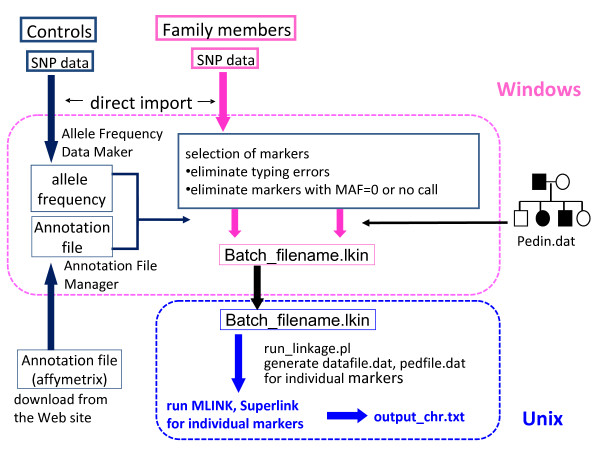
Figure 1
Figure 1
Flowcharts of data processing for pair-wise linkage analysis employing MLINK or Superlink by SNP HiTLink. In Windows OS, import of SNP data, generation of allele frequency file, annotation file and lkin file are conducted along with selection of markers. After lkin file is transported to Unix OS, run_linkage.pl carries out continuous run of MLINK or Superlink by rewriting pedin.pre and pedin.dat files for each marker.
Figure 2
Figure 2
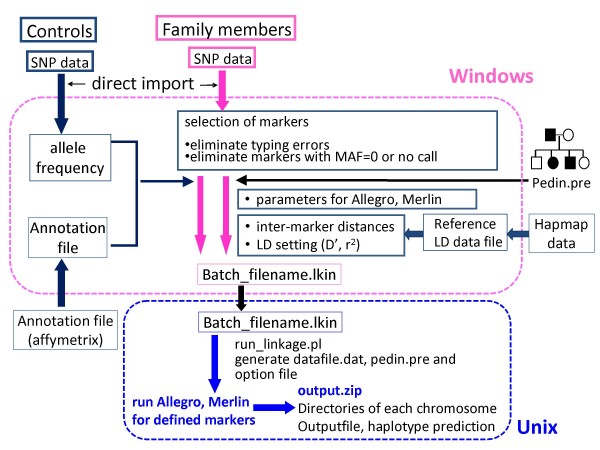
Flowcharts of data processing for multipoint linkage analysis employing Merlin or Allegro with SNP HiTLink. Procedures are basically similar to those by pair-wise analysis except that the model setting, selection of intermarker distances are executable here. run_linkage.pl carries out a run of Allegro or Merlin with all selected markers by writing whole information in pedin.pre, datain.dat.
Figure 3
Figure 3
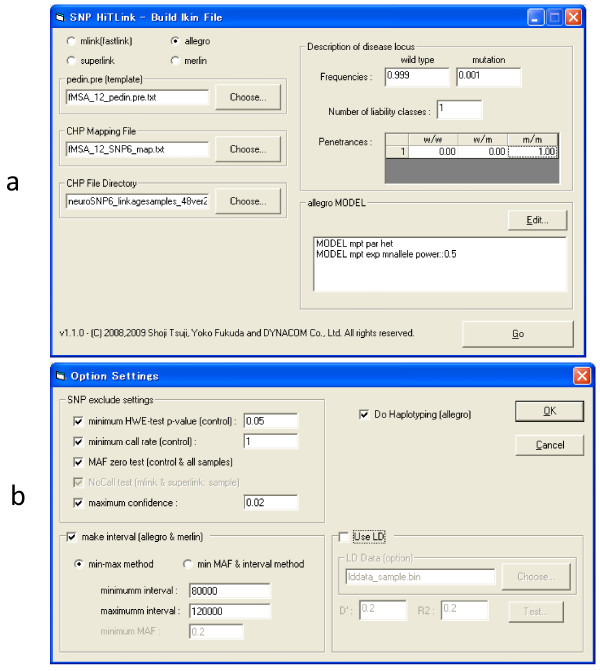
Interface of first step of "build lkin file"(a) and "option settings"(b) of SNP HiTLink.
Figure 4
Figure 4
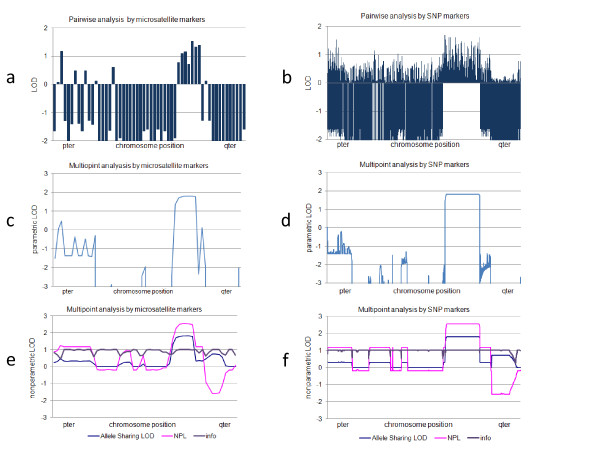
Results of pairwise analysis (a and b) by MLINK, multipoint parametric analysis (c and d), and multipoint nonparametric analysis (e and f) by Allegro employing microsatellite (a, c and e) and 100KSNP (b, d, and f) markers. SNP markers were selected as confidence score < 0.1, HWE > 0.05, call rate > 0.95, and intervals of 100 kb (for multipoint analysis). The x-axis represents the position on each chromosome and the y-axis represents calculated parametric LOD scores (allele sharing LOD), nonparametric linkage scores (NPL), or information measures (info).
Figure 5
Figure 5
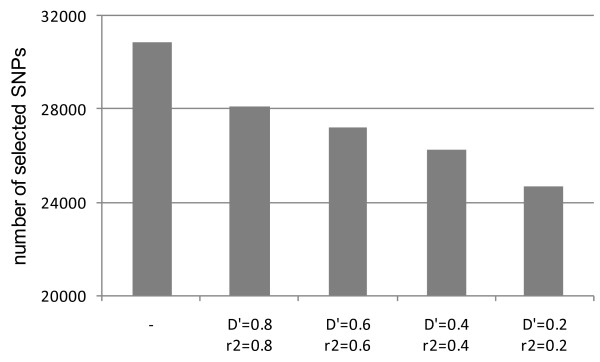
Number of markers on chromosome 1 employed in multipoint analysis (intervals of 100–500 bp, confidence score < 0.02, and HWE > 0.05, call rate = 1) with varied LD settings. DNA obtained from two affected siblings of a family was analyzed using Genome-Wide Human SNP array 6.0.
Figure 6
Figure 6
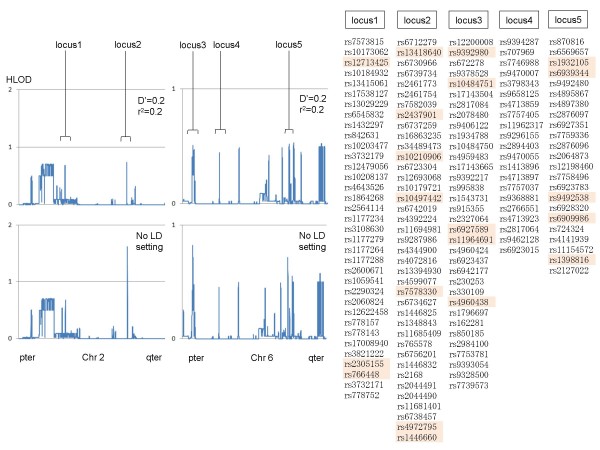
Effect of LD between markers on multipoint parametric heterogeneity LOD scores on chromosome 2 and 6. Multipoint analysis by Allegro (intervals of 100–500 bp, confidence score < 0.02, and HWE > 0.05) were conducted with strict LD settings (D' = r2 = 0.2) or without settings. Results of chromosome 2 and 6 were shown. DNAs obtained from four affected sibling pairs were analyzed by Genome-Wide Human SNP array 6.0. SNP IDs of five loci were extracted. Colored SNP IDs are those eliminated in analysis with LD settings.

References

    1. Evans DM, Cardon LR. Guidelines for genotyping in genomewide linkage studies: single-nucleotide-polymorphism maps versus microsatellite maps. Am J Hum Genet. 2004;75:687–692. doi: 10.1086/424696. - DOI - PMC - PubMed
    1. Matise TC, Sachidanandam R, Clark AG, Kruglyak L, Wijsman E, Kakol J, Buyske S, Chui B, Cohen P, de Toma C, et al. A 3.9-centimorgan-resolution human single-nucleotide polymorphism linkage map and screening set. Am J Hum Genet. 2003;73:271–284. doi: 10.1086/377137. - DOI - PMC - PubMed
    1. John S, Shephard N, Liu G, Zeggini E, Cao M, Chen W, Vasavda N, Mills T, Barton A, Hinks A, et al. Whole-genome scan, in a complex disease, using 11,245 single-nucleotide polymorphisms: comparison with microsatellites. Am J Hum Genet. 2004;75:54–64. doi: 10.1086/422195. - DOI - PMC - PubMed
    1. Cottingham RW, Jr, Idury RM, Schaffer AA. Faster sequential genetic linkage computations. Am J Hum Genet. 1993;53:252–263. - PMC - PubMed
    1. Lathrop GM, Lalouel JM, Julier C, Ott J. Strategies for multilocus linkage analysis in humans. Proc Natl Acad Sci USA. 1984;81:3443–3446. doi: 10.1073/pnas.81.11.3443. - DOI - PMC - PubMed

Publication types