


Fourth-grade children's dietary recall accuracy is influenced by retention interval (target period and interview time)
- PMID: 19394471
- PMCID: PMC2706914
- DOI: 10.1016/j.jada.2009.02.015
Fourth-grade children's dietary recall accuracy is influenced by retention interval (target period and interview time)
Abstract
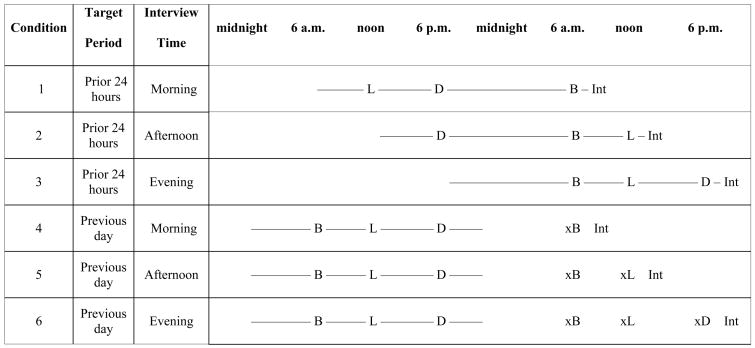
Background: For a 24-hour dietary recall, two possible target periods are the prior 24 hours (24 hours immediately preceding the interview time) and previous day (midnight to midnight of the day before the interview), and three possible interview times are morning, afternoon, and evening. Target period and interview time determine the retention interval (elapsed time between to-be-reported meals and the interview), which, along with intervening meals, can influence reporting accuracy.
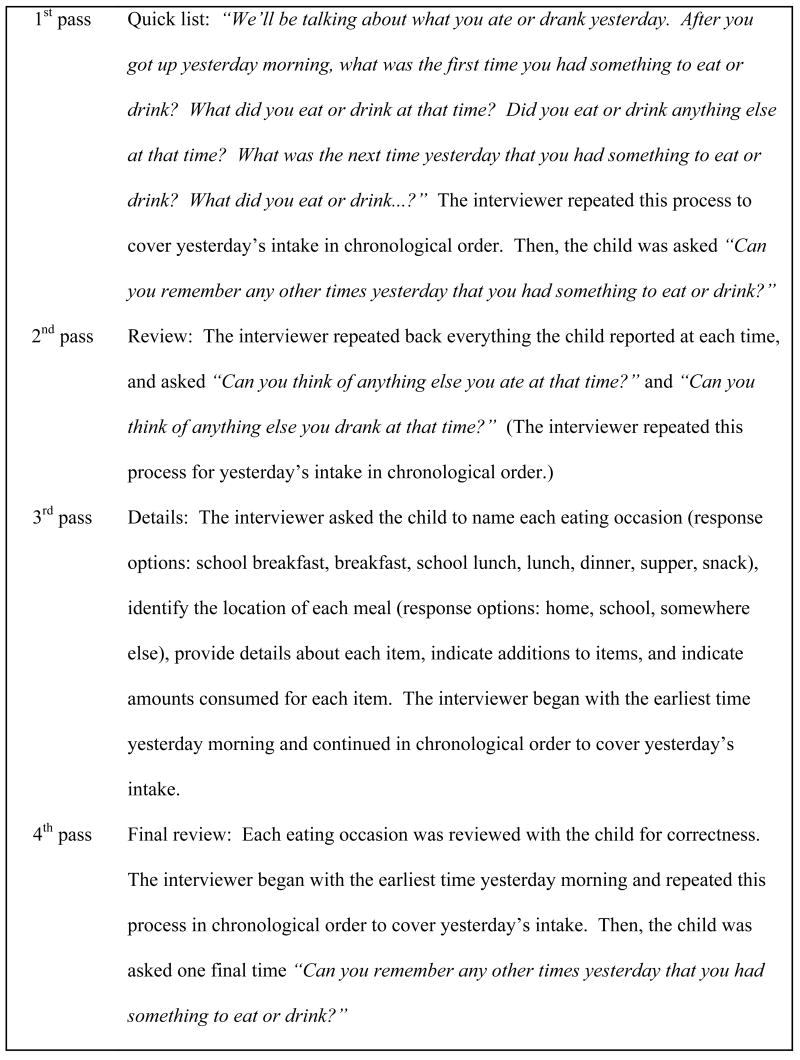
Objective: The effects of target period and interview time on children's accuracy for reporting school meals during 24-hour dietary recalls were investigated. DESIGN AND SUBJECTS/SETTING: During the 2004-2005, 2005-2006, and 2006-2007 school years in Columbia, SC, each of 374 randomly selected fourth-grade children (96% African American) was observed eating two consecutive school meals (breakfast and lunch) and interviewed to obtain a 24-hour dietary recall using one of six conditions defined by crossing two target periods with three interview times. Each condition had 62 or 64 children (half boys).
Main outcome measures: Accuracy for reporting school meals was quantified by calculating rates for omissions (food items observed eaten but unreported) and intrusions (food items reported eaten but unobserved); a measure of total inaccuracy combined errors for reporting food items and amounts.
Statistical analyses performed: For each accuracy measure, analysis of variance was conducted with target period, interview time, their interaction, sex, interviewer, and school year in the model.
Results: There was a target-period effect and a target-period by interview-time interaction on omission rates, intrusion rates, and total inaccuracy (six P values <0.004). For prior-24-hour recalls compared to previous-day recalls, and for prior-24-hour recalls in the afternoon and evening compared to previous-day recalls in the afternoon and evening, omission rates were better by one third, intrusion rates were better by one half, and total inaccuracy was better by one third.
Conclusions: To enhance children's dietary recall accuracy, target periods and interview times that minimize the retention interval should be chosen.
Figures




References
-
- Burghardt J, Ensor T, Hutchinson G, Weiss C, Spencer B. Contract No. 53-3198-0-16; MPR Reference No. 7937-140. Princeton, NJ: Princeton, NJ: Mathematica Policy Research, Inc; 1993. [Accessed October 5, 2008]. The School Nutrition Dietary Assessment Study: Data collection and sampling. http://www.fns.usda.gov/oane/MENU/Published/CNP/FILES/SNDA-Datacol.pdf.
-
- US Department of Agriculture, Food and Nutrition Service, Office of Research, Nutrition, and Analysis. School Nutrition Dietary Assessment Study-III: Volume II: Student Participation and Dietary Intakes, by A Gordon, et al., Project Officer: P McKinney, Report No. CN-7-SNDA-III. Alexandria, VA: 2007. [Accessed October 5, 2008]. http://www.fns.usda.gov/oane/menu/Published/CNP/FILES/SNDAIII-Vol2.pdf#x....
-
- Moore HJ, Ells LJ, McLure SA, Crooks S, Cumbor D, Summerbell CD, Batterham AM. The development and evaluation of a novel computer program to assess previous-day dietary and physical activity behaviours in school children: The Synchronised Nutrition and Activity Program™ (SNAP™) Br J Nutr. 2008;99:1266–1274. - PubMed
-
- Todd KS, Kretsch MJ. Accuracy of the self-reported dietary recall of new immigrant and refugee children. Nutr Res. 1986;6:1031–1043.
Publication types
MeSH terms
Grants and funding
LinkOut - more resources
Full Text Sources
Medical
