. 2009 Jun;19(6):987-93.
doi: 10.1101/gr.092668.109. Epub 2009 Apr 24.

The colorectal cancer risk at 18q21 is caused by a novel variant altering SMAD7 expression

Affiliations

The colorectal cancer risk at 18q21 is caused by a novel variant altering SMAD7 expression

Alan M Pittman et al. Genome Res. 2009 Jun.

Abstract

Recent genome-wide scans for colorectal cancer (CRC) have revealed the SMAD7 (mothers against decapentaplegic homolog 7) gene as a locus associated with a modest, but highly significant increase in CRC risk. To identify the causal basis of the association between 18q21 variation and CRC, we resequenced the 17-kb region of linkage disequilibrium and evaluated all variants in 2532 CRC cases and 2607 controls. A novel C to G single nucleotide polymorphism (SNP) at 44,703,563 bp was maximally associated with CRC risk (P = 5.98 x 10(-7); > or =1.5-fold more likely to be causal than other variants). Using transgenic assays in Xenopus laevis as a functional model, we demonstrate that the G risk allele leads to reduced reporter gene expression in the colorectum (P = 5.4 x 10(-3)). Electrophoretic mobility shift assays provided evidence for the role of Novel 1 in transcription factor binding. We propose that the novel SNP we have identified is the functional change leading to CRC predisposition through differential SMAD7 expression and, hence, aberrant TGF-beta signaling.


Figures
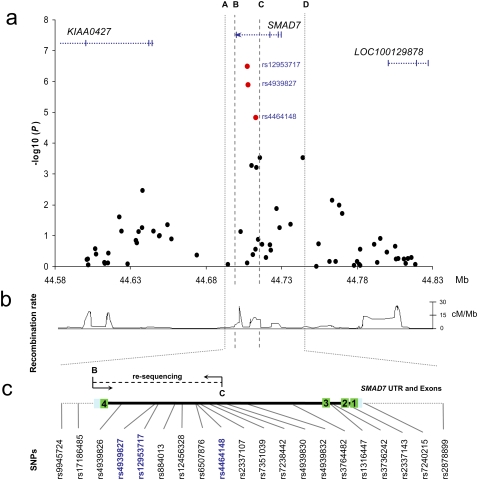
Figure 1.
Figure 1.
The SMAD7 locus. (a) Single-marker association statistics (as –log10 values) as a function of genomic position (NCBI build 36.1) obtained in the GWAS (Broderick et al. 2007) covering SMAD7 and 100 kb of flanking sequence. All known genes and transcripts in the area are shown (UCSC 2006 March 2006 assembly, NCBI build 36.1). (b) Recombination rate (cM/Mb) across the region derived from HapMap project data (release 21a). (c) The interval between B and C corresponds to the 17-kb region resequenced.
Figure 2.
Figure 2.
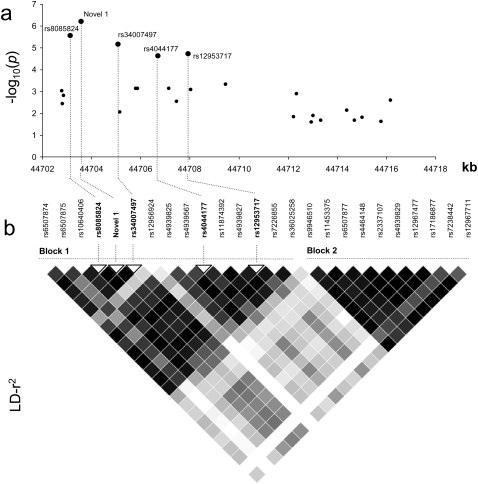
(a) Single marker association statistics (as –log10 values) for each of the 25 SNPs mapping to the 17-kb region sequenced. The five SNPs with the strongest evidence for an association with colorectal cancer are denoted in blue (rs8085824, Novel1, rs34007497, rs4044177, and rs12953717). (b) Pairwise linkage disequilibrium (r2) metrics of the 25 SNPs calculated in Haploview (v4.0) software. The values indicate the LD relationship between each pair of SNPs; the darker the shading, the greater extent of LD. Shown are the two haplotype blocks defined within the region.
Figure 3.
Figure 3.
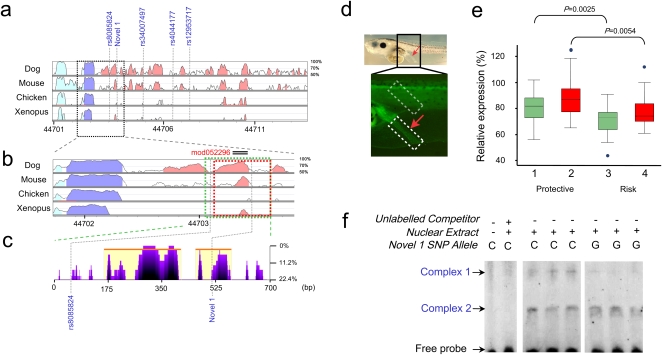
(a) VISTA view of the occurrence of conserved sequence domains in the SMAD7 risk-associated region. Shown from top to bottom are global alignments of human vs. dog, mouse, chicken, and Xenopus tropicalis, respectively. Colored peaks indicate regions of at least 100 bp in length and with 75% sequence similarity. Cyan peaks are UTR, purple peaks are coding regions, and pink peaks are noncoding regions. (b) Detail of the genomic regions used in the Xenopus functional enhancer assays (green and red blocks). Note that this region contains an evolutionarily-conserved noncoding peak. (c) eShadow view (ClustalW multiple sequence alignments presented as percent mismatch) of the SMAD7 construct showing regions of sequence conservation amongst primates (Human, Chimp, Orangutan, Rhesus, and Marmoset). Note that SNP Novel 1 is conserved in primates. (d) The tested regions contain an enhancer that promotes reporter gene expression in the rectal region of Xenopus tadpoles. The bright field image above shows a 5-d tadpole embryo. The rectal region is indicated by a red arrow. The fluorescent image below shows a detail of the rectal region of a Xenopus transgenic embryo in which GFP expression is promoted by the enhancer. The intensity of the rectal expression promoted by the enhancer from the Protective or the Risk haplotypes was measured relative to the signal observed in a fixed area in the muscles region (boxed in gray), which was considered as 100%. The DNA tested contains either the protective or risk variants of both rs8085824 and Novel 1 (green; 1 and 3) or solely Novel 1 (red; 2 and 4). (e) Box-whisker plot of the relative expression observed in transgenic embryos harboring the Protective or the Risk DNA promoting GFP expression. The enhancer from the risk haplotype/allele shows a significantly decreased enhancer activity. (f) EMSA revealing allele-specific binding of unknown nuclear factors at Novel 1 SNP.
Figure 4.
Figure 4.
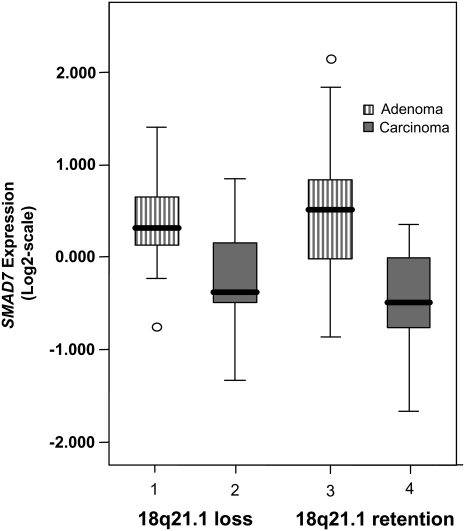
SMAD7 expression in 36 rectal adenomas and 43 carcinomas. Vertical axis present normalized relative SMAD7 gene expression (Log2-scale). Expression of SMAD7 was significantly lower in carcinomas than adenomas, irrespective of 18q21 copy-number status. (Difference of expression between tumor groups: 1 vs. 2, P = 0.524; 3 vs. 4, P = 0.34; 1 vs. 3, P = 0.13; 2 vs. 4, P = 4.0 × 10⁻⁴; 1,3 vs. 2,4, P = 0.06; 1,2 vs. 3,4, P = 5.1 × 10⁻⁶)

References

    1. Broderick P., Carvajal-Carmona L., Pittman A.M., Webb E., Howarth K., Rowan A., Lubbe S., Spain S., Sullivan K., Fielding S., et al. A genome-wide association study shows that common alleles of SMAD7 influence colorectal cancer risk. Nat. Genet. 2007;39:1315–1317. - PubMed
    1. Curtin K., Lin W.Y., George R., Katory M., Shorto J., Cannon-Albright L.A., Bishop D.T., Cox A., Camp N.J. Meta association of colorectal cancer confirms risk alleles at 8q24 and 18q21. Cancer Epidemiol. Biomarkers Prev. 2009;18:616–621. - PMC - PubMed
    1. de Bruin E.C., van de Pas S., Lips E.H., van Eijk R., van der Zee M.M., Lombaerts M., van Wezel T., Marijnen C.A., van Krieken J.H., Medema J.P., et al. Macrodissection versus microdissection of rectal carcinoma: Minor influence of stroma cells to tumor cell gene expression profiles. BMC Genomics. 2005;6:142. doi: 10.1186/1471-2164-6-142. - DOI - PMC - PubMed
    1. De Gobbi M., Viprakasit V., Hughes J.R., Fisher C., Buckle V.J., Ayyub H., Gibbons R.J., Vernimmen D., Yoshinaga Y., de Jong P., et al. A regulatory SNP causes a human genetic disease by creating a new transcriptional promoter. Science. 2006;312:1215–1217. - PubMed
    1. Dermitzakis E.T., Reymond A., Antonarakis S.E. Conserved non-genic sequences - an unexpected feature of mammalian genomes. Nat. Rev. Genet. 2005;6:151–157. - PubMed

Publication types

MeSH terms