Review
. 2009 Apr;5(4):317-22.
doi: 10.1039/b820398a. Epub 2009 Jan 27.

Structure and mechanism of beta-hairpin antimicrobial peptides in lipid bilayers from solid-state NMR spectroscopy

Affiliations
Review

Structure and mechanism of beta-hairpin antimicrobial peptides in lipid bilayers from solid-state NMR spectroscopy

Ming Tang et al. Mol Biosyst. 2009 Apr.

Abstract

The membrane-bound structure, lipid interaction, and dynamics of the arginine-rich beta-hairpin antimicrobial peptide PG-1 as studied by solid-state NMR are highlighted here. A variety of solid-state NMR techniques, including paramagnetic relaxation enhancement, (1)H and (19)F spin diffusion, dipolar recoupling distance experiments, and 2D anisotropic-isotropic correlation experiments, are used to elucidate the structural basis for the membrane disruptive activity of this representative beta-hairpin antimicrobial peptide. We found that PG-1 structure is membrane dependent: in bacteria-mimetic anionic lipid membranes the peptide forms oligomeric transmembrane beta-barrels, whereas in cholesterol-rich membranes mimicking eukaryotic cells the peptide forms beta-sheet aggregates on the surface of the bilayer. PG-1 causes toroidal pore defects in the anionic membrane, suggesting that the cationic arginine residues drag the lipid phosphate groups along as the peptide inserts. Mutation of PG-1 to reduce the number of cationic residues or to change the arginine guanidinium structure significantly changes the degree of insertion and orientation of the peptide in the lipid membrane, resulting in much weaker antimicrobial activities.


Figures
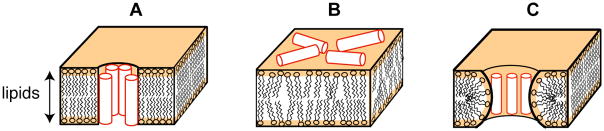
Fig. 1
Fig. 1
Three models of membrane disruption by antimicrobial peptides. (A) Barrel-stave model. (B) Carpet model. (C) Toroidal pore model.
Fig. 2
Fig. 2
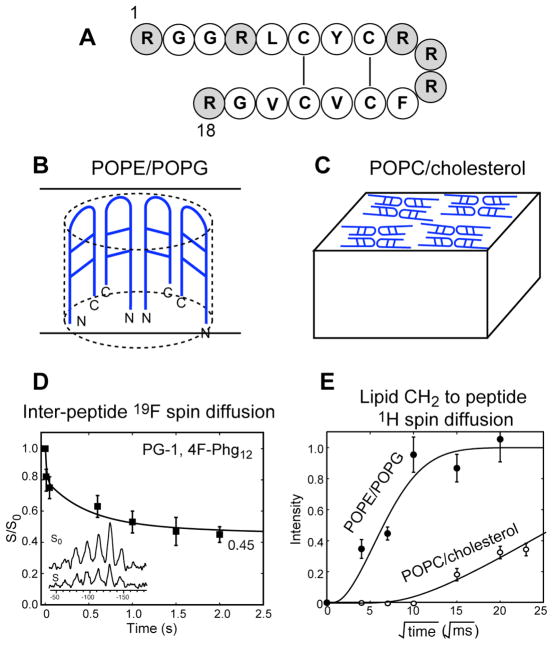
(A) Amino acid sequence of PG-1 with the Arg residues shaded. (B) The depth of insertion, orientation and oligomeric structure of PG-1 in anionic POPE/POPG membranes. (C) The depth of insertion and oligomeric structure of PG-1 in neutral POPC/cholesterol membranes. (D) Representative 19F spin diffusion data that yielded the oligomeric structure of PG-1 in the lipid membrane . (E) Representative lipid-protein 1H spin diffusion data that yielded the transmembrane insertion of PG-1 in anionic membranes and surface-bound state in neutral cholesterol-containing membranes .
Fig. 3
Fig. 3
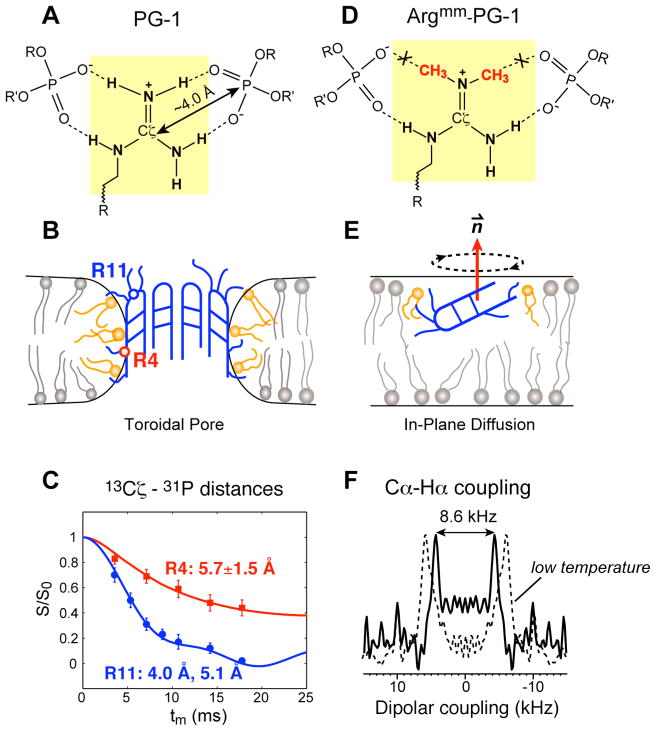
(A) Guanidinium-phosphate complexes between PG-1 Arg residues and the lipid headgroups. (B) Toroidal pore model of PG-1 in anionic lipid membranes. For clarity, only half of the PG-1 β-barrel is shown. (C) Representative 13C-31P distance data of PG-1 that yielded the toroidal pore model . (D) A dimethylated guanidinium group removes two potential hydrogen bonds with the lipid phosphates. (E) The orientation and depth of insertion of Argmm-PG-1 in the anionic membrane . (F) Representative C-H dipolar coupling data that showed the dynamic structure and orientation of Argmm-PG-1.
Fig. 4
Fig. 4
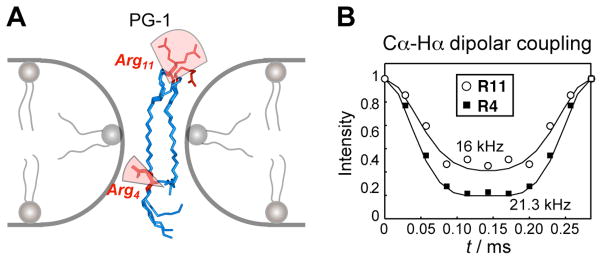
(A) Dynamics of PG-1 arginine residues in the lipid membrane. Arg11 on the β-turn is much more mobile than Arg4 on the β-strand. For simplicity, only two peptides are shown, although PG-1 is oligomerized into larger barrels. (B) Representative C-H dipolar coupling data that revealed the Arg dynamics in PG-1 in lipid membranes .
Fig. 5
Fig. 5
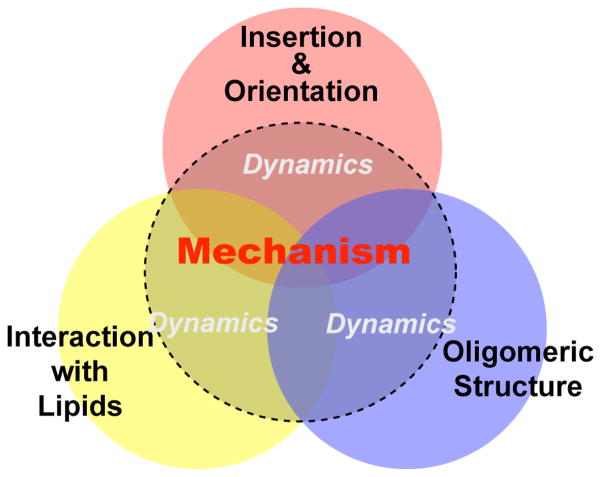
Summary of the main structural aspects of antimicrobial peptides that have been studied using solid-state NMR. Insertion and orientation, interactions with lipids, and oligomeric structure information are combined to deduce the mechanism of action of the peptides. The peptide dynamics reflect all three aspects and is important to examine to validate the mechanism.

References

    1. Epand RM, Vogel HJ. Biochim Biophys Acta. 1999;1462:11–28. - PubMed
    1. Zasloff M. Proc Natl Acad Sci U S A. 1987;84:5449–5453. - PMC - PubMed
    1. Gudmundsson GH, Agerberth B, Odeberg J, Bergman T, Olsson B, Salcedo R. Eur J Biochem. 1996;238:325–332. - PubMed
    1. Nakamura T, Furunaka H, Miyata T, Tokunaga F, Muta T, Iwanaga S, Niwa M, Takao T, Shimonishi Y. J Biol Chem. 1988;263:16709–16713. - PubMed
    1. Bellm L, Lehrer RI, Ganz T. Expert Opin Investig Drugs. 2000;9:1731–1742. - PubMed

Publication types

Substances