. 2009 May 26;19(10):859-63.
doi: 10.1016/j.cub.2009.03.066. Epub 2009 Apr 23.

Adaptive sugar provisioning controls survival of C. elegans embryos in adverse environments

Affiliations

Adaptive sugar provisioning controls survival of C. elegans embryos in adverse environments

Harold N Frazier 3rd et al. Curr Biol. .

Abstract

The ability to adapt to changing environmental conditions is essential to the fitness of organisms. In some cases, adaptation of the parent alters the offspring's phenotype [1-10]. Such parental effects are adaptive for the offspring if the future environment is similar to the current one but can be maladaptive otherwise [11]. One mechanism by which adaptation occurs is altered provisioning of embryos by the parent [12-16]. Here we show that exposing adult Caenorhabditis elegans to hyperosmotic conditions protects their offspring from these conditions but causes sensitivity to anoxia exposure. We show that this alteration of survival is correlated with changes in the sugar content of adults and embryos. In addition, mutations in gene products that alter sugar homeostasis also alter the ability of embryos to survive in hyperosmotic and anoxic conditions and engage in the adaptive parental effect. Our results indicate that there is a physiological trade-off between the presence of glycerol, which protects animals from hyperosmotic conditions, and glycogen, which is consumed during anoxia. These two metabolites play an essential role in the survival of worms in these adverse environments, and the adaptive parental effect we describe is mediated by the provisioning of these metabolites to the embryo.


Figures
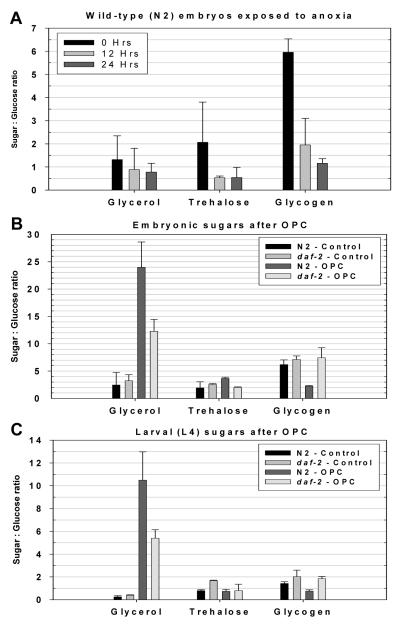
Figure 1
Figure 1
OPC mediated adaptive sugar provisioning in C. elegans requires daf-2 The graphs display the mass of each of the sugars relative to the mass of glucose in the sample, as described in the materials and methods section. The values represented are the mean of 3-6 replicates, +/- SD. (A) Young embryos were collected and placed into anoxia, with samples taken for sugar analysis at T=0; 12 and 24 hours. Over the 24 hour incubation, glycogen levels fall to 1/5 of their initial level (P<0.01). (B) Wild-type (N2) Embryos from OPC adults have much more glycerol, near twice the amount of trehalose, and 1/3 of the glycogen of control animals (P<0.01 for glycerol and glycogen; P<0.05 for trehalose). daf-2 embryos only accumulate ½ of the glycerol of wild-type after OPC, have decreased trehalose levels and no change in glycogen storage (P<0.01 for trehalose). (C) Changes in larval sugar levels largely reiterate the observation in embryos, with the exception of the fact that trehalose levels do not increase in wild-type larvae treated with OPC.
Figure 2
Figure 2
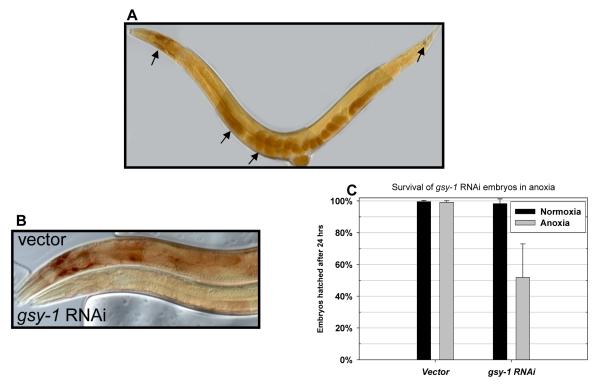
Iodine staining reveals glycogen storage in C. elegans. (A) Wild-type (N2) adult animal stained with iodine vapor. Arrows denote the primary sites of glycogen deposition. From left to right they are: anterior to the posterior bulb of the pharynx, the proximal oocytes; embryos in utero and the tail hypodermis. (B) A wild-type (N2) animal fed with empty vector RNAi control food (top) stained with iodine simultaneously with an N2 animal treated with glycogen synthase RNAi (bottom). (C) gsy-1 RNAi renders embryos sensitive to 24hrs of anoxia at 23°C. Values are mean survival rate from 14 trials, +SD.
Figure 3
Figure 3
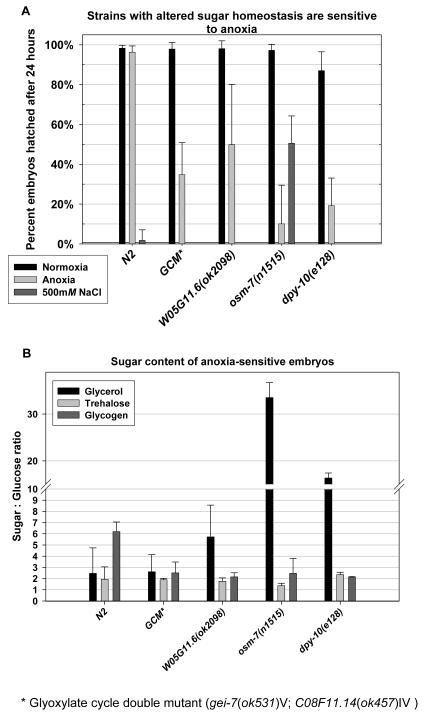
Mutations that alter sugar homeostasis affect the survival of embryos in adverse environments. (A) This graph displays the mean percent of embryos hatching 24 hours after the treatments described, with error bars representing the standard deviation from the mean (N=number of embryos assayed). N2 embryos survive 24hrs of anoxia, but die when exposed to 500mM NaCl (P<0.01). Glyoxylate cycle double mutant (GCM, gei-7(ok531); C08F11.14(ok457) embryos are sensitive to anoxia (N=277 normoxia; N= 1026 anoxia, P<0.01). W05G11.6 (ok2098) embryos are sensitive to anoxia (N=150 normoxia; N=299 anoxia, P<0.01). osm-7 embryos are sensitive to anoxia (N=572 normoxia; N=600 anoxia, P<0.01). osm-7 embryos are resistant to 500mM NaCl compared to wild-type (N=252 500mM NaCl, P<0.01). dpy-10(e128) animals are sensitive to anoxia (N=83 normoxia; N=100 anoxia, P<0.01). (B) Embryos from each of the strains that has decreased survival in anoxia also has decreased glycogen storage compared to wild-type (N2) embryos (P<0.01 for all comparisons) Both osm-7 and dpy-10 embryos accumulate glycerol, as well as being deficient in glycogen. Glycerol accumulation is associated with resistance to hyperosmotic conditions. Values are the mean of three replicates, +/- SD.

References

    1. Horton TH. Fetal origins of developmental plasticity: animal models of induced life history variation. Am J Hum Biol. 2005;17:34–43. - PubMed
    1. Stetson MH, Elliott JA, Goldman BD. Maternal transfer of photoperiodic information influences the photoperiodic response of prepubertal Djungarian hamsters (Phodopus sungorus sungorus) Biol Reprod. 1986;34:664–669. - PubMed
    1. Horton TH. Cross-fostering of voles demonstrates in utero effect of photoperiod. Biol Reprod. 1985;33:934–939. - PubMed
    1. Horton TH. Growth and reproductive development of male Microtus montanus is affected by the prenatal photoperiod. Biol Reprod. 1984;31:499–504. - PubMed
    1. Shaw D, Goldman BD. Developmental changes in male Siberian hamsters (Phodopus sungorus) exposed to different gestational and postnatal photoperiods. J Pineal Res. 2007;43:25–34. - PubMed

Publication types

LinkOut - more resources