. 2009 Jul;77(7):2887-95.
doi: 10.1128/IAI.00087-09. Epub 2009 Apr 27.

Purification of Legiobactin and importance of this siderophore in lung infection by Legionella pneumophila

Affiliations

Purification of Legiobactin and importance of this siderophore in lung infection by Legionella pneumophila

Kimberly A Allard et al. Infect Immun. 2009 Jul.

Abstract

When cultured in a low-iron medium, Legionella pneumophila secretes a siderophore (legiobactin) that is both reactive in the chrome azurol S (CAS) assay and capable of stimulating the growth of iron-starved legionellae. Using anion-exchange high-pressure liquid chromatography (HPLC), we purified legiobactin from culture supernatants of a virulent strain of L. pneumophila. In the process, we detected the ferrated form of legiobactin as well as other CAS-reactive substances. Purified legiobactin had a yellow-gold color and absorbed primarily from 220 nm and below. In accordance, nuclear magnetic resonance spectroscopy revealed that legiobactin lacks aromatic carbons, and among the 13 aliphatics present, there were 3 carbonyls. When examined by HPLC, supernatants from L. pneumophila mutants inactivated for lbtA and lbtB completely lacked legiobactin, indicating that the LbtA and LbtB proteins are absolutely required for siderophore activity. Independently derived lbtA mutants, but not a complemented derivative, displayed a reduced ability to infect the lungs of A/J mice after intratracheal inoculation, indicating that legiobactin is required for optimal intrapulmonary survival by L. pneumophila. This defect, however, was not evident when the lbtA mutant and its parental strain were coinoculated into the lung, indicating that legiobactin secreted by the wild type can promote growth of the mutant in trans. Legiobactin mutants grew normally in murine lung macrophages and alveolar epithelial cells, suggesting that legiobactin promotes something other than intracellular infection of resident lung cells. Overall, these data represent the first documentation of a role for siderophore expression in the virulence of L. pneumophila.


Figures
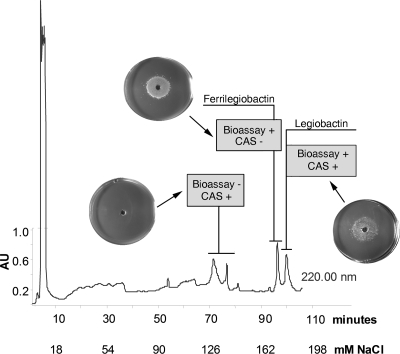
FIG. 1.
FIG. 1.
Anion-exchange HPLC analysis of L. pneumophila CDM culture supernatants. Concentrated supernatants obtained from deferrated CDM cultures of wild-type strain 130b were injected onto a TSK-GEL DEAE-2SW anion-exchange column and then subjected to NaCl elution over a 120-min period. Fractions obtained were analyzed at A220 and tested for their reactivity (positive [+] or negative [−]) in the CAS assay and the feoB bioassay. Images showing the ability or inability of a supernatant fraction to stimulate the growth of the feoB mutant on low-iron BCYE plates are inserted over the A220 scan. The results presented are representative of at least four independent experiments. AU, arbitrary units.
FIG. 2.
FIG. 2.
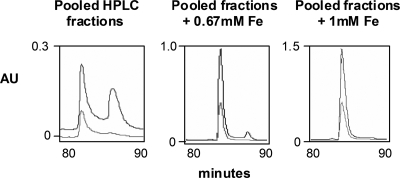
Anion-exchange HPLC analysis of legiobactin samples treated with iron. HPLC fractions containing legiobactin (i.e., both CAS-positive and bioassay-positive material) were pooled and reinjected into the HPLC following no addition of iron (left), addition of 0.67 mM FeCl3 (middle), or addition of 1 mM FeCl3 (right). Fractions were eluted with NaCl over a 120-min period. Shown here are those peaks eluted between 80 and 90 min, as detected at A220 (top line) and A254 (bottom line). The results presented are representative of at least two independent experiments. AU, arbitrary units.
FIG. 3.
FIG. 3.
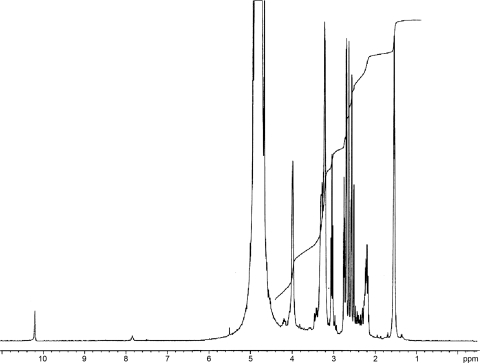
Proton NMR spectrum of legiobactin. Purified legiobactin in deuterium oxide was subjected to 300-MHz proton NMR. The protons of legiobactin were detected from 1.1 to 4.2 ppm. A large DOH peak was present at 4.8 ppm due to the deuterium picking up a hydrogen atom, and water suppression experiments showed that no legiobactin-related peaks were hidden under the D2O peak. The peak near 10 ppm was not observed in repeat experiments. The results presented are representative of three independent experiments.
FIG. 4.
FIG. 4.
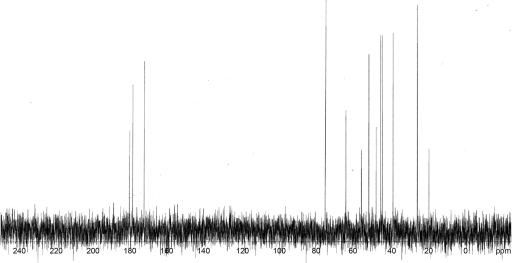
Proton-decoupled C-13 NMR spectrum of legiobactin. Purified legiobactin in deuterium oxide revealed 13 aliphatic carbons (0 to 80 ppm), with 3 of those being carbonyls (170 to 181 ppm). The results presented are representative of two independent experiments.
FIG. 5.
FIG. 5.
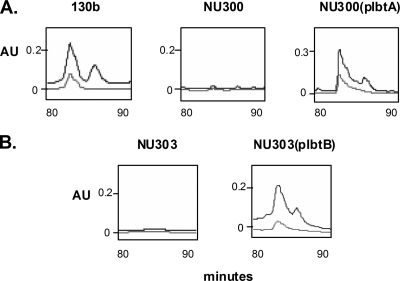
HPLC analysis of CDM culture supernatants from lbtA and lbtB mutants. Concentrated supernatants obtained from deferrated CDM cultures of wild-type 130b, lbtA mutant NU300, and complemented mutant NU300(plbtA) (A) as well as lbtB mutant NU303 and complemented mutant NU303(plbtB) (B) were injected onto a TSK-GEL DEAE-2SW anion-exchange column and then subjected to NaCl elution over a 120-min period. Shown here are those peaks eluted between 80 and 90 min, as detected at A220 (top line) and A254 (bottom line). The results presented are representative of at least three independent experiments. AU, arbitrary units.
FIG. 6.
FIG. 6.
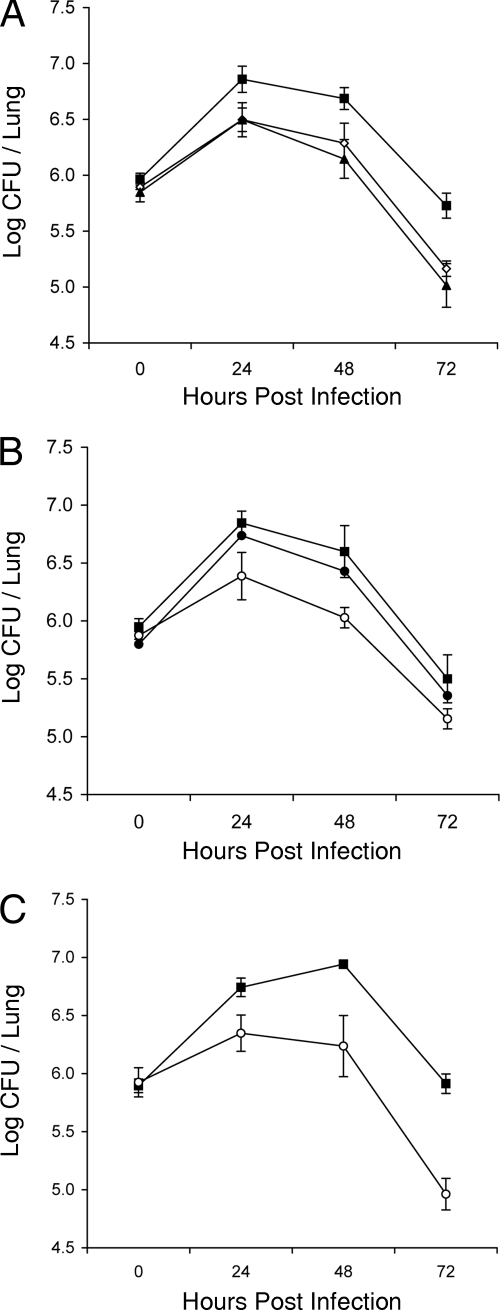
Growth and survival of wild-type and lbtA mutant L. pneumophila in the lungs of infected mice. A/J mice were intratracheally inoculated with equal numbers of wild-type and mutant bacteria, and then at various time points, the CFU in infected lungs were determined by plating. (A) Infections with wild-type strain 130b (▪), lbtA mutant NU300 (⋄), and feoB mutant NU269 (▴). (B) Infections with 130b (▪), lbtA mutant NU302 (○), and complemented mutant NU302(plbtA) (•). (C) Another infection with wild-type 130b (▪) versus lbtA mutant NU302 (○). Data are the means and standard deviations (error bars) obtained from five infected animals. Significant differences were obtained between the CFU recovered from mice infected with 130b or the complemented mutants and those infected with NU300, NU302, or NU269 at 24, 48, and 72 h postinoculation (Student's t test, P < 0.05).
FIG. 7.
FIG. 7.
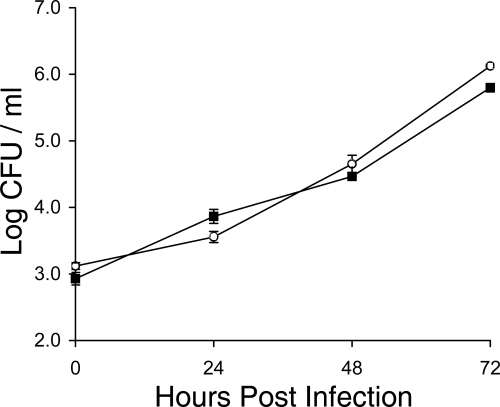
Intracellular infection of murine alveolar macrophages by wild-type and lbtA mutant L. pneumophila. Explanted alveolar macrophages from A/J mice were infected with wild-type strain 130b (▪) and lbtA mutant NU302 (○), and then at various time points, the CFU in infected monolayers were determined by plating. Data are the means and standard deviations (error bars) obtained from four infected wells. No significant differences were obtained between the CFU recovered from cells infected with the wild type and those infected with the mutants at 0, 24, 48, and 72 h postinoculation (Student's t test, P > 0.05). The results presented are representative of two independent experiments.

References

    1. Allard, K. A., V. K. Viswanathan, and N. P. Cianciotto. 2006. lbtA and lbtB are required for production of the Legionella pneumophila siderophore legiobactin. J. Bacteriol. 1881351-1363. - PMC - PubMed
    1. Autenrieth, I., K. Hantke, and J. Heesemann. 1991. Immunosuppression of the host and delivery of iron to the pathogen: a possible dual role of siderophores in the pathogenesis of microbial infections? Med. Microbiol. Immunol. 180135-141. - PubMed
    1. Autenrieth, I. B., E. Bohn, J. H. Ewald, and J. Heesemann. 1995. Deferoxamine B but not deferoxamine G1 inhibits cytokine production in murine bone marrow macrophages. J. Infect. Dis. 172490-496. - PubMed
    1. Bearden, S. W., J. D. Fetherston, and R. D. Perry. 1997. Genetic organization of the yersiniabactin biosynthetic region and construction of avirulent mutants in Yersinia pestis. Infect. Immun. 651659-1668. - PMC - PubMed
    1. Beare, P. A., R. J. For, L. W. Martin, and I. L. Lamont. 2003. Siderophore-mediated cell signalling in Pseudomonas aeruginosa: divergent pathways regulate virulence factor production and siderophore receptor synthesis. Mol. Microbiol. 47195-207. - PubMed

Publication types

MeSH terms

Substances