Effect of an interactive voice response system on oral anticoagulant management
- PMID: 19398739
- PMCID: PMC2670905
- DOI: 10.1503/cmaj.081659
Effect of an interactive voice response system on oral anticoagulant management
Abstract
Background: Monitoring oral anticoagulants is logistically challenging for both patients and medical staff. We evaluated the effect of adding an interactive voice response system to computerized decision support for oral anticoagulant management.
Methods: We developed an interactive voice response system to communicate to patients the results of international normalized ratio testing and their dosage schedules for anticoagulation therapy. The system also reminded patients of upcoming and missed appointments for blood tests. We recruited patients whose anticoagulation control was stable after at least 3 months of warfarin therapy. We prospectively examined clinical data and outcomes for these patients for an intervention period of at least 3 months. We also collected retrospective data for each patient for the 3 months before study enrolment.
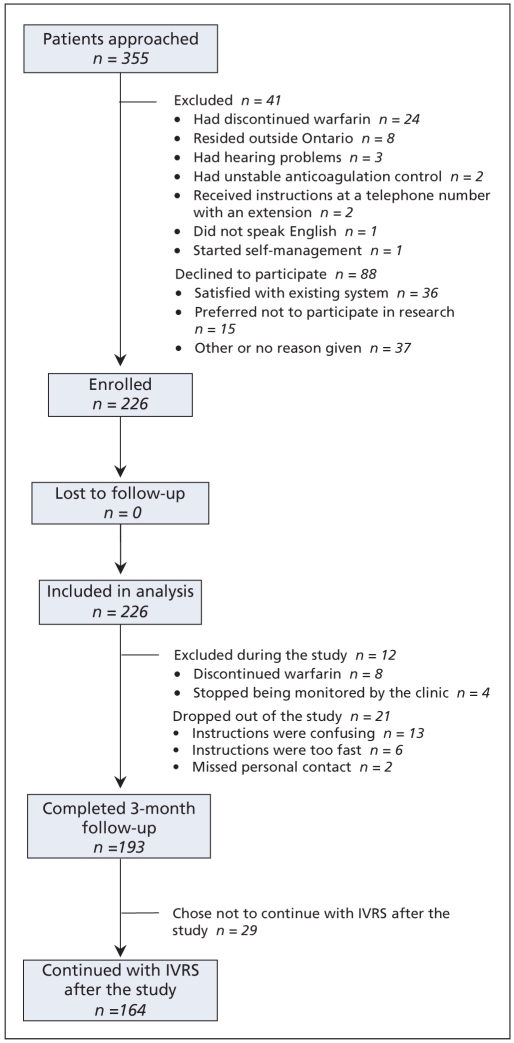
Results: We recruited 226 patients between Nov. 23, 2006, and Aug. 1, 2007. The mean duration of the intervention period (prospective data collection) was 4.2 months. Anticoagulation control was similar for the periods during and preceding the intervention (mean time within the therapeutic range 80.3%, 95% confidence interval [CI] 77.5% to 83.1% v. 79.9%, 95% CI 77.3% to 82.6%). The interactive voice response system delivered 1211 (77.8%) of 1557 scheduled dosage messages, with no further input required from clinic staff. The most common reason for clinic staff having to deliver the remaining messages (accounting for 143 [9.2%] of all messages) was an international normalized ratio that was excessively high or low, (i.e., 0.5 or more outside the therapeutic range). When given the option, 76.6% of patients (164/214) chose to continue with the interactive voice response system for management of their anticoagulation after the study was completed. The system reduced staff workload for monitoring anticoagulation therapy by 48 min/wk, a 33% reduction from the baseline of 2.4 hours.
Interpretation: Interactive voice response systems have a potential role in improving the monitoring of patients taking oral anticoagulants. Further work is required to determine the generalizability and cost-effectiveness of these results.
Figures
Comment in
-
Can anticoagulation care be improved with technology?CMAJ. 2009 Apr 28;180(9):909-10. doi: 10.1503/cmaj.090396. CMAJ. 2009. PMID: 19398732 Free PMC article. No abstract available.
References
-
- Kim H, Bracha Y, Tipnis A. Automated depression screening in disadvantaged pregnant women in an urban obstetric clinic. Arch Womens Ment Health. 2007;10:163–9. - PubMed
-
- Gruenewald PJ, Searles J, Helzer J, et al. Exploring drinking dynamics using interactive voice response technology. J Stud Alcohol. 2005;66:571–6. - PubMed
-
- Friedman RH. Automated telephone conversations to assess health behavior and deliver behavioral interventions. J Med Syst. 1998;22:95–102. - PubMed
-
- Stuart GW, Laraia MT, Ornstein SM, et al. An interactive voice response system to enhance antidepressant medication compliance. Top Health Inf Manage. 2003;24:15–20. - PubMed
Publication types
MeSH terms
Substances
LinkOut - more resources
Full Text Sources
Medical
Molecular Biology Databases