Comparative Study
. 2009 Dec;44(12):793-7.
doi: 10.1038/bmt.2009.88. Epub 2009 Apr 27.

Effect of iron overload and iron-chelating therapy on allogeneic hematopoietic SCT in children

Affiliations
Comparative Study

Effect of iron overload and iron-chelating therapy on allogeneic hematopoietic SCT in children

J W Lee et al. Bone Marrow Transplant. 2009 Dec.

Abstract

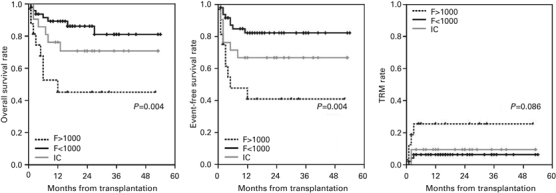
Iron overload is known to increase complications of hematopoietic SCT (HSCT). We investigated the association of pre-transplant ferritin level with complications and survival after allogeneic HSCT, and evaluated the efficacy of iron-chelating therapy before HSCT. We retrospectively reviewed 101 patients who underwent allogeneic HSCT and divided these patients into three groups: F>1000, patients with ferritin level above 1000 ng/ml at the time of HSCT; F<1000, patients whose ferritin levels were maintained below 1000 ng/ml before HSCT without iron-chelating therapy; IC, patients with ferritin level decreased to less than 1000 ng/ml after iron-chelating therapy before HSCT. In the comparison between the F>1000 group and the F<1000 group, hyperbilirubinemia and treatment-related mortality (TRM) were significantly higher in the F>1000 group. The F>1000 group also showed decreased OS and EFS. In the comparison of the F<1000 and IC groups, there was no significant difference in complications and survival. When compared with the F>1000 group, the IC group showed lower TRM and higher survival. Elevated serum ferritin level was associated with increased TRM and decreased survival, and the analysis of the IC group suggested the benefit of iron-chelating therapy to improve the outcome of HSCT.


Figures
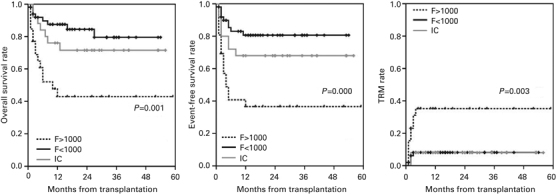
Figure 1
Figure 1
The patients with ferritin level more than 1000 ng/ml before HSCT (F>1000) showed lower OS and EFS, and higher TRM rate than those with ferritin level less than 1000 ng/ml with (IC) or without (F<1000) iron-chelating therapy.
Figure 2
Figure 2
This is the analysis of the patients without history of earlier transplantation. The lower OS and EFS of the F>1000 group were maintained after excluding the patients with the history of earlier transplantation.

References

    1. Dürken M, Nielsen P, Knobel S, Finckh B, Herrnring C, Dresow B. Nontransferrin-bound iron in serum of patients receiving bone marrow transplants. Free Radic Bio Med. 1997;22:1159–1163. doi: 10.1016/S0891-5849(96)00497-2. - DOI - PubMed
    1. Evens AM, Mehta J, Gordon LI. Rust and corrosion in hematopoietic stem cell transplantation: the problem of iron and oxidative stress. Bone marrow transplant. 2004;34:561–571. doi: 10.1038/sj.bmt.1704591. - DOI - PubMed
    1. Morado M, Ojeda E, Garcia-Bustos J, Aguado MJ, Arrieta R, Quevedo E. BMT: Serum ferritin as risk factor for veno-occlusive disease of the liver: prospective cohort study. Hematology. 2000;4:505–512. doi: 10.1080/10245332.1999.11746478. - DOI - PubMed
    1. Altes A, Remacha AF, Sarda P, Baiget M, Sureda A, Martino R. Early clinical impact of iron overload in stem cell transplantation. A prospective study. Ann Hematol. 2007;86:443–447. doi: 10.1007/s00277-007-0266-x. - DOI - PubMed
    1. Altes A, Remacha AF, Sarda P, Sancho FJ, Sureda A, Martino R. Frequent severe liver iron overload after stem cell transplantation and its possible association with invasive aspergillosis. Bone marrow transplant. 2004;34:505–509. doi: 10.1038/sj.bmt.1704628. - DOI - PubMed

Publication types

MeSH terms