Review
. 2009:11:25-47.
doi: 10.1146/annurev-bioeng-061008-124920.

Fluorescent probes for live-cell RNA detection

Affiliations
Review

Fluorescent probes for live-cell RNA detection

Gang Bao et al. Annu Rev Biomed Eng. 2009.

Abstract

Commonly used techniques for analyzing gene expression, such as polymerase chain reaction (PCR), microarrays, and in situ hybridization, have proven invaluable in understanding RNA processing and regulation. However, these techniques rely on the use of lysed and/or fixed cells and are therefore limited in their ability to provide important spatial-temporal information. This has led to the development of numerous techniques for imaging RNA in living cells, some of which have already provided important insight into the dynamic role RNA plays in dictating cell behavior. Here we review the fluorescent probes that have allowed for RNA imaging in living cells and discuss their utility and limitations. Common challenges faced by fluorescent probes, such as probe design, delivery, and target accessibility, are also discussed. It is expected that continued advancements in live cell imaging of RNA will open new and exciting opportunities in a wide range of biological and medical applications.


Figures
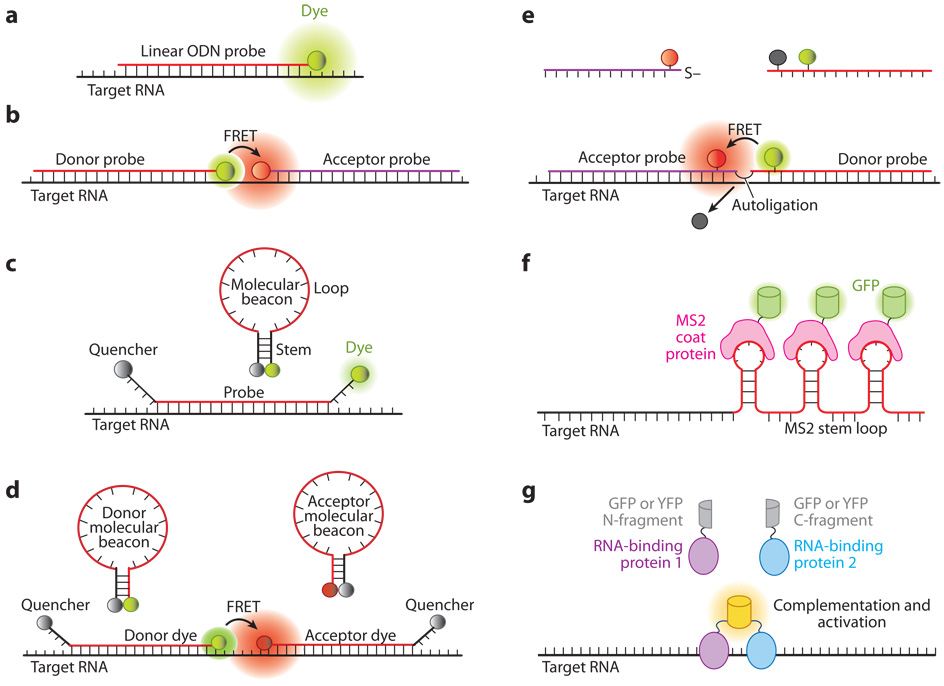
Figure 1
Figure 1
Illustrations of fluorescent probes for live-cell RNA detection. (a) Tagged linear oligonucleotide (ODN) probes. (b) Linear fluorescence resonance energy transfer (FRET) probes in which two linear ODN probes have, respectively, a donor and an acceptor fluorophore that form a FRET pair. (c) Molecular beacons are dual-labeled stem-loop oligonucleotide hairpin probes with a reporter fluorophore at one end and a quencher molecule at the other end. (d) Dual FRET donor and acceptor molecular beacons hybridize to adjacent regions on the same mRNA target, resulting in FRET signal. (e) Autoligation FRET probes. The fluorescence of the donor is initially quenched. Upon binding of the two probes to adjacent sites on the same RNA, the quencher is displaced and the ligation brings the donor and acceptor fluophores together, resulting in FRET signal. ( f ) Probes using the coat protein of the bacterial phage MS2 fused with green fluorescent protein (GFP) (MS2-GFP). The MS2-GFP complexes bind to multiple hairpin sequences in the 3′ untranslated region (UTR) of an mRNA, giving rise to a high signal compared with the background. (g) Probes based on fragment complementation of fluorescent protein. When two RNA-binding proteins, each carrying a fluorescent protein fragment, bind to adjacent sites on the same RNA, a fluorescence signal is generated owing to fragment complementation of the fluorescent protein.
Figure 2
Figure 2
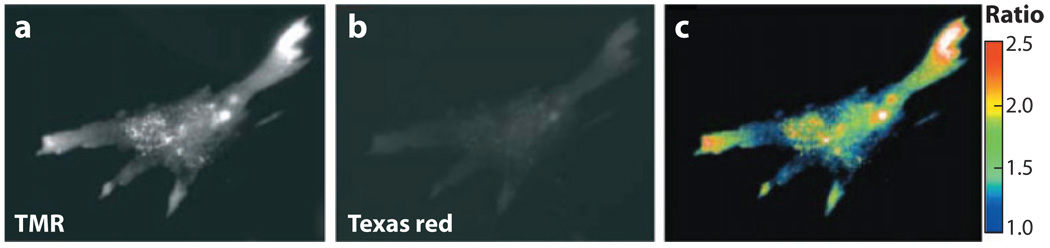
Imaging the distribution of β-actin mRNA in living fibroblasts using molecular beacons. Tetramethylrhodamine (TMR)-labeled β-actin mRNA-specific molecular beacons and Texas Red–labeled control molecular beacons complexed with streptavidin were microinjected into cells. The fluorescence signals in the TMR (a) and Texas Red (b) channels were detected, and a ratio image (c) was obtained by dividing the fluorescence intensity of TMR by that of Texas Red at every pixel in the image, indicating the localization of β-actin mRNA. The color of each pixel in (c) reflects the value of the ratio, with warmer colors representing higher ratios and cooler colors representing lower ratios.
Figure 3
Figure 3
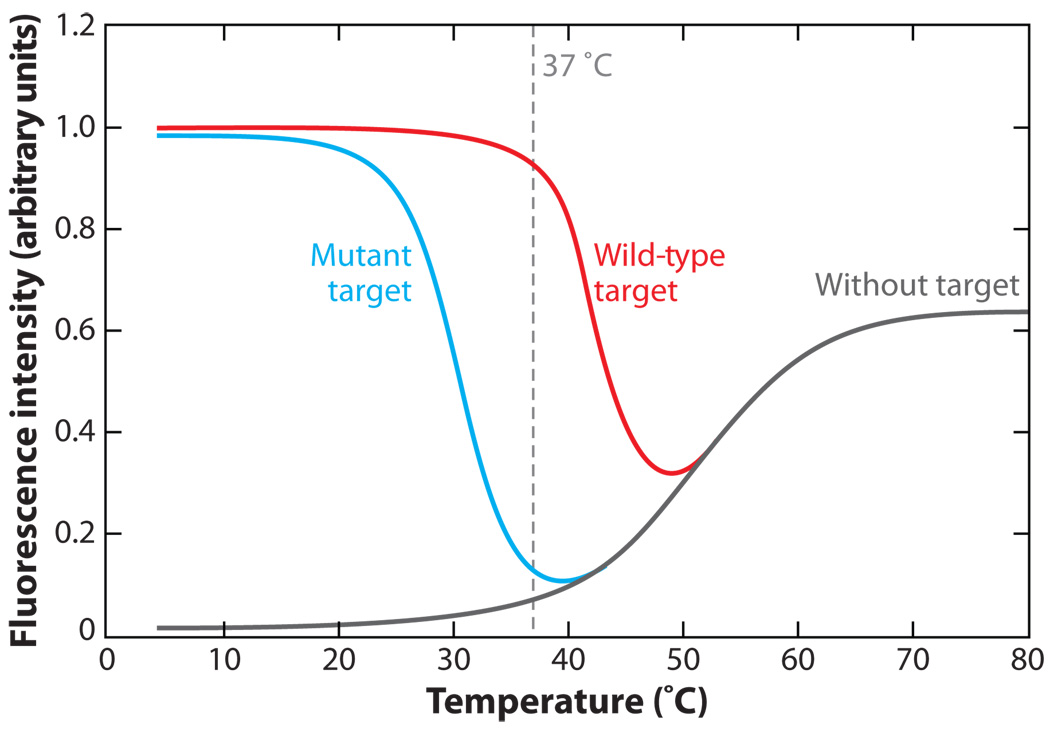
Typical molecular beacon thermal denaturation profiles. With wild-type (complementary) targets, molecular beacons emit a maximal signal at low temperatures, indicating that the molecular beacons are bound to target; as temperature increases, the molecular beacons melt away from target. With mutant targets, the melting temperature of the molecular beacons is reduced. The difference between the wild-type target and mutant target curves over a range of temperatures represents the window of discrimination between wild-type and mutant targets. In live-cell studies, it is desirable for the melting temperature of perfectly complementary hybrids to be above 37°C and the melting temperature for hybrids with single-base mismatches to be less than 37°C.
Figure 4
Figure 4
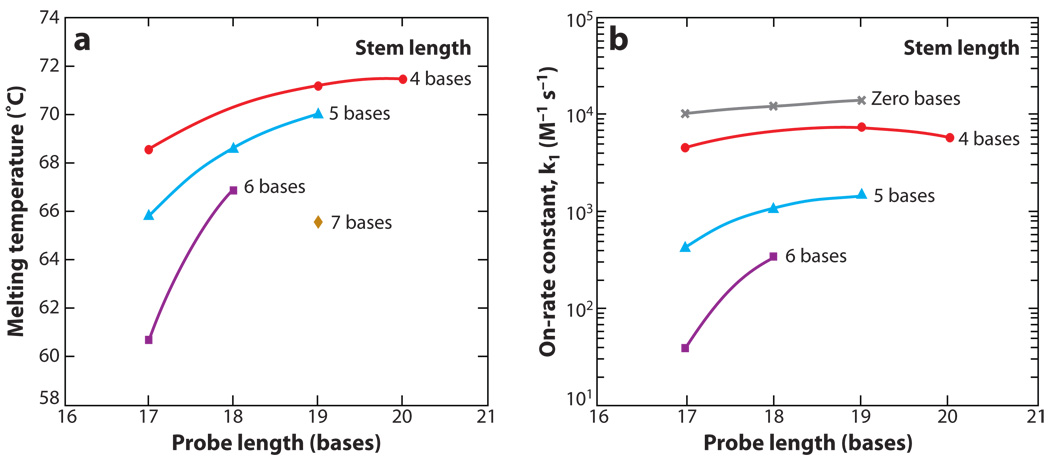
Structure-function relations of molecular beacons. (a) Melting temperatures for molecular beacons with different structures in the presence of complementary targets. (b) The rate constant of hybridization k1(on-rate constant) for molecular beacons with various probe and stem lengths hybridized to their complementary targets.
Figure 5
Figure 5
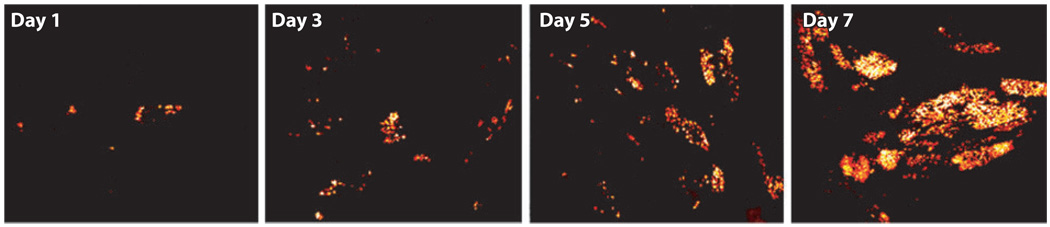
Live-cell fluorescence imaging of the genome of bovine respiratory syncytial virus (bRSV) using molecular beacons shows the spreading of infection in host cells at days 1, 3, 5, and 7 postinfection (PI). Primary bovine turbinate cells were infected by a clinical isolate of bRSV, CA-1, with a viral titer of 2 × 103.6 TCID50 ml−1. Molecular beacons were designed to target several repeated sequences of the gene-end-intergenic-gene-start signal within the bRSV genome, with a signal-to-noise ratio of 50–200.
Figure 6
Figure 6
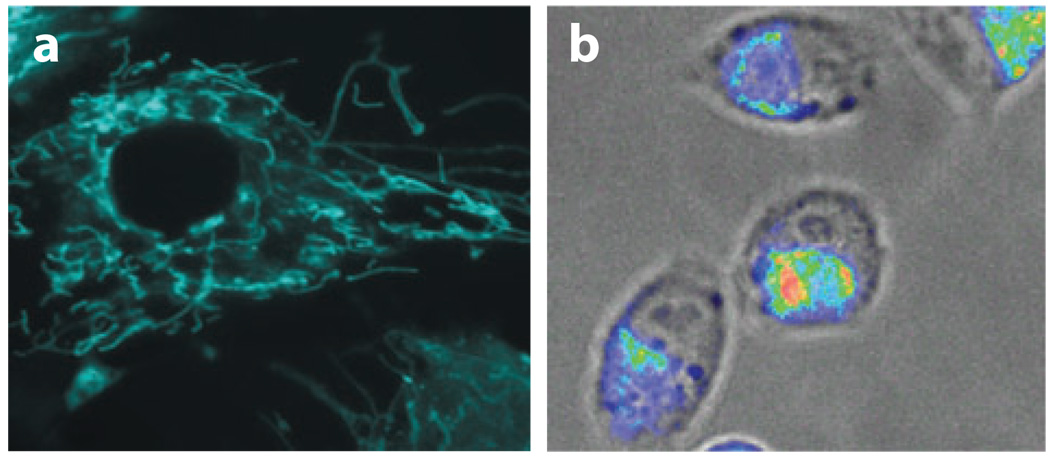
Imaging mRNA localization in HDF and MIAPaCa-2 cells using dual FRET molecular beacons targeting K-ras and survivin mRNA, respectively. (a) Fluorescence images of K-ras mRNA in stimulated HDF cells. Note the filamentous K-ras mRNA localization pattern. (b) A fluorescence image of survivin mRNA localization in MIAPaCa-2 cells. Note that survivin mRNAs often localized to one side of the nucleus of the MIAPaCa-2 cells.
Figure 7
Figure 7
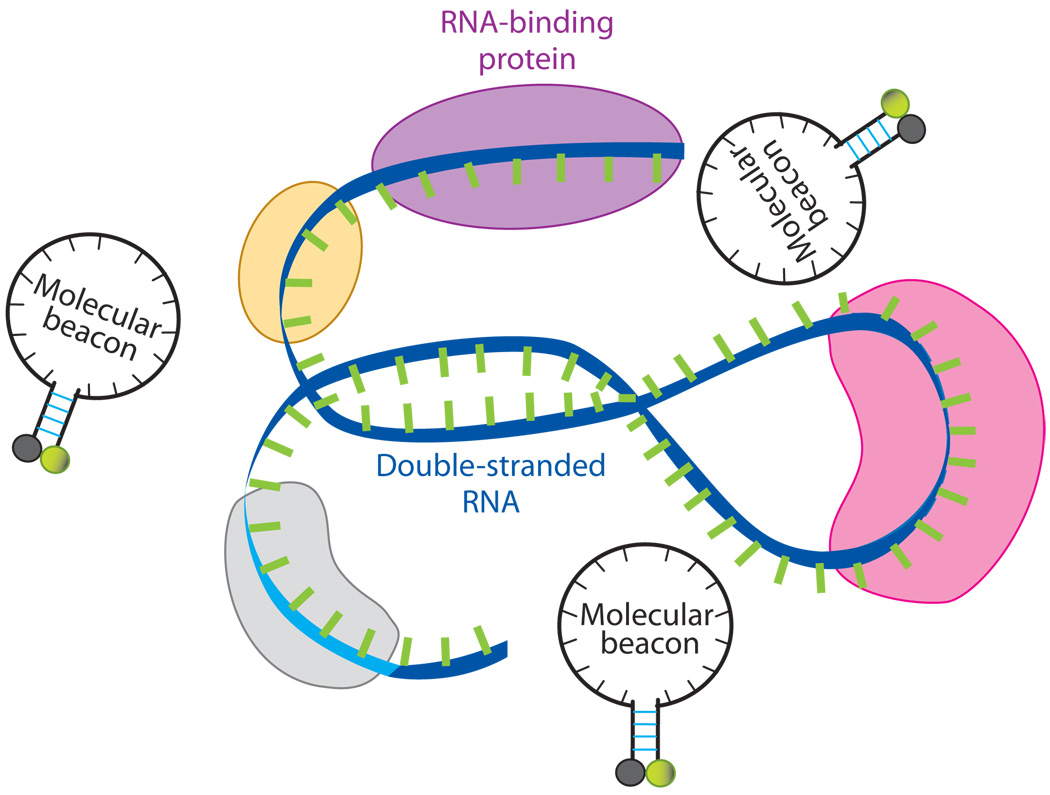
A schematic illustration of a segment of the target mRNA with a double-stranded portion and RNA-binding proteins. A molecular beacon has to compete off an mRNA strand or RNA-binding protein(s) in order to hybridize to the target.
Figure 8
Figure 8
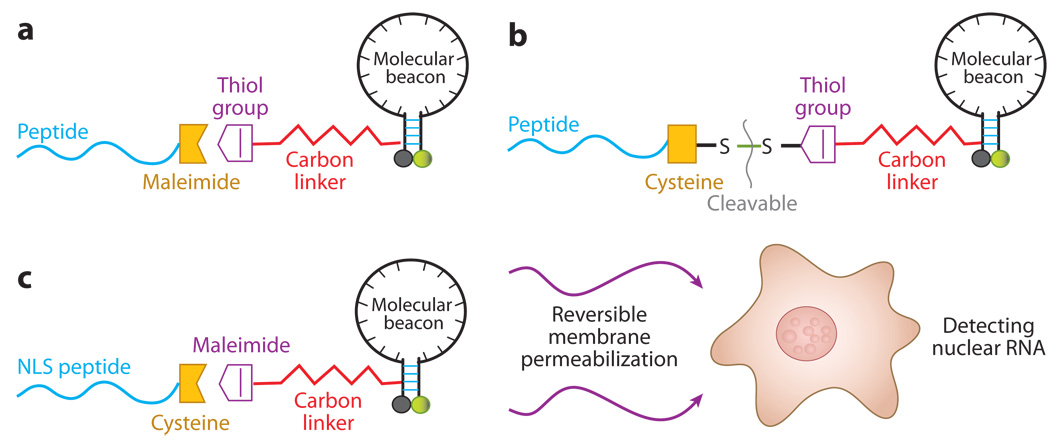
A schematic of peptide-linked molecular beacons. (a) A peptide-linked molecular beacon using the thiol-maleimide linkage in which the quencher arm of the molecular beacon stem is modified by adding a thiol group, which can react with a maleimide group placed to the C terminus of the peptide to form a direct, stable linkage. (b) A peptide-linked molecular beacon with a cleavable disulfide bridge in which the peptide is modified by adding a cysteine residue at the C terminus, which forms a disulfide bridge with the thiol-modified molecular beacon. This disulfide bridge design allows the peptide to be cleaved from the molecular beacon by the reducing environment of the cytoplasm. (c) A schematic illustration of the design of a peptide-linked molecular beacon and its delivery into cell nucleus. The NLS peptide is covalently linked to the molecular beacon using a modified nucleotide in its quencher arm. The NLS-linked molecular beacons are delivered into the cytoplasm first using streptolysin O (SLO), and the NLS peptide actively transports the probes into the nucleus of a living cell.

References

    1. Adams MD, Dubnick M, Kerlavage AR, Moreno R, Kelley JM, et al. Sequence identification of 2375 human brain genes. Nature. 1992;355:632–634. - PubMed
    1. Allinquant B, Hantraye P, Mailleux P, Moya K, Bouillot C, Prochiantz A. Downregulation of amyloid precursor protein inhibits neurite outgrowth in vitro. J. Cell Biol. 1995;128:919–927. - PMC - PubMed
    1. Alwine JC, Kemp DJ, Parker BA, Reiser J, Renart J, et al. Detection of specific RNAs or specific fragments of DNA by fractionation in gels and transfer to diazobenzyloxymethyl paper. Methods Enzymol. 1979;68:220–242. - PubMed
    1. Barry MA, Eastman A. Identification of deoxyribonuclease II as an endonuclease involved in apoptosis. Arch. Biochem. Biophys. 1993;300:440–450. - PubMed
    1. Bassell GJ, Powers CM, Taneja KL, Singer RH. Single mRNAs visualized by ultrastructural in situ hybridization are principally localized at actin filament intersections in fibroblasts. J. Cell Biol. 1994;126:863–876. - PMC - PubMed

Publication types

MeSH terms

LinkOut - more resources