Review
. 2009:32:225-47.
doi: 10.1146/annurev.neuro.051508.135335.

The neurobiology of individual differences in complex behavioral traits

Affiliations
Review

The neurobiology of individual differences in complex behavioral traits

Ahmad R Hariri. Annu Rev Neurosci. 2009.

Abstract

Neuroimaging, especially BOLD fMRI, has begun to identify how variability in brain function contributes to individual differences in complex behavioral traits. In parallel, pharmacological fMRI and multimodal PET/fMRI are identifying how variability in molecular signaling pathways influences individual differences in brain function. Against this background, functional genetic polymorphisms are being utilized to understand the origins of variability in signaling pathways as well as to model efficiently how such emergent variability impacts behaviorally relevant brain function. This article provides an overview of a research strategy seeking to integrate these complementary technologies and utilizes existing empirical data to illustrate its effectiveness in illuminating the neurobiology of individual differences in complex behavioral traits. The article also discusses how such efforts can contribute to the identification of predictive markers that interact with environmental factors to precipitate disease and to develop more effective and individually tailored treatment regimes.


Figures
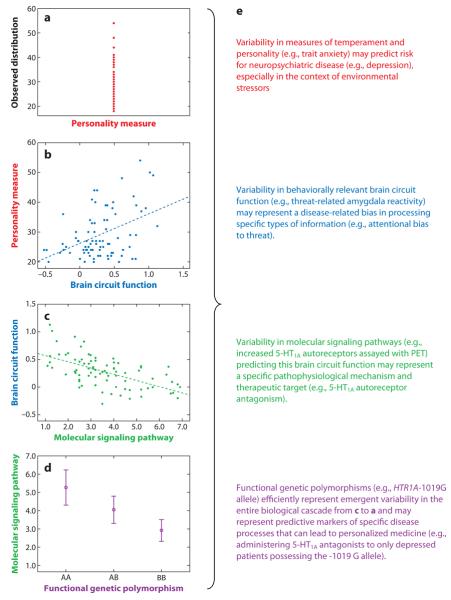
Figure 1
Figure 1
Integration of complementary technologies can be used to reveal the neurobiology of individual differences in complex behavioral traits. (a) Individual differences in personality and temperament are critical to shaping complex human behaviors and may serve as important predictors of vulnerability to neuropsychiatric disorders. (b) Neuroimaging technologies, especially BOLD fMRI, can identify links between variability in brain circuit function and individual differences in personality and temperament. (c) Multimodal PET/fMRI (or pharmacological fMRI) can map individual differences in behaviorally relevant brain circuit function to variability in specific molecular signaling pathways. (d) Variability in specific molecular signaling pathways can be mapped to functional genetic polymorphisms, which inform their ultimate biological origins and can be used to model efficiently how such emergent variability impacts behaviorally relevant brain function. (e) Each level of analysis can potentially inform clinically relevant issues, provide guiding principles for the development of more effective and personalized treatment options, and represent predictive risk markers that interact with unique environmental factors to precipitate disease.
Figure 2
Figure 2
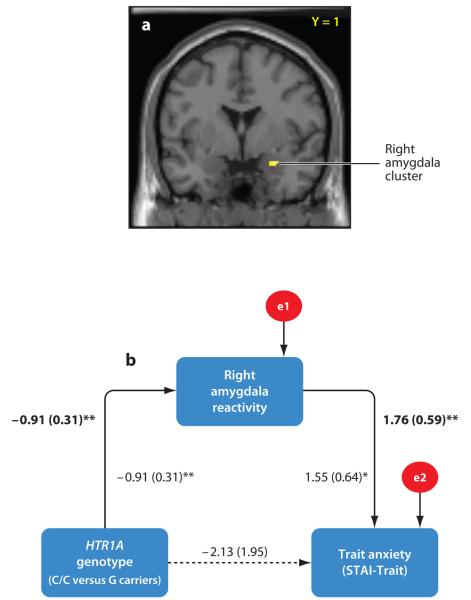
The HTR1A genotype indirectly predicts trait anxiety through amygdala reactivity (adapted from Fakra et al. 2009). (a) Statistical parametric map illustrating the right amygdala cluster correlated with both HTR1A genotype and trait anxiety. Single-subject activation values from the maximal voxel in this cluster were entered into path analyses. (b) Path model testing indirect effects of the HTR1A genotype on trait anxiety. Lines are labeled with nonstandardized path coefficients and standard errors in parentheses. Coefficients in bold above the line represent values from the trimmed model, whereas coefficients in Roman represent values from the full model with all paths included. Indirect effects of the HTR1A genotype on trait anxiety were significant (αβ = −1.60, SE = 0.73, P < 0.05), whereas direct effects were nonsignificant and dropped from the model. e1 and e2 represent the residual variances not explained by model variables. *P < 0.05, **P < 0.01.
Figure 3
Figure 3
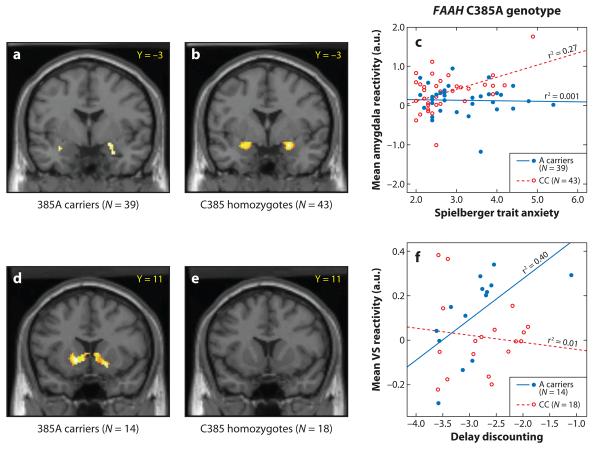
Divergent effects of the FAAH genotype on threat- and reward-related brain function (adapted from Hariri et al. 2008). Statistical parametric maps illustrating the correlation between fear-related amygdala reactivity and trait anxiety in (a) FAAH 385A carriers and (b) C385 homozygotes. (c) Plots of the differential correlation between fear-related amygdala reactivity and trait anxiety as a function of the FAAH C385A genotype (β = 0.38, P = 0.03; 385A carriers: r = −0.03, P = 0.84; C385 homozygotes: r = 0.52, P < 0.001). Statistical parametric maps illustrating the correlation between reward-related VS reactivity and delay discounting in (d ) FAAH 385A carriers and (e) C385 homozygotes (no significant correlation). (f) Plots of the differential correlation between reward-related VS reactivity and delay discounting as a function of the FAAH C385A genotype (β = −0.54, P = 0.04; 385A carriers: r = 0.63, P = 0.02) and C385 homozygotes (r = 0.11, P = 0.65).

References

    1. Alessi SM, Petry NM. Pathological gambling severity is associated with impulsivity in a delay discounting procedure. Behav. Process. 2003;64:345–54. - PubMed
    1. Amat J, Matus-Amat P, Watkins LR, Maier SF. Escapable and inescapable stress differentially alter extracellular levels of 5-HT in the basolateral amygdala of the rat. Brain Res. 1998;812:113–20. - PubMed
    1. Amat J, Tamblyn JP, Paul ED, Bland ST, Amat P, et al. Microinjection of urocortin 2 into the dorsal raphe nucleus activates serotonergic neurons and increases extracellular serotonin in the basolateral amygdala. Neuroscience. 2004;129:509–19. - PubMed
    1. Bannon MJ, Michelhaugh SK, Wang J, Sacchetti P. The human dopamine transporter gene: gene organization, transcriptional regulation, and potential involvement in neuropsychiatric disorders. Eur. Neuropsychopharmacol. 2001;11:449–55. - PubMed
    1. Basavarajappa BS, Yalamanchili R, Cravatt BF, Cooper TB, Hungund BL. Increased ethanol consumption and preference and decreased ethanol sensitivity in female FAAH knockout mice. Neuropharmacology. 2006;50:834–44. - PubMed

MeSH terms