


A psychometric evaluation of the DSM-IV borderline personality disorder criteria: age and sex moderation of criterion functioning
- PMID: 19400977
- PMCID: PMC2844893
- DOI: 10.1017/S0033291709005807
A psychometric evaluation of the DSM-IV borderline personality disorder criteria: age and sex moderation of criterion functioning
Abstract
Background: Despite its importance as a paradigmatic personality disorder, little is known about the measurement invariance of the DSM-IV borderline personality disorder (BPD) criteria; that is, whether the criteria assess the disorder equivalently across different groups.
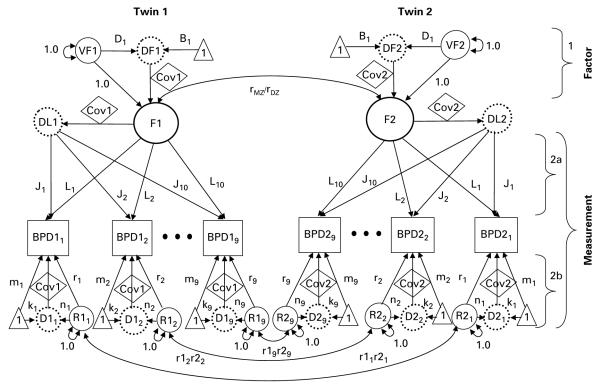
Method: BPD criteria were evaluated at interview in 2794 young adult Norwegian twins. Analyses, based on item-response modeling, were conducted to test for differential age and sex moderation of the individual BPD criteria characteristics given factor-level covariate effects.
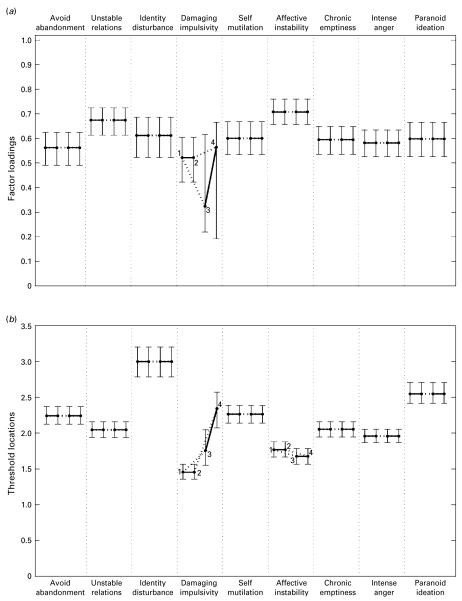
Results: Confirmatory factor analytic results supported a unidimensional structure for the nine BPD criteria. Compared to males, females had a higher BPD factor mean, larger factor variance and there was a significant age by sex interaction on the factor mean. Strong differential sex and age by sex interaction effects were found for the 'impulsivity' criterion factor loading and threshold. Impulsivity related to the BPD factor poorly in young females but improved significantly in older females. Males reported more impulsivity compared to females and this difference increased with age. The 'affective instability' threshold was also moderated, with males reporting less than expected.
Conclusions: The results suggest the DSM-IV BPD 'impulsivity' and 'affective instability' criteria function differentially with respect to age and sex, with impulsivity being especially problematic. If verified, these findings have important implications for the interpretation of prior research with these criteria. These non-invariant age and sex effects may be identifying criteria-level expression features relevant to BPD nosology and etiology. Criterion functioning assessed using modern psychometric methods should be considered in the development of DSM-V.
Figures
References
-
- Akaike H. Likelihood of a model and information criteria. Journal of Econometrics. 1981;16:3–14.
-
- Akaike H. Factor analysis and AIC. Psychometrika. 1987;52:317–332.
-
- APA . Diagnostic and Statistical Manual of Mental Disorders. 4th edn American Psychiatric Association; Washington, DC: 1994.
-
- Bentler PM. Comparative fit indexes in structural models. Psychological Bulletin. 1990;107:238–246. - PubMed
Publication types
MeSH terms
Grants and funding
LinkOut - more resources
Full Text Sources
