


Appetite responds to changes in meal content, whereas ghrelin, leptin, and insulin track changes in energy availability
- PMID: 19401375
- PMCID: PMC2708957
- DOI: 10.1210/jc.2008-2495
Appetite responds to changes in meal content, whereas ghrelin, leptin, and insulin track changes in energy availability
Abstract
Context: It is uncertain how between-meal variations in energy availability and physiological changes in ghrelin, leptin, and insulin affect appetite.
Objective: The aim of the study was to examine the influence on human appetite of the meal size and its nutrient content or changes in energy availability and concentrations of ghrelin, leptin, and insulin.
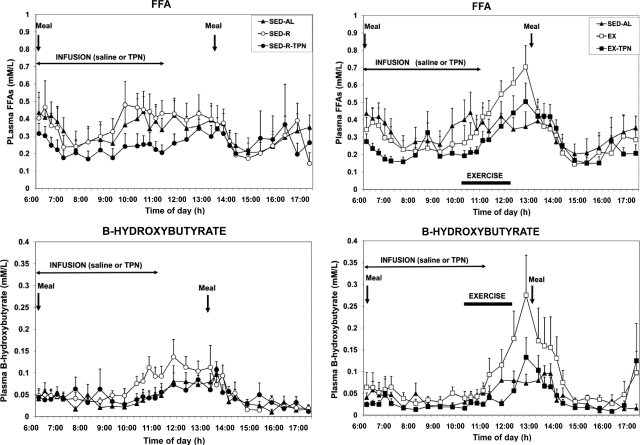
Design: We conducted a crossover study manipulating meal size and energy availability through exercise energy expenditure and iv nutrient replacement (TPN).
Setting: The study was performed at a Clinical Research Center.
Participants: Ten healthy postmenopausal women (age, 59.7 +/- 1.5 yr; mean body mass index, 26 kg/m(2)) were studied.
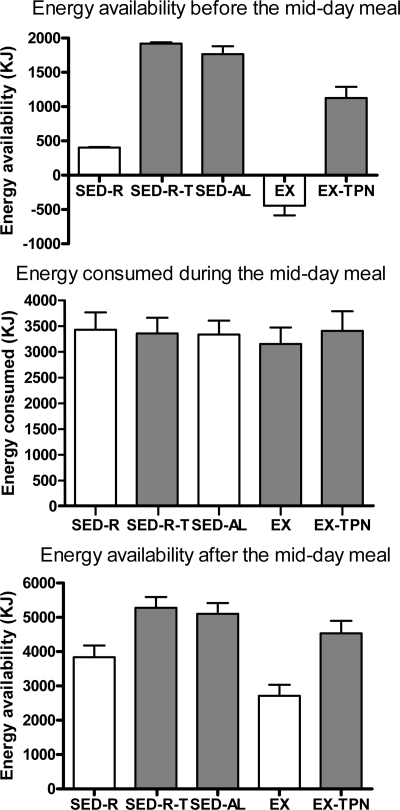
Interventions: We conducted trials based on different morning meal size (418 vs. 2090 KJ), presence or absence of exercise energy expenditure (2273 to 2361 KJ), energy replacement by TPN (1521 to 1538 KJ), and a midday ad libitum meal.
Main outcome measures: Changes in hunger, fullness, midday ad libitum food consumption, and concentrations of ghrelin, leptin, insulin, and metabolic fuels were measured. We also performed midday meal tests for the presence of caloric compensation.
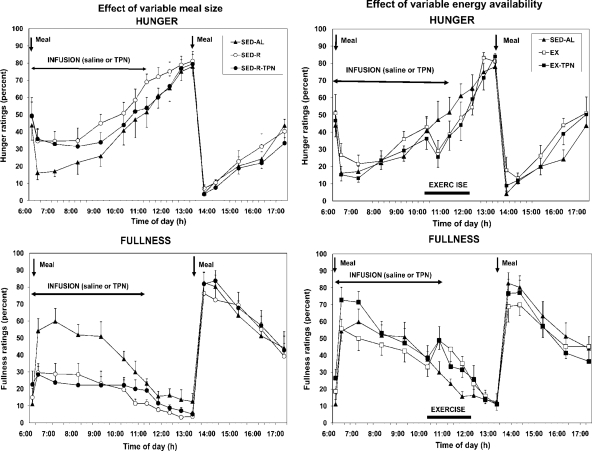
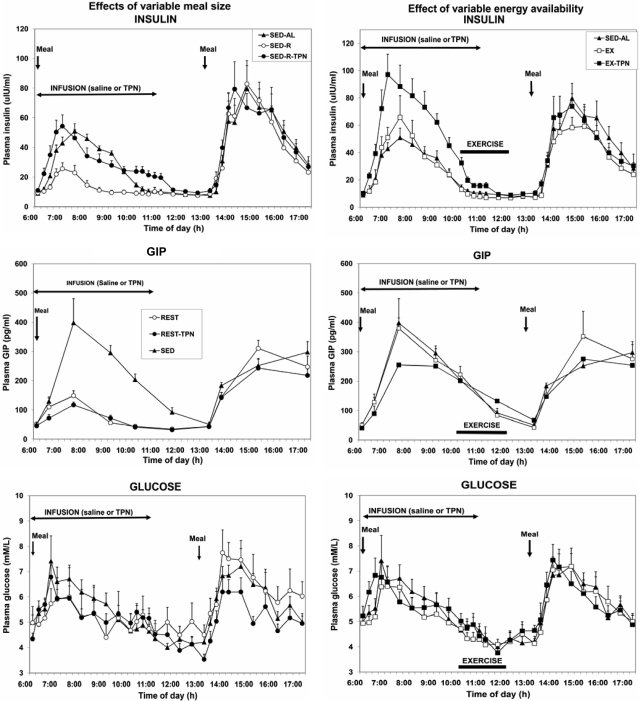
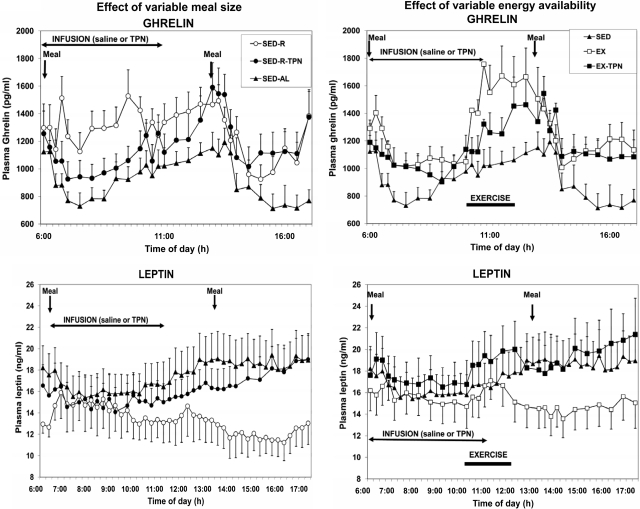
Results: Appetite was influenced by the size and energy content of the meals, but not by variation in energy availability which also did not trigger consummatory compensation. Exercise reduced hunger and increased fullness. Ghrelin, leptin, and insulin responded to changes in energy availability but not to meal size. Appetite was unaffected by physiological changes in ghrelin, leptin, or insulin.
Conclusions: During rest, appetite is influenced by the size and energy content of meals, but it bears no homeostatic relationship to between-meal changes in energy availability due to small meals, exercise, or TPN, or concentrations of ghrelin, leptin, and insulin.
Figures
References
-
- Batterham RL, Cowley MA, Small CJ, Herzog H, Cohen MA, Dakin CL, Wren AM, Brynes AE, Low MJ, Ghatei MA, Cone RD, Bloom SR 2002 Gut hormone PYY(3–36) physiologically inhibits food intake. Nature 418:650–654 - PubMed
-
- Woods SC 2004 Gastrointestinal satiety signals. An overview of gastrointestinal signals that influence food intake. Am J Physiol Gastrointest Liver Physiol 286:G7–G13 - PubMed
-
- Cummings DE, Purnell JQ, Frayo RS, Schmidova K, Wisse BE, Weigle DS 2001 A preprandial rise in plasma ghrelin levels suggests a role in meal initiation in humans. Diabetes 50:1714–1719 - PubMed
Publication types
MeSH terms
Substances
Grants and funding
LinkOut - more resources
Full Text Sources
Medical
Research Materials
