. 2009;60(9):2601-12.
doi: 10.1093/jxb/erp102. Epub 2009 Apr 28.

MUM ENHANCERS are important for seed coat mucilage production and mucilage secretory cell differentiation in Arabidopsis thaliana

Affiliations

MUM ENHANCERS are important for seed coat mucilage production and mucilage secretory cell differentiation in Arabidopsis thaliana

Andrej A Arsovski et al. J Exp Bot. 2009.

Abstract

Pollination triggers not only embryo development but also the differentiation of the ovule integuments to form a specialized seed coat. The mucilage secretory cells of the Arabidopsis thaliana seed coat undergo a complex differentiation process in which cell growth is followed by the synthesis and secretion of pectinaceous mucilage. A number of genes have been identified affecting mucilage secretory cell differentiation, including MUCILAGE-MODIFIED4 (MUM4). mum4 mutants produce a reduced amount of mucilage and cloning of MUM4 revealed that it encodes a UDP-L-rhamnose synthase that is developmentally up-regulated to provide rhamnose for mucilage pectin synthesis. To identify additional genes acting in mucilage synthesis and secretion, a screen for enhancers of the mum4 phenotype was performed. Eight mum enhancers (men) have been identified, two of which result from defects in known mucilage secretory cell genes (MUM2 and MYB61). Our results show that, in a mum4 background, mutations in MEN1, MEN4, and MEN5 lead to further reductions in mucilage compared to mum4 single mutants, suggesting that they are involved in mucilage synthesis or secretion. Conversely, mutations in MEN2 and MEN6 appear to affect mucilage release rather than quantity. With the exception of men4, whose single mutant exhibits reduced mucilage, none of these genes have a single mutant phenotype, suggesting that they would not have been identified outside the compromised mum4 background.


Figures
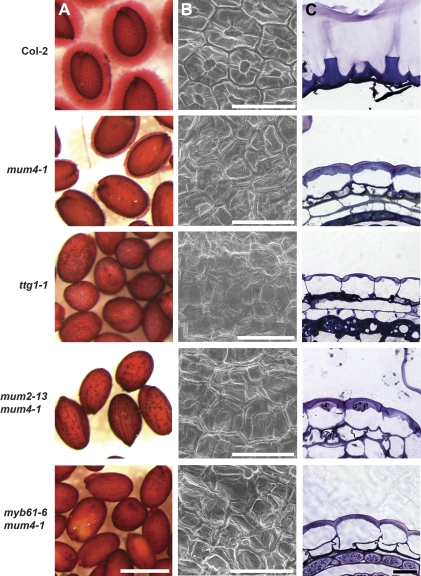
Fig. 1.
Fig. 1.
Mucilage release and seed coat structure of controls and mum4 enhancer lines resulting from mutations in MUM2 and MYB61. (A) Seeds pretreated in EDTA with shaking and stained with ruthenium red. Note the thick layer of mucilage surrounding wild-type Col-2 seeds and the very thin layer around mum4-1 seeds. (B) Scanning electron microscopy of dry seeds. Note the prominent hexagonal cell walls and central volcano-shaped columella in the centre of Col-2 cells. (C) Toluidine blue-stained resin sections of 13 DPA seeds. Wild-type mucilage cells have burst open in the aqueous fixative, leaving tall, blue-stained, volcano-shaped columellae with some cell wall material attached to the centre of the columella. mum4-1 cells do not burst, and contain small pockets of purple-stained mucilage in the upper apical corners, subtended by a blue dome of secondary cell wall. ttg1-1 cells, similar to mum4-1, do not burst, however, the mucilage pockets are smaller and the secondary cell wall is thinner in appearance. Scale bars: (A) 500 μm, (B) 50 μm, (C) 10 μm.
Fig. 2.
Fig. 2.
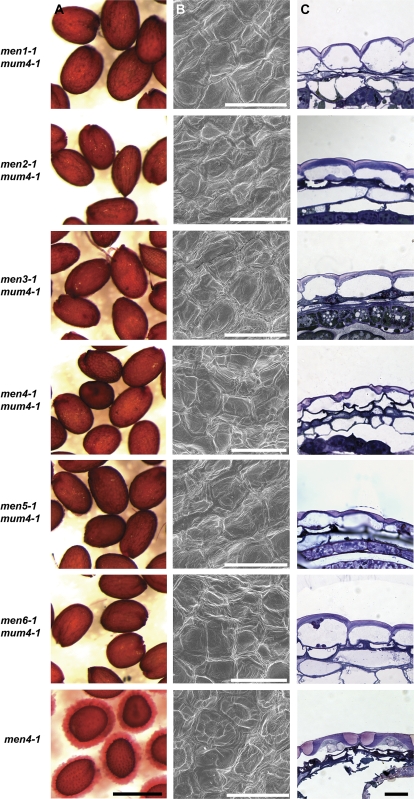
Mucilage release and seed coat structure of mum4 enhancer lines. (A) Seeds pretreated in EDTA with shaking and stained with ruthenium red. (B) Scanning electron microscopy of dry seeds. (C) Toluidine blue-stained resin sections of 13 DPA seeds. Scale bars: (A) 500 μm, (B) 50 μm, (C) 10 μm.
Fig. 3.
Fig. 3.
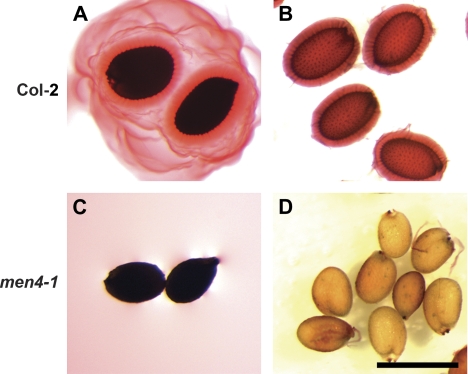
Mucilage release of men4-1 versus wild-type seeds in ruthenium red with and without shaking. (A, B) Col-2 wild-type seeds. (A) Seeds put directly into ruthenium red without shaking are surrounded by an outer, diffuse layer of mucilage and an inner, dense layer of mucilage, while those shaken in dye lose the soluble outer layer (B). (C, D) men4-1 seeds lack mucilage release when treated directly with ruthenium red, with or without agitation. Scale bar: 500 μm. (This figure is available in colour at JXB online.)
Fig. 4.
Fig. 4.
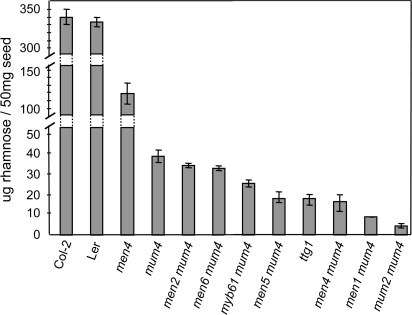
Rhamnose levels of soluble mucilage extracted from mum4 enhancers and controls. Ammonium oxalate extracts of concurrently-grown seed batches were hydrolysed with trifluoroacetic acid and derivatized to alditol acetates, followed by gas chromatography. Extractions were done in triplicate, error bars=SE.
Fig. 5.
Fig. 5.
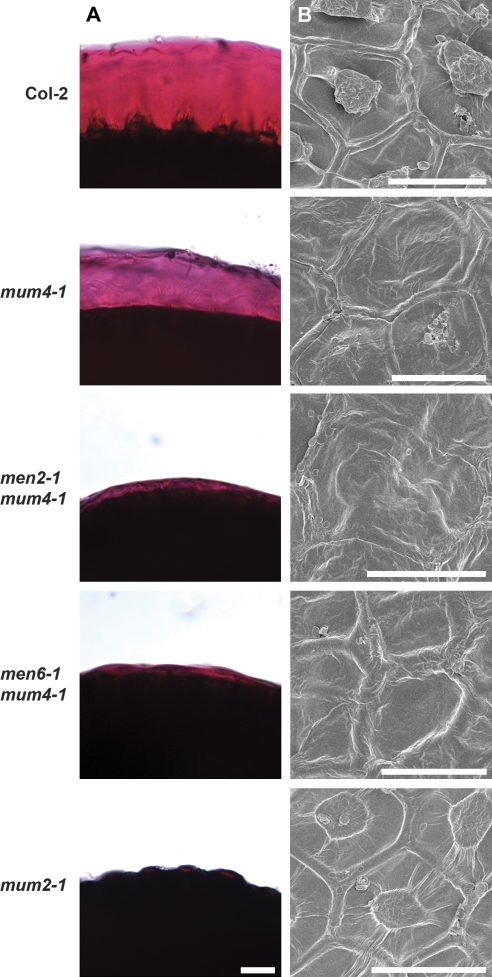
Seed coat phenotype of men2 mum4, men6 mum4, and control seeds following extraction with ammonium oxalate. (A) Seeds extracted with ammonium oxalate with shaking at 30 oC, then stained with ruthenium red. Note substantial mucilage release for Col-2 seeds. mum4-1 seeds release less mucilage, with the outer wall appearing to remain largely intact. (B) Scanning electron microscopy of air-dried ammonium oxalate extracted seeds. Only Col-2 seeds show obvious rupture of outer primary cell wall. Scale bars: (A) 10 μm, (B) 25 μm. (This figure is available in colour at JXB online.)
Fig. 6.
Fig. 6.
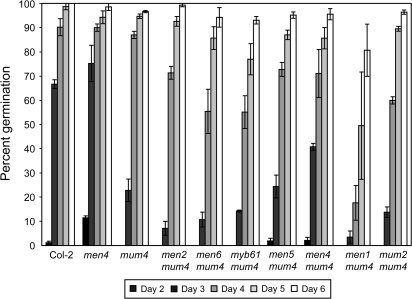
Time-course of germination of mum4 enhancers and controls. Genotypes are organized in the same order as Fig. 4 for comparison. Seeds were stratified for 3 d at 4 °C, followed by germination at 22 °C under 16/8 h light/dark. 40–80 seed of each genotype were sowed on filter paper with water, error bars=SE. Similar results were obtained in a separate experiment using seed from an independent set of plants.

References

    1. Beeckman T, De Rycke R, Viane R, Inzé D. Histological study of seed coat development in Arabidopsis thaliana. Journal of Plant Research. 2000;113:139–148.
    1. Boesewinkel FD, Bouman F. The seed: structure. In: Johri BM, editor. Embryology of Angiosperms. New York: Springer-Verlag; 1984. pp. 567–610.
    1. Bouton S, Leboeuf E, Mouille G, Leydecker M-T, Talbotek J, Granier F, Lahaye M, Höfte H, Truong H-N. QUASIMODO1 encodes a putative membrane-bound glycosyltransferase required for normal pectin synthesis and cell adhesion in Arabidopsis. The Plant Cell. 2002;14:2577–2590. - PMC - PubMed
    1. Bowman JL, Koornneef M. Seed morphology. In: Bowman JL, editor. Arabidopsis: an atlas of morphology and development. New York: Springer-Verlag; 1993. pp. 398–401.
    1. Burn JE, Hurley UA, Birch RJ, Arioli T, Cork A, Williamson RE. The cellulose-deficient Arabidopsis mutant rsw3 is defective in a gene encoding a putative glucosidase II, an enzyme processing N-glycans during ER quality control. The Plant Journal. 2002;32:949–960. - PubMed

Publication types