


The leukemic stem cell niche: current concepts and therapeutic opportunities
- PMID: 19401558
- PMCID: PMC2723012
- DOI: 10.1182/blood-2009-01-202606
The leukemic stem cell niche: current concepts and therapeutic opportunities
Abstract
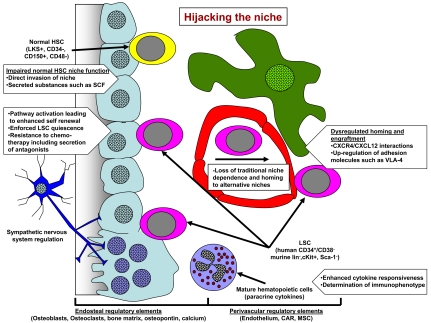
The genetic events that contribute to the pathogenesis of acute myeloid leukemia are among the best characterized of all human malignancies. However, with notable exceptions such as acute promyelocytic leukemia, significant improvements in outcome based on these insights have not been forthcoming. Acute myeloid leukemia is a paradigm of cancer stem (or leukemia initiating) cells with hierarchy analogous to that seen in hematopoiesis. Normal hematopoiesis requires complex bidirectional interactions between the bone marrow microenvironment (or niche) and hematopoietic stem cells (HSCs). These interactions are critical for the maintenance of normal HSC quiescence and perturbations can influence HSC self-renewal. Leukemia stem cells (LSCs), which also possess limitless self-renewal, may hijack these homeostatic mechanisms, take refuge within the sanctuary of the niche during chemotherapy, and consequently contribute to eventual disease relapse. We will discuss the emerging evidence supporting the importance of the bone marrow microenvironment in LSC survival and consider the physiologic interactions of HSCs and the niche that inform our understanding of microenvironment support of LSCs. Finally, we will discuss approaches for the rational development of therapies that target the microenvironment.
Figures
References
-
- Krivtsov AV, Twomey D, Feng Z, et al. Transformation from committed progenitor to leukaemia stem cell initiated by MLL-AF9. Nature. 2006;442:818–822. - PubMed
-
- Huntly BJ, Shigematsu H, Deguchi K, et al. MOZ-TIF2, but not BCR-ABL, confers properties of leukemic stem cells to committed murine hematopoietic progenitors. Cancer Cell. 2004;6:587–596. - PubMed
-
- Barabe F, Kennedy JA, Hope KJ, Dick JE. Modeling the initiation and progression of human acute leukemia in mice. Science. 2007;316:600–604. - PubMed
Publication types
MeSH terms
Grants and funding
LinkOut - more resources
Full Text Sources
Other Literature Sources
Medical
