


Targeting HSP90 for cancer therapy
- PMID: 19401686
- PMCID: PMC2696754
- DOI: 10.1038/sj.bjc.6605066
Targeting HSP90 for cancer therapy
Abstract
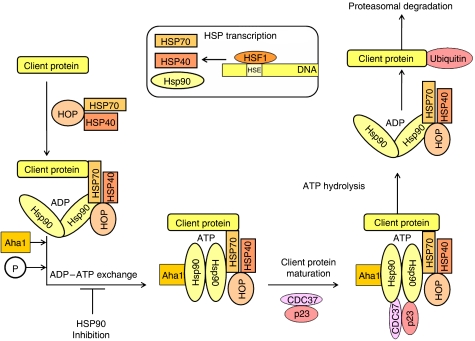
Heat-shock proteins (HSPs) are molecular chaperones that regulate protein folding to ensure correct conformation and translocation and to avoid protein aggregation. Heat-shock proteins are increased in many solid tumours and haematological malignancies. Many oncogenic proteins responsible for the transformation of cells to cancerous forms are client proteins of HSP90. Targeting HSP90 with chemical inhibitors would degrade these oncogenic proteins, and thus serve as useful anticancer agents. This review provides an overview of the HSP chaperone machinery and the structure and function of HSP90. We also highlight the key oncogenic proteins that are regulated by HSP90 and describe how inhibition of HSP90 could alter the activity of multiple signalling proteins, receptors and transcriptional factors implicated in carcinogenesis.
Figures
References
-
- Bagatell R (2004) Altered Hsp90 function in cancer: a unique therapeutic opportunity. Mol Cancer Ther 3: 1021–1030 - PubMed
-
- Banerji U, Sain N, Sharp SY, Valenti M, Asad Y, Ruddle R, Raynaud F, Walton M, Eccles SA, Judson I, Jackman AL, Workman P (2008) An in vitro and in vivo study of the combination of the heat shock protein inhibitor 17-allylamino-17-demethoxygeldanamycin and carboplatin in human ovarian cancer models. Cancer Chemother Pharmacol 62: 769–778 - PubMed
-
- Banerji U, Walton M, Raynaud F, Grimshaw R, Kelland L, Valenti M, Judson I, Workman P (2005) Pharmacokinetic-pharmacodynamic relationships for the heat shock protein 90 molecular chaperone inhibitor 17-allylamino, 17-demethoxygeldanamycin in human ovarian cancer xenograft models. Clin Cancer Res 11: 7023–7032 - PubMed
-
- Bauer S, Yu LK, Demetri GD, Fletcher JA (2006) Heat shock protein 90 inhibition in imatinib-resistant gastrointestinal stromal tumor. Cancer Res 66: 9153–9161 - PubMed
-
- Beliakoff J, Bagatell R, Paine-Murrieta G, Taylor CW, Lykkesfeldt AE, Whitesell L (2003) Hormone-refractory breast cancer remains sensitive to the antitumor activity of heat shock protein 90 inhibitors. Clin Cancer Res 9: 4961–4971 - PubMed
Publication types
MeSH terms
Substances
LinkOut - more resources
Full Text Sources
Other Literature Sources
