


Hereditary kidney cancer: unique opportunity for disease-based therapy
- PMID: 19402075
- PMCID: PMC2720093
- DOI: 10.1002/cncr.24230
Hereditary kidney cancer: unique opportunity for disease-based therapy
Abstract
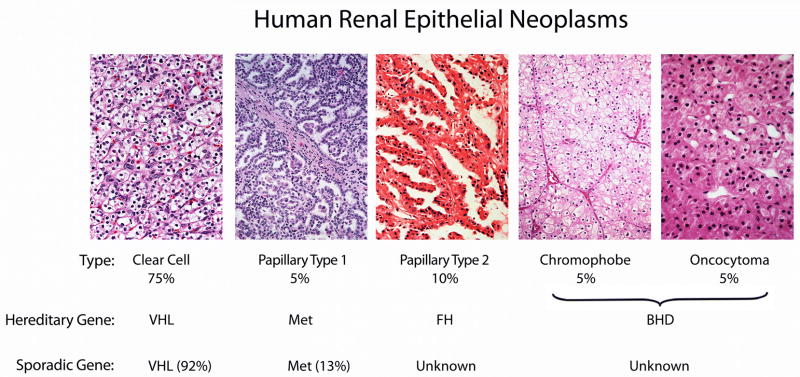
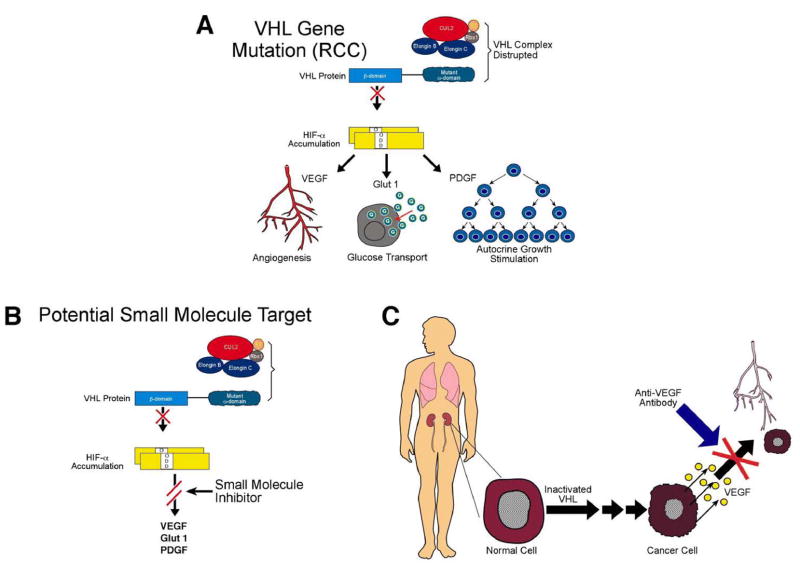
Kidney cancer is not a single disease; it is comprised of several different types of cancer, each with a different histology, with a different clinical course, caused by a different gene, and responding differently to therapy. The VHL gene is the gene for the hereditary cancer syndrome, von Hippel-Lindau, as well as for the common form of sporadic, noninherited, clear cell kidney cancer. Understanding the VHL-hypoxia inducible factor (HIF) pathway has provided the foundation for the development of several agents targeting this pathway, such as sunitinib, sorafenib, and temsirolimus. Hereditary papillary renal carcinoma (HPRC) is a hereditary renal cancer syndrome in which affected individuals are at risk for the development of bilateral, multifocal, type 1 papillary renal cell carcinoma. The genetic defect underlying HPRC is MET, the cell surface receptor for hepatocyte growth factor. Mutations of MET also have been identified in a subset of tumors from patients with sporadic type 1 papillary renal cell carcinoma (RCC). Clinical trials targeting the MET pathway are currently underway in patients with HPRC and in patients with sporadic (nonhereditary) papillary kidney cancer. The BHD gene (also known as folliculin or FLCN) is the gene for Birt-Hogg-Dube syndrome, an autosomal-dominant genodermatosis associated with a hereditary form of chromophobe and oncocytic, hybrid RCC. Preclinical studies are underway targeting the BHD gene pathway in preparation for clinical trials in Birt-Hogg-Dube and sporadic chromophobe RCC. Patients with hereditary leiomyomatosis RCC (HLRCC) are at risk for developing cutaneous and uterine leiomyomas and a very aggressive type of RCC. HLRCC is characterized by germline mutation of the Krebs cycle enzyme, fumarate hydratase (FH). Studies of the tricarboxylic acid cycle and the VHL-HIF pathways have provided the foundation for therapeutic approaches in patients with HLRCC-associated kidney cancer as well as other hereditary and sporadic forms of RCC.
Figures
References
-
- Jemal A, Siegel R, Ward E, Hao Y, Xu J, Murray T, et al. Cancer statistics, 2008. CA Cancer Journal for Clinicians. 2008;58:71–96. - PubMed
-
- Linehan WM, Yang JC, Rini B. Cancer of the Kidney. In: DeVita VT, Lawrence TS, Rosenberg SA, editors. Cancer: Principles and Practice of Oncology. 8. New Haven: Lippincott Williams & Wilkins; 2008. pp. 1331–58.
-
- Linehan WM, Vasselli J, Srinivasan R, Walther MM, Merino MJ, Choyke P, et al. Genetic Basis of Cancer of the Kidney: Disease-Specific Approaches to Therapy. Clinical Cancer Research. 2004;10:6282S–9S. - PubMed
-
- Linehan WM, Zbar B. Focus on kidney cancer. Cancer Cell. 2004;6:223–8. - PubMed
-
- Linehan WM, Walther MM, Zbar B. The genetic basis of cancer of the kidney. Journal of Urology. 2003;170:2163–72. - PubMed
Publication types
MeSH terms
Grants and funding
LinkOut - more resources
Full Text Sources
Medical
Miscellaneous
