. 2009 Jul;83(14):6995-7003.
doi: 10.1128/JVI.00268-09. Epub 2009 Apr 29.

Fibrils of prostatic acid phosphatase fragments boost infections with XMRV (xenotropic murine leukemia virus-related virus), a human retrovirus associated with prostate cancer

Affiliations

Fibrils of prostatic acid phosphatase fragments boost infections with XMRV (xenotropic murine leukemia virus-related virus), a human retrovirus associated with prostate cancer

Seunghee Hong et al. J Virol. 2009 Jul.

Abstract

The xenotropic murine leukemia virus-related virus (XMRV) has recently been detected in prostate cancer tissues and may play a role in tumorigenesis. It is currently unclear how this virus is transmitted and which factors promote its spread in the prostate. We show that amyloidogenic fragments known as semen-derived enhancer of virus infection (SEVI) originating from prostatic acid phosphatase greatly increase XMRV infections of primary prostatic epithelial and stromal cells. Hybrid simian/human immunodeficiency chimeric virus particles pseudotyped with XMRV envelope protein were used to demonstrate that the enhancing effect of SEVI, or of human semen itself, was at the level of viral attachment and entry. SEVI enhanced XMRV infectivity but did not bypass the requirement for the xenotropic and polytropic retrovirus receptor 1. Furthermore, XMRV RNA was detected in prostatic secretions of some men with prostate cancer. The fact that the precursor of SEVI is produced in abundance by the prostate indicates that XMRV replication occurs in an environment that provides a natural enhancer of viral infection, and this may play a role in the spread of this virus in the human population.


Figures
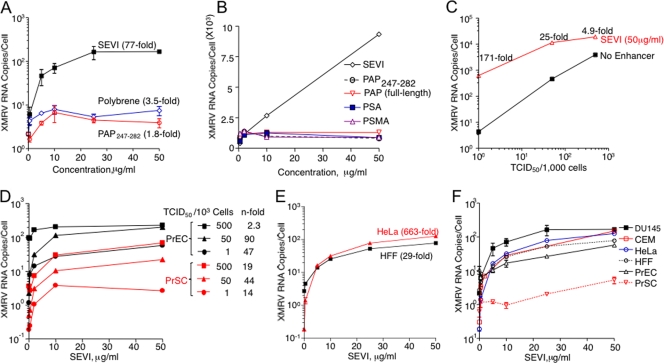
FIG. 1.
FIG. 1.
SEVI enhances XMRV infections of human prostatic and nonprostatic cells. Effects of SEVI on XMRV RNA yields in DU145 cells (A to C), PrEC and PrSC cells (D), HFF and HeLa M cells (E), and all of these cell types (F) are shown. For comparison, PAP247-282 and polybrene were used in panel A. Effects of SEVI, PAP247-282, full-length PAP, PSA, and PSMA on XMRV infectivity are as indicated in panel B. Infections were with 1 TCID50/103 cells of XMRV for 3 days unless otherwise indicated. XMRV env RNA levels were determined by qRT-PCR. Data are average values ± standard deviations obtained from triplicate experiments (except for panel D).
FIG. 2.
FIG. 2.
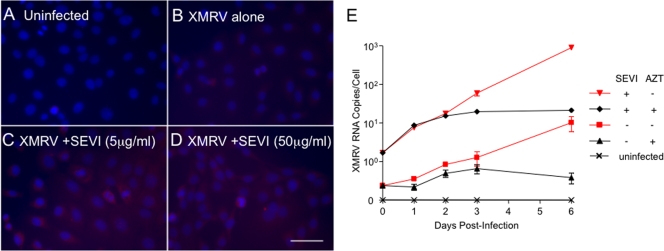
SEVI increases the fraction of cells that become infected with XMRV. (A to D) Enhancement of infectivity by SEVI was determined by IFA with a monoclonal antibody against SFFV Gag (red). DU145 cells were either uninfected or infected with 1 TCID50/103 of XMRV with 0, 5, or 50 μg/ml of SEVI for 3 days. Nuclei were counterstained with DAPI. Bar, 50 μm. (E) Effects of AZT (10 μM added at 1 day postinfection) on XMRV RNA levels in DU145 cells were determined in the absence or presence of SEVI (50 μg/ml).
FIG. 3.
FIG. 3.
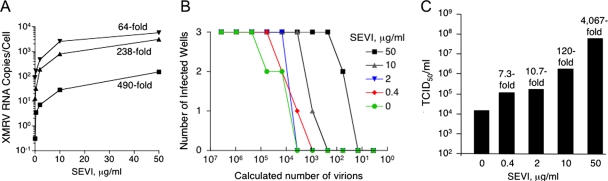
SEVI lowers the threshold for XMRV infection. (A) Effects of SEVI on XMRV RNA yields in CEM cells (1 [▪], 50 [▴], or 500 [▾] TCID50s 103 cells) at 3 days postinfection. (B) CEM cells were infected in triplicate with serial fourfold dilutions of XMRV supernatant in the presence of the indicated concentrations of SEVI. Indicated on the y axis is the number of cultures that became productively infected at 21 days postinfection. (C) Effect of SEVI on XMRV yield (TCID50) calculated based on the infectivity data from panel (B).
FIG. 4.
FIG. 4.
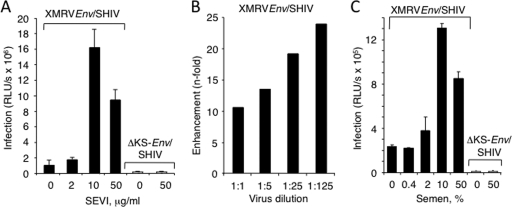
SEVI and semen enhance virus entry by the XMRV envelope protein. (A) Enhancement of the specific entry of an XMRV env-pseudotyped lentivirus (XMRVenv/SHIV) into HEK-293T cells by SEVI. (B) Infectivities of undiluted or serial fivefold dilutions of XMRVenv/SHIV determined with and without addition of SEVI (10 μg/ml). (C) Enhancement of XMRVenv/SHIV infectivity by semen. Virus supernatants (as indicated) were preincubated with the indicated percentage of semen for 15 min and further diluted 1:15 prior to infecting cells. Data are average values ± standard deviations obtained from triplicate experiments at 2 days postinfection.
FIG. 5.
FIG. 5.
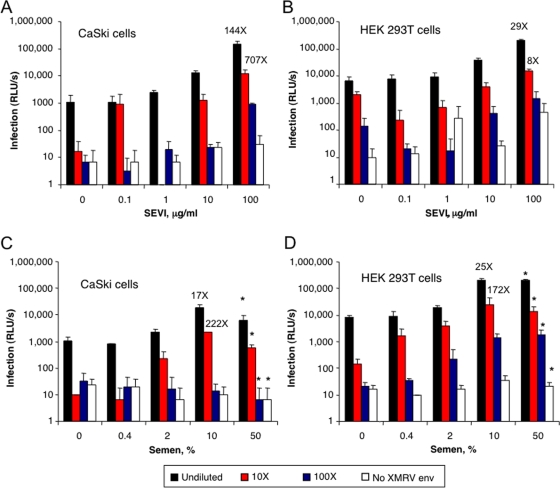
SEVI and semen enhance infectivity of HIV-derived particles pseudotyped with XMRV Env. Undiluted and serial 10-fold dilutions of HIV particles encoding luciferase that were pseudotyped with XMRV Env were treated with the indicated concentrations of SEVI or semen and used to infect CaSki (A and C) or HEK 293T (B and D) cells. Nonpseudotyped particles served as the control (No XMRV Env). Infection rates were determined at 3 days postinfection by luciferase assay. Shown are average values and standard deviations derived from triplicate infections. *, slightly cytotoxic. RLU/s, relative light units per second. Numbers above bars indicate fold enhancement rates relative to untreated virus.
FIG. 6.
FIG. 6.
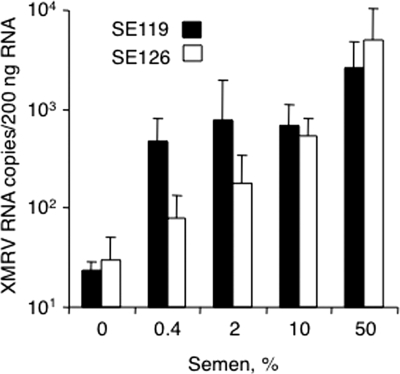
Effect of human semen samples (SE126 and SE119) on XMRV infectivity of DU145 cells determined by measuring XMRV env RNA levels at 3 days postinfection. Semen-XMRV mixtures were diluted 10-fold prior to infecting cells. Data are average values ± standard deviations obtained from triplicate experiments.
FIG. 7.
FIG. 7.
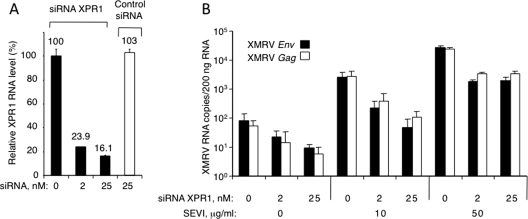
SEVI does not bypass the requirement of XPR1 for infection. (A) Downregulation of XPR1 RNA by siRNA and lack of effect of control siRNA in DU145 cells at 5 days posttransfection. (B) Two days after XPR1 siRNA transfection, cells were infected with XMRV premixed with SEVI. RNA levels were measured by qRT-PCR at 3 days postinfection. Data are average values ± standard deviations obtained from triplicate experiments.
FIG. 8.
FIG. 8.
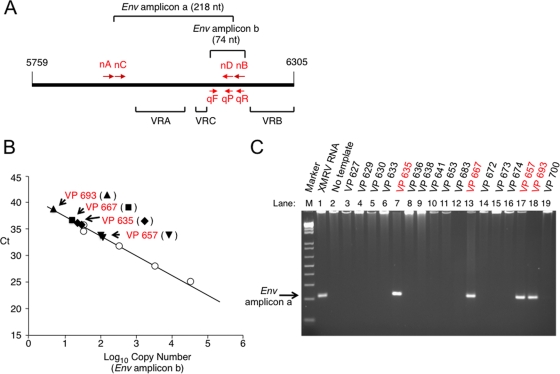
Detection of XMRV RNA in prostatic secretions of prostate cancer patients. (A) Locations of qRT-PCR primers and probe (qF, qR, and qP for forward primer, reverse primer, and probe, respectively) and two rounds of nested PCR primers (nA and nB for first round; nC and nD for second round) in the variable regions of the XMRV gp70 env gene. qRT-PCR amplifies a region of 74 nucleotides (nt) between variable C and B regions (VRC and VRB); second-round nested RT-PCR amplifies a region of 218 nt including both the variable A region (VRA) and VRC. (B) qRT-PCR results for RNA isolated from EPS or standard control 1.95-kb env RNA (circles). Ct, cycle threshold. (C) Nested RT-PCR for env amplicon “a” of total RNA isolated from EPS. As a control, XMRV env RNA was used (lane 1). The case (VP) numbers are indicated, and the XMRV-positive cases are shown in red.

References

    1. Bannert, N., D. Schenten, S. Craig, and J. Sodroski. 2000. The level of CD4 expression limits infection of primary rhesus monkey macrophages by a T-tropic simian immunodeficiency virus and macrophagetropic human immunodeficiency viruses. J. Virol. 7410984-10993. - PMC - PubMed
    1. Battini, J. L., J. E. Rasko, and A. D. Miller. 1999. A human cell-surface receptor for xenotropic and polytropic murine leukemia viruses: possible role in G protein-coupled signal transduction. Proc. Natl. Acad. Sci. USA 961385-1390. - PMC - PubMed
    1. Chesebro, B., W. Britt, L. Evans, K. Wehrly, J. Nishio, and M. Cloyd. 1983. Characterization of monoclonal antibodies reactive with murine leukemia viruses: use in analysis of strains of friend MCF and Friend ecotropic murine leukemia virus. Virology 127134-148. - PubMed
    1. De Marzo, A. M., E. A. Platz, S. Sutcliffe, J. Xu, H. Gronberg, C. G. Drake, Y. Nakai, W. B. Isaacs, and W. G. Nelson. 2007. Inflammation in prostate carcinogenesis. Nat. Rev. Cancer 7256-269. - PMC - PubMed
    1. Dong, B., S. Kim, S. Hong, J. Das Gupta, K. Malathi, E. A. Klein, D. Ganem, J. L. Derisi, S. A. Chow, and R. H. Silverman. 2007. An infectious retrovirus susceptible to an IFN antiviral pathway from human prostate tumors. Proc. Natl. Acad. Sci. USA 1041655-1660. - PMC - PubMed

Publication types

Substances